


Hi all! I want to start today by thanking all of you for subscribing. It means more than you know. I also want to ask that if you like what you are reading, please don’t forget to like, comment, and restack— it really helps. Finally, if you can afford to do so, please consider upgrading your subscription as well. It supports my work, and you get free access to my online streaming site.
“I am speaking just as a philosopher. People sometimes call me a religious leader. I am not that. I have no messages, no mission. I attempt only to understand. We are philosophers in the old sense of the word, lovers of wisdom. That avoids the sometimes questionable company of those who offer a religion.”
— C.G. Jung, C.G. Jung Speaking, p. 98
“I could not say I believe. I know! I have had the experience of being gripped by something that is stronger than myself, something that people call God.”
— C.G. Jung, BBC Interview with John Freeman, 1959
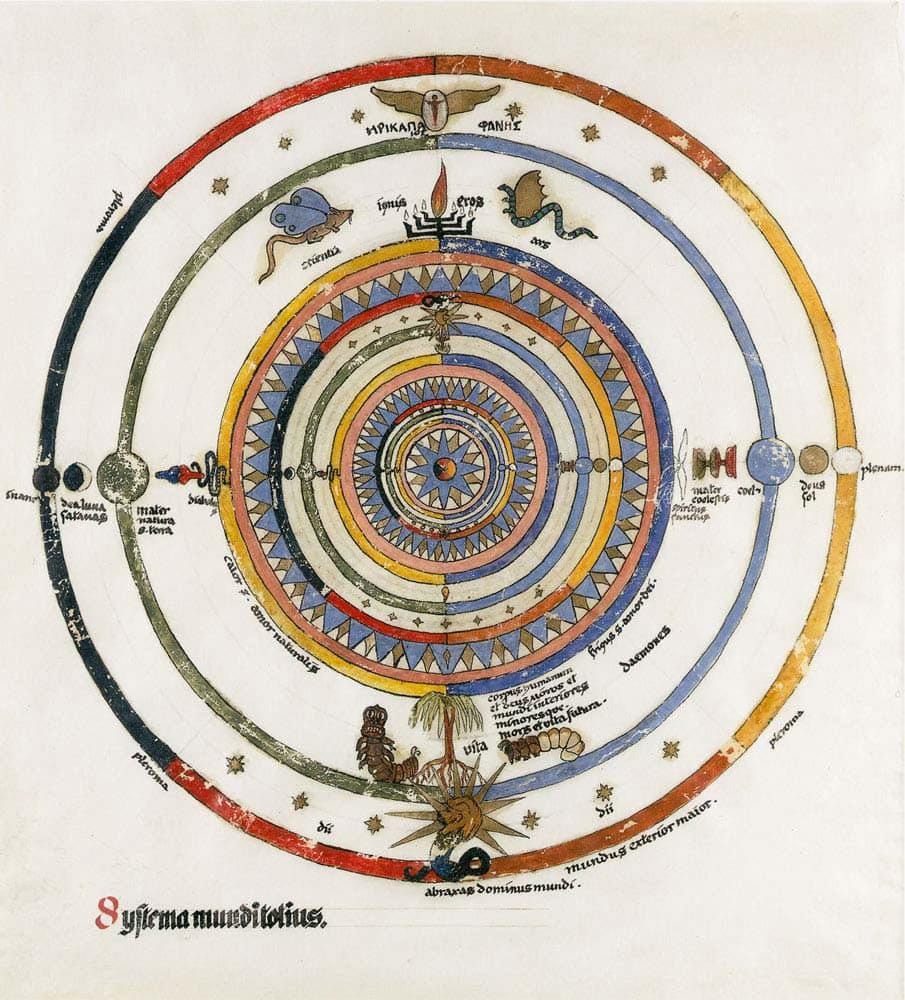
Someone asked me recently, "What is it about Jungian psychology that is so different?” The answer to this question is almost too big for one post, let alone a paragraph or a simple response to a casual inquiry— but this morning, Easter Sunday, feels like a good day to sit down with the question.
Jung’s psychology is so vastly different that it’s not even taught in mainstream university programs. In our increasingly rational, materialistic1 culture, Jung’s metaphysical concepts, techniques of dream interpretation, and study of things like alchemy and fairy tales tend to make people uncomfortable. In my own grad school program, for example, one professor stated breezily, “We know now there’s no such thing as the ‘unconscious.’ People have behaviors based on cognitions, and we change those. That’s it.”2
As you can see by the two quotes at the head of this post, Jung struggled mightily with these concepts himself. He knew that in order to be taken seriously, his concepts had to be “scientific;” and yet in his own experience, and in his extensive experience with his patients, he found that there was evidence of something greater than Western science could grasp; what he called the Self.3
The Self, says Edward Edinger, is “the ordering and unifying center of the total psyche.” It has a transpersonal quality; that is, it is something greater than us, beyond us. The “ordering and unifying” aspect is what gives our life meaning. With this understanding, we can recognize that symptoms have what is referred to as a teleological function: they are moving us toward something; our life’s unique path.
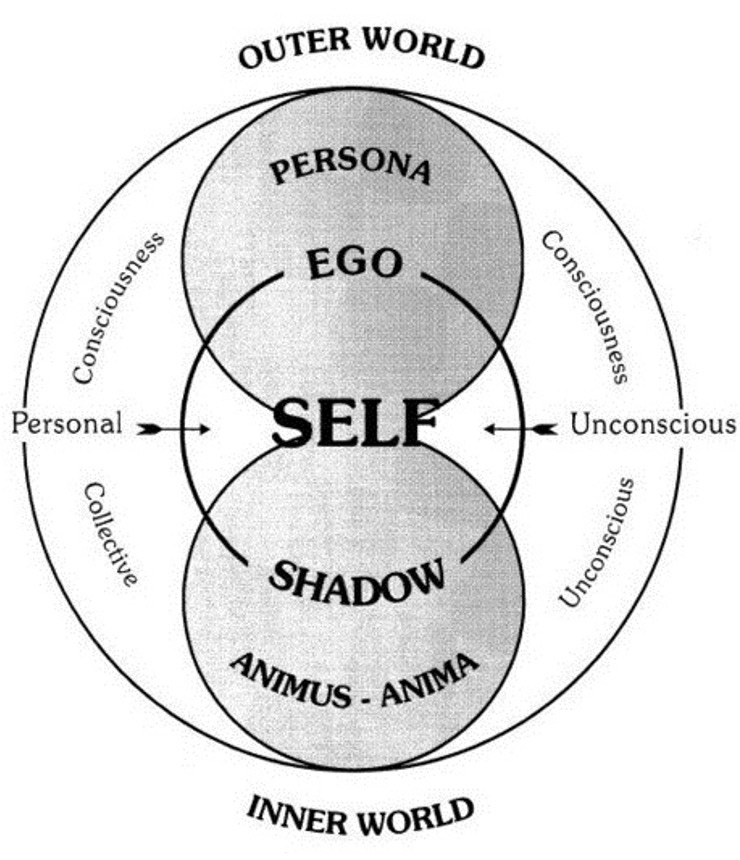
“Intellectually the self is no more than a psychological concept, a construct that serves to express an unknowable essence which we cannot grasp as such, since by definition it transcends our powers of comprehension. It might equally well be called the ‘God within.’”
– C.G. Jung, Two Essays on Analytical Psychology
Jung believed that the Self operates as both the “center and the circumference” of the psyche. It is both our inner image of the divine, and the container that acts as its outermost limit.
Encounters with the Self
The Self, according to Jung, shows its presence in dreams, visions, creative products (such as art of all kinds), traumatic events4, and even in waking life, often in surprising ways. He believed that encounters with the Self always had a “numinous” quality— a word he borrowed from the theologian Rudolf Otto:
“The feeling of it may at times come sweeping like a gentle tide, pervading the mind with a tranquil mood of deepest worship. It may pass over into a more set and lasting attitude of the soul, continuing, as it were, thrillingly vibrant and resonant, until at last it dies away and the soul resumes its ‘profane’, non-religious mood of everyday experience. It may burst in sudden eruption up from the depths of the soul with spasms and convulsions, or lead to the strangest excitements, to intoxicated frenzy, to transport, and to ecstasy. It has its wild and demonic forms and can sink to an almost grisly horror and shuddering. It has its crude, barbaric antecedents and early manifestations, and again it may be developed into something beautiful and pure and glorious. It may become the hushed, trembling and speechless humility of the creature in the presence of— whom or what? In the presence of that which is a mystery inexpressible and above all creatures.”
-R. Otto, The Idea of the Holy
Numinous encounters, as Otto says, have a quality about them that is undeniable: we feel them in our body as terror, awe, or overwhelming love; they are beyond words. They have a relativizing effect; we are at once humbled and cognizant of our place in the order of things. As a result, Lionel Corbett says, these encounters restructure our psyche:
“Their efficacy in doing so is the result of their tremendous affective intensity, which alone is able to dislodge entrenched patterns with such speed… it is as if the intensity of the affect associated with the new experience disrupts and dissipates existing structures and defenses and replaces them with something new… The affective component of the experience is also the major vehicle for the cognitive level of the experience to be driven home.5”
Despite our culture’s unease with topics that stray into the realm of the “woo,” there is evidence that bears out these concepts. Researchers are studying awe as a “pathway to physical and mental health.” Of course, if you’ve had one of these experiences yourself, you already know what a tremendous impact these moments hold. Like Jim Lovell, Apollo 13 astronaut, whose 1968 broadcast from orbit summed up his own numinous experience. “The vast loneliness is awe-inspiring and it makes you realize just what you have back there on Earth,” he said.
If you click on the “researchers” link above, you can view a diagram that maps exactly how these states of “awe” affect our body’s systems, decreasing physical symptoms such as anxiety, stress, and pain, while increasing prosocial behavior, our sense of meaning, and overall well-being. But this was no secret to Jung, who knew that the “approach to the numinous” was, in fact, the “real therapy:”
“The main interest of my work is not concerned with the treatment of neuroses but rather with the approach to the numinous. But the fact is that the approach to the numinous is the real therapy and inasmuch as you attain to the numinous experiences you are released from the curse of pathology. Even the very disease takes on a numinous character.”
— C.G. Jung, Letter to P.W. Martin, August 20, 1945. Letters, Vol. 1
Organized religion & the Self
Within this framework of Jung’s Self and the numinous, there are endless variations for spiritual diversity. Each individual can (and, he might even say, should) have their own unique relationship with the transpersonal. But what about religion? Where do Catholics, Jews, Muslims, fit into this schema?
The image below from Edward Edinger’s Ego and Archetype demonstrates how organized religion can act as a group container for the Self. In this configuration, each individual member (illustrated by the circles at the bottom) need not have a personal relationship with the divine, because it is carried by the Church itself. This, Edinger says, is a stable state for a community.
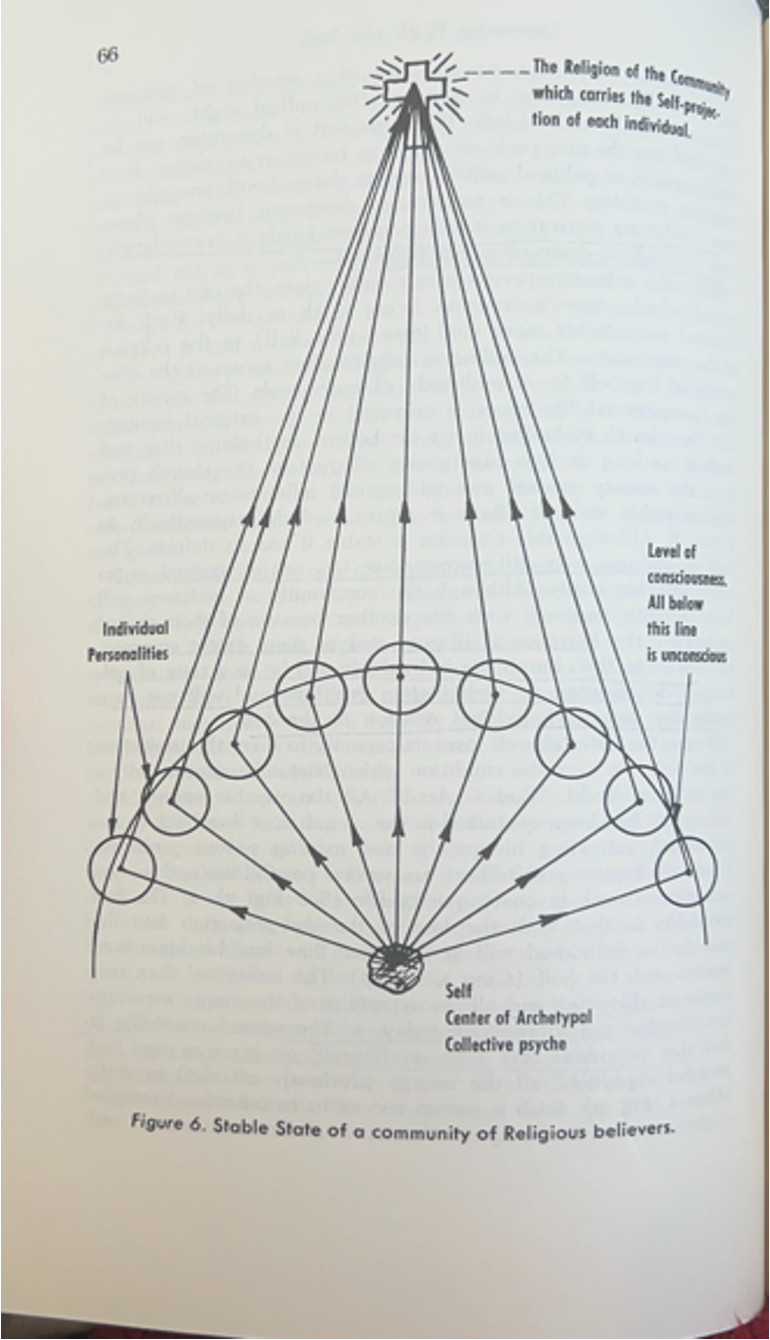
This is not at all a problematic situation, or a psychologically unhealthy one. These individuals have a relationship with the transpersonal that is quite functional.
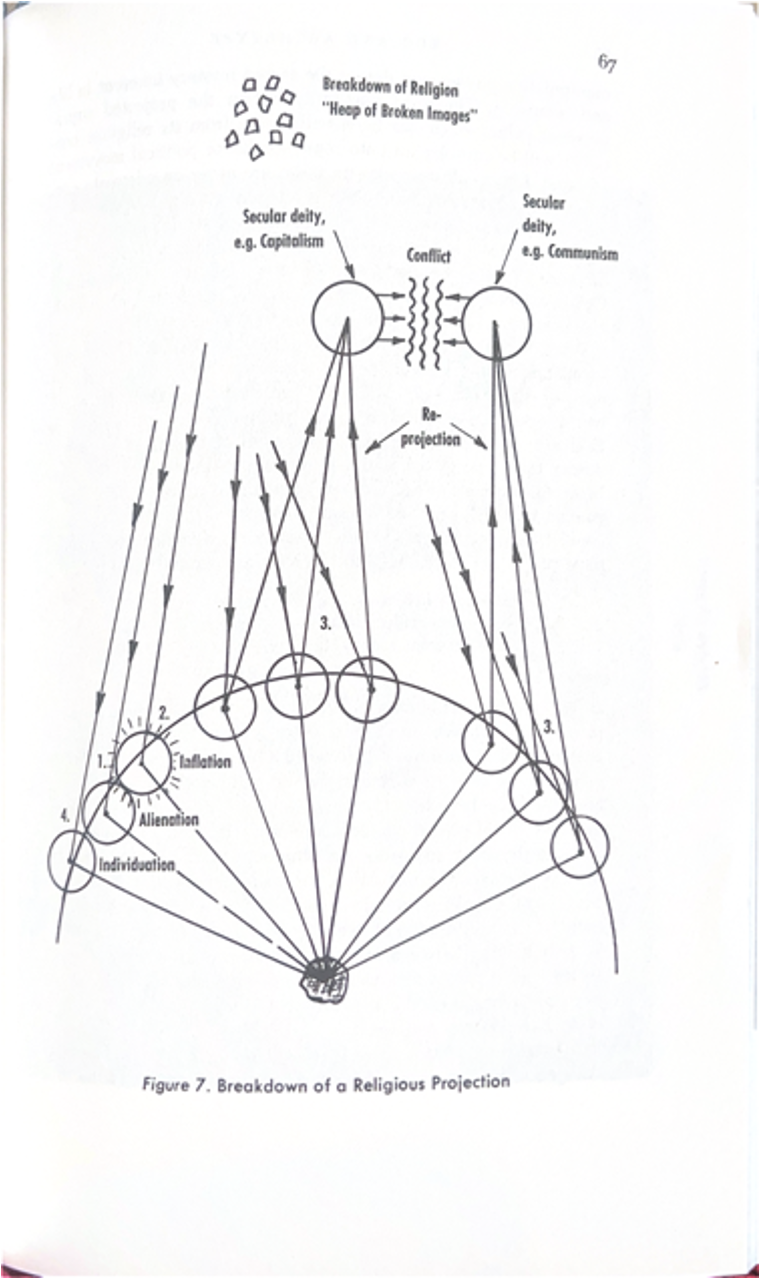
But what happens when this system begins to break down? For example, when beloved religious leaders are found to be frauds, or spiritual abuse is revealed?
This second image shows how the individuals at the bottom are left to find their own relationship to the Self. While some of them (such as the circle on the far left) succeed in connecting directly to their Self-image (perhaps through an encounter with the numinous, as described above), others are not so lucky.
Some, like the second circle, become alienated from the Self: cynical, jaded, isolated.
Others, such as the third circle, decide that they are the Self: they become inflated, delusions of grandeur, etc; maybe they go set up their own new religion.
And others (illustrated by the rest of the circles)— do not seek a personal relationship with the divine, but instead, look for another container for their spiritual needs— like Capitalism, MAGA, Fundamentalism, Communism, Fascism, or Healthism.
Edinger goes on to warn about the dangers of this situation:
“When the archetypes have no adequate container such as an established religious structure, they have to go somewhere else because the archetypes are facts of psychic life. One possibility is that they will be projected onto banal or secular matters…. This is particularly dangerous because whenever a religious motivation is acting unconsciously it causes fanaticism with all its destructive consequences.”
This is very clearly the situation we find ourselves in now.
Finding our way to the Self
This is why I find that Jung’s psychology is so essential for our times. In his 1957 essay, The Undiscovered Self, he speaks directly to what happens when our collective container is no longer sufficient, and we find ourselves in that second picture of Edinger’s:
“Under these circumstances it is small wonder that individual judgment grows increasingly uncertain of itself and that responsibility is collectivized as much as possible, i.e., is shuffled off by the individual and delegated to a corporate body. In this way the individual becomes more and more a function of society, which in its turn usurps the function of the real life carrier, whereas, in actual fact, society is nothing more than an abstract idea like the State. Both are hypostatized, that is, have become autonomous. The State in particular is turned into a quasi- animate personality from whom everything is expected. In reality it is only a camouflage for those individuals who know how to manipulate it. Thus the constitutional State drifts into the situation of a primitive form of society—the communism of a primitive tribe where everybody is subject to the autocratic rule of a chief or an oligarchy.”
He says that the antidote— the only hope for individuals, and for humanity as a whole— lies in our ability to connect to our own understanding of what he calls “God” (but can be read as “the Self”):
“The individual who is not anchored in God can offer no resistance on his own resources to the physical and moral blandishments of the world. For this he needs the evidence of inner, transcendent experience which alone can protect him from the otherwise inevitable submersion in the mass.”
In a later section, he goes on to add, in italics of his own, emphasizing the importance of these words:“Resistance to the organized mass can be effected only by the man who is as well organized in his individuality as the mass itself.”
How, then, do we begin to connect to the Self; to begin to understand what is our role in this resistance?
Dreams are one way (and one I use frequently with my own clients). But we can also dialogue with our unconscious through creative practices (like the one shown below); through divinatory work such as the I Ching, or the Tarot (my friend and colleague Amy Lawson is a wonderful resource); through journaling, meditation, and prayer.
The practice below is from my online subscription site (as a reminder, paid subscribers get free access to all of the videos there, but I wanted to share this one with all of you today!). In this short video, join me for a simple creative practice based on Jung’s work. You’ll just need paper and some drawing tools (crayons are fine!), and a little quiet time to be with yourself.
If you do practice “with me” here, I’d love to hear how it went (or see your drawing, if you’d like to share!). And, as always, I really value your reflections on my writings and ideas.
Wishing you a special day, no matter what your spiritual orientation.
xo-
LBW
That is, materialistic in the philosophical sense; the view that only physical matter exists and that everything — including consciousness, emotion, thought, and experience — can ultimately be explained in terms of physical processes.
He was a genuinely terrible professor.
Jung did not use the capital “S” in his writing, but contemporary Jungians capitalize the term to differentiate it from other uses of the term.
Traumatic events as numinous encounters are a larger topic— their archetypal energy can be overwhelming to the ego. More on this in a future piece.
Lionel Corbett, The Religious Function of the Psyche. One of my favorite books on this topic.
This was a lovely read, glad the algorithm showed it to me!
They may not have denied the unconscious exists in my MSc program, but there was at least one pure positivist/behaviorist professor (so rigid), and my advisor actively and expressly discouraged me from writing my thesis about psychological type (booh, I know). Not sure I would say our culture is “increasingly” materialistic though, I think some scientists are slowly calling for a broader lens, including phenomenology. E.g., physicist Àlex Gómez-Marín is sharing about his own near-death experiences; the IAI YouTube channel has a few clips if you’re interested. (Might be more generally about consciousness than Self, but still.)
Regarding Self and spirituality, I just read the chapter in Richard Schwartz’s “No Bad Parts” about his model, Internal Family Systems (IFS). Schwartz argues that our thoughts, feelings, and behaviors may get “blended” with certain “parts”, but that in essence we are Self. He makes the case for leading from Self as a way to securely attach to our own essence (so the opposite of the “delusions of grandeur” Edinger suggested). Based on years of empirical evidence working with therapy patients, Schwartz posits that leading from Self feels calm, clear, curious, compassionate, confident, courageous, creative, and connecting. I’m only getting started with IFS, but I kinda like that idea. 😊
Anyway, you said comments help, so here you go!