


“The decisive question in life is: are we related to the infinite or not? That is the real criterion. Then we can put personal sensitivities to one side. We still have them, these sensitivities, but they no longer define us.“
— CG Jung, interview with Aniela Jaffe, Jung’s Life and Work
“The body that can engage in building what we truly need, that can sustain action over time, is something different from the distractible, unmoored body manipulated by social media. It is a rhythmic body, undulating, present, feeling, capable of curiosity, awe, rage, and love. It is a body that can generate a safety for ourselves and others, that along with the despair, can tap into the possibility that if we commit and are willing to change, and allow others the same grace, we might just win.”
-Prentis Hemphill, What it Takes to Heal1
I’m writing this on a Sunday morning after my daily walk around the neighborhood. As I started out, I’d just read Heather Cox Richardson’s daily post, in which she describes how the Trump administration released video from an ICE agent showing the murder of protestor Renee Good, thinking it would exonerate the agent:
“In the case of the murder of Renee Good, the shooter and his protectors are clearly so isolated in their own authoritarian bubble they cannot see how regular Americans would react to the video of a woman smiling at a masked agent and saying: ‘That’s fine, dude. I’m not mad at you,’ only to have him shoot her in the face and then spit out ‘F*cking bitch’ after he killed her.”
-Heather Cox Richardson, Letters From an American, January 10, 2026
I was turning this over and over in my mind as I walked, feeling the painful reality of our broken country in my body, when I ran into a neighbor who (I happen to know) voted for the current regime and its ideology. We stopped and talked about our dogs; she empathized with Louis’ arthritis, and I could feel her friendliness, her kindness, her innate good qualities. As I stood talking to her, I felt both genuine warmth toward her, and the pain, confusion and dissonance of knowing how likely it was that she supports ICE and its agents.
What are we embodying?
One of the principles of somatics— the ancient technology of working with our body as a vehicle for transformation— is that at any given moment, we are embodying something.
We can embody love, compassion, anger, confusion, fear, or any combination of these mental/emotional states. When we’re disconnected from our bodies— as many of us are— we’re still embodying disconnection from ourselves.
Whatever we’re embodying is transmitted from our bodies to those around us, intentionally or not. This is how we can feel when someone’s words don’t match their body language; when there’s dissonance, incongruence, or something just feels “off.”
What are you embodying right now? You don’t need to be a somatic expert to answer this question. We can begin this inquiry by asking ourselves, what am I thinking, or feeling? What’s my mood like? Am I irritable? Do I have a headache? Whatever we are thinking or feeling is being lived out through our tissues, and transmitted to the world around us.
Conversely, sometimes it is our bodies that give us information about our mental or emotional state. Take a moment more to notice how you’re holding your body right now; are you curled inward, or ready to spring into action? Check in with your breath: is it shallow, or more global? Let go of any judgment or anxiety around this, if you can, and just notice what is there without trying to change it. There is no mental, emotional, or somatic state that is inherently bad; they all serve a purpose.
When we are living in a difficult season— perhaps, in a democratic crisis, the most difficult season of our lives— it is completely natural that we embody the tension, fear, grief, and anger that we are all carrying. If we can normalize that, we’ve gone a good way toward understanding ourselves better. We can also make space to intentionally embody something else in addition to this pain: we can embody our sense of the infinite, whatever that is for each of us.
Finding the infinite
One of the reasons I resonate with Jung’s work is that it is centered around the idea that each of us must find what is personally meaningful to us.
“Among all my patients in the second half of life—that is to say, over thirty-five—there has not been one whose problem in the last resort was not that of finding a religious outlook on life.”
– Carl Jung, CW 11, par. 509
“Religion,” according to Jung, was not necessarily tied to any formal religion or dogma, but rather the individual’s personal understanding of, or encounter with what he termed “the infinite,” or “the numinous”— our personal understanding of something larger than us, that moves us, that keeps us going when it feels like life is to heavy to bear. Some individuals find this in church; others, in a forest; others, after a life-shattering loss. Jung felt so strongly about the critical importance of this "factor that he said,
“The main interest of my work is not concerned with the treatment of neuroses, but rather with the approach to the numinous. But the fact is that the approach to the numinous is the real therapy, and in as much as you attain to numinous experiences, you are released from the curse of pathology. Even the very disease takes on a numinous character.2”
-Carl Jung, Letters, Vol. 1, emphasis mine
That genuine spirituality has a healing role in our lives is borne out by modern research.3. But it cannot be something that is externally imposed, as Lionel Corbett reminds us:
“To be useful, one’s spirituality has to be authentic, which means it has to arise organically from the depth of one’s being. It cannot be imposed by a tradition when the teachings of the tradition to not match the personality of the individual.”
While I was raised a Lutheran Christian, nothing about it ever really connected for me. It wasn’t until I encountered Tibetan Buddhism that I had my first felt sense— or, another way of saying it, my first embodied knowing— of a numinous experience. There’s a saying in Tibetan Buddhism, you can be drawn to it “like iron filings to a magnet.” That’s how I felt when I discovered these teachings— it was a magnetic attraction that was beyond rational understanding; I felt this as an ineffable truth in my body.
So, I cannot tell you how to find the infinite, your own experience of the divine, if you do not already know. Nobody can (although they certainly will try). But I’m betting that you already have a sense of this in your own life. If you’re not sure, you can ask yourself, where do I feel most authentic, most myself? What do I feel is most purposeful, or meaningful, for me? If all we have is a sense of longing, can we connect to that?
Intention over disconnection
We live in a time of deep disconnection: disconnection from our bodies, from “the infinite,” from each other.
When we make a choice to consciously embody our personal sense of the infinite, we can infuse meaning and purpose into our lives— and bring the infinite to life in the world.
Our bodies are the means by which we communicate, not only verbally, but somatically, with each other. This morning, on my walk, I was mindful that I was embodying not only my grief and pain, but also the lovingkindness that I experience as Jung’s “infinite.” In this I find the potential to heal not only my own pain, but the dissonance that stands between “Us” and “Them.”
Timothy Snyder’s powerful treatise, On Tyranny, suggests that we “practice corporeal politics” as a means to achieve liberation. While he is referring primarily to protests, marches, and rallies, we can also practice corporeal politics by “building,” as Prentis Hemphill says, a body “that can sustain action over time…something different from the distractible, unmoored body manipulated by social media.5”
Embodying truth: a practice
Many of us are familiar with the idea of intention-setting from our yoga classes. Our yoga teacher may ask us to set an intention before we practice. This can be as personal or global as you like (I once had a student set an intention to find her lost cell phone, which she later did!), but there’s a particular potency in setting an intention that is bigger than us.
“Thus all the physical world is
the pure body of enlightenment;
Hearing all sound is
the pure speech of enlightenment;
Experiencing all the movements of mind is
the pure mind of enlightenment.”
– Indian Mahāsiddha Kukkuripa
We can set an intention simply to embody what is important to us (compassion, love, God, truth, the infinite); we can ask that principle to work through us; we can ask that our actions be meaningful, purposeful, useful; we can ask that our own suffering and grief transform others’; we can use whatever words we like, as long as they resonate with us.
Using our imagination, we can ask that through our bodies, we effect change not only in ourselves, but in the world (as with Ton Glen practice; you can read more and practice with me here).
We might set an intention at the beginning of our day, just taking a quiet moment for ourselves. Or we can make this more of a ritual by lighting a candle, or invoking a prayer. We can return to this intention again and again throughout the day, if we like. Keeping a reminder near us (a special stone, or statue, or piece of jewelry) can help keep us centered.
“Biceps for Buddha,” or whatever
There’s no reason why intention-setting should be limited to yoga, or meditation practices. Infusing meaning into movement practice isn’t new, after all. “Muscular Christianity” was quite popular in the late 1800s in the US and Britain (ultimately, and problematically, contributing to the moralization of health in western culture, but that’s another post). In fact, a Christian Pilates place opened in my town not too long ago. Why not?
Lama Willa, in her beautiful book The Wakeful Body, suggests that we can transform any movement practice into sadhana (spiritual practice) by beginning with the following intention:
My body is the body of all beings.
May I breathe for all beings.
May I move for all beings.
May I become awakened for all beings.6
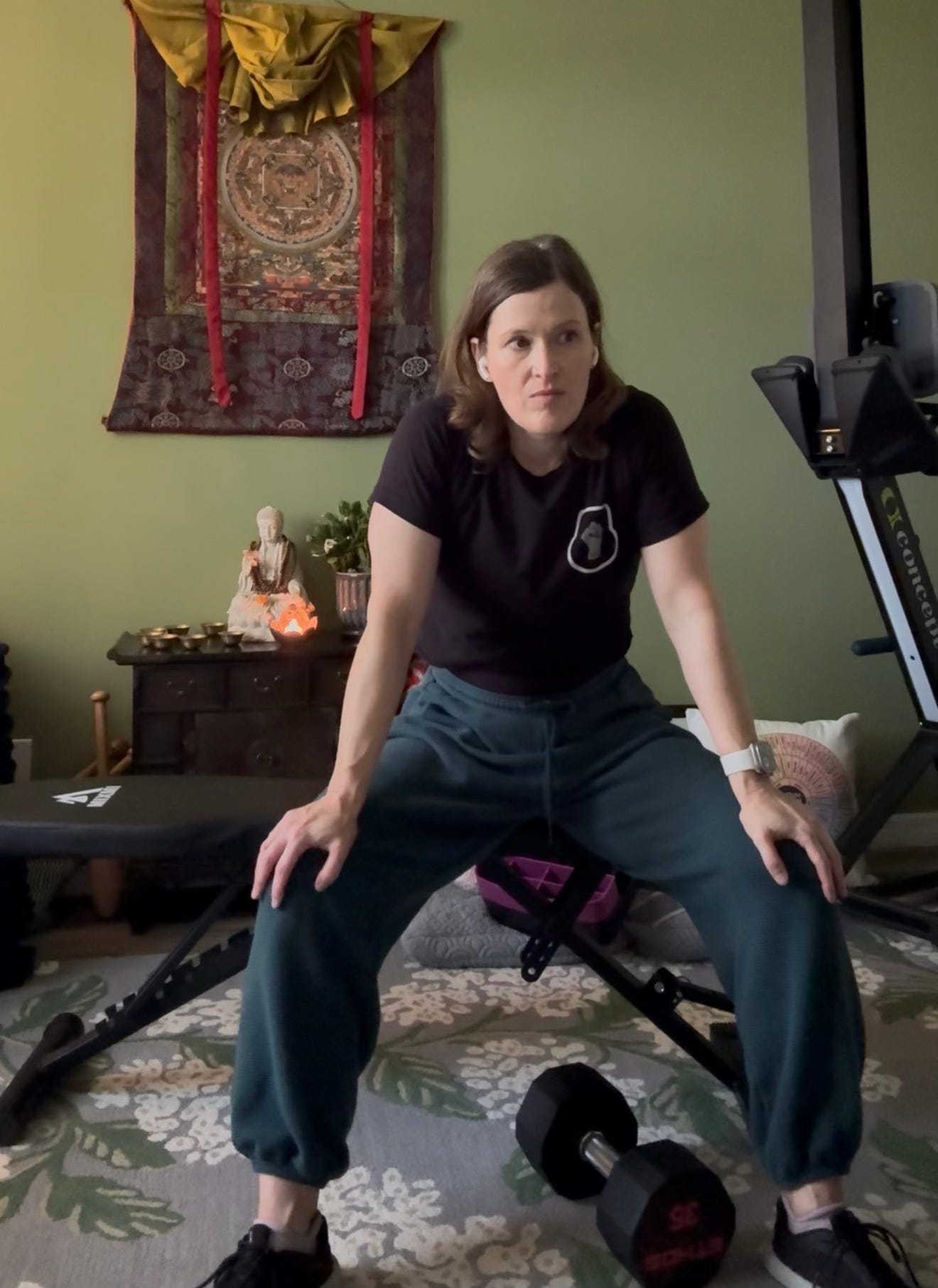
As you can see from the image at the head of this post, I do most of my movement practice in the room where my altar is. I light incense, a candle, and set the intention, and then bang out some reps, or whatever.
We are always embodying something. What we choose to embody— how we infuse intention into our lives— can help bridge the gap between where we are, as humans, as a community, and where we’d like to be.
Hemphill, P. (2024). What it takes to heal: How transforming ourselves can change the world. Random House
Jung, C. G. (1945/1973). Letter to P. W. Martin, 20 August 1945 (G. Adler & A. Jaffé, Eds.). In C. G. Jung: Letters, Vol. 1(p. 377). Princeton University Press.
Milner K, Crawford P, Edgley A, Hare-Duke L, Slade M. The experiences of spirituality among adults with mental health difficulties: a qualitative systematic review. Epidemiology and Psychiatric Sciences. 2020;29:e34. doi:10.1017/S2045796019000234
Corbett, L. (2011). The sacred cauldron: Psychotherapy as a spiritual practice. Chiron Publications.
Hemphill, P. (2024). What it takes to heal: How transforming ourselves can change the world. Random House
Baker, W. B. (2021). The wakeful body: Somatic mindfulness as a path to freedom (Foreword by Tsoknyi Rinpoche). Shambhala Publications.
In the state of our world, there is so much grief, anger, fear, and anxiety we are carrying. Holding our breath, waiting for the next cruel attack against humanity. "Whatever we are embodying is being transmitted to others, whether intentional or not.
This is just what i needed to hear today. Thank you...setting my intention to be present with love in my body, my heart and connection to the numinous...
Also recognizing that even a broken and diseased body has a connection to the numinous. Helpful to focus on that rather than the fear i feel in my gut as i sit in the hospital with my hurting husband. Trying to be present to the love that is here too..which is always numinous...and not ignore the rage, grief and helplessness that is there too.