


The palm trees in my neighborhood are dying.
A few years ago— mid-pandemic— a neighbor stopped me outside. “Your palm tree is dying,” he said. “There’s a fungus inside of it— it’s all spongy and rotting.” Stepping back, I could see he was right. The tree was listing, no, drooping, to the side. What I’d initially taken for normal frond droppage was, in fact, a litter of dead leaves. The tree was sick and sad.
The fungus, my neighbor said, lived in the ground, and was likely to infect all of the trees in our neighborhood. There was nothing to be done to stop it, though we cut down the tree, and then another nearby— the fungus had spread.
I felt, at the time, a sense of familiar sick foreboding. That this fungus was festering; that it would infect, and kill, all the glorious palms in my South Florida neighborhood; that things could look healthy enough on the outside, but be sick and rotten inside— well, not to beat you over the head with this metaphor, but it mirrored my fears around our country, our democracy, the values I believed we (mostly, at least?) collectively upheld— that it was only a matter of time before the rot spread, and was exposed, and the ugliness inside made visible.
The malignancy has spread. On my walk each morning, I feel a deep grief for these beautiful trees— woodpeckers swooping from one Queen palm, just starting to sag in its illness, to another foxtail— bees harvesting the white clusters of flowers— squirrels peering at me from around another fat trunk. Some of these palms are enormous. A falling frond could knock out an elderly lady; I steer clear with my small dogs as I walk by.
In addition to my sorrow, I feel a sense of disbelief— as though I am the only one witnessing this extinction, the slowly sagging trunks, the listless fronds, the clearly-almost-dead specimen two doors down. Why, if some of the neighbors knew of this blight years ago, did we not cut the sick palms down earlier? Try to limit the spread? Were there no lessons from The Last of Us to be learned? How could we let this happen?
And as the palm trees were dying, these last five years, my neighbors hoisted “Let’s Go Brandon” flags outside their homes, and slapped derogatory bumper stickers (“Does not play well with liberals”) on their middle-upper-class vehicles. And today violence is welcome, democracy is endangered, if not dead— innocent humans are deported, critical federal programs are defunded, and I have an existential fear I had never before known.
Nonconscious awareness: all we do not see
There are, in our culture, things that we all see without seeing. Jungian writer Barbara Holifield calls this the “nonconscious.” These things are “not unconscious because it has not been conscious and then repressed, but (nonconscious) because it is an unreflected-upon aspect of our reality that hums through our daily existence.”
Many of my neighbors know the palms are dying, and choose not to see them— in the same way they see the violence being spoken on Fox News— the vitriolic statements of our MAGA governor— and continue to smile and wave at each other each morning. Their continued existence as agreeable neighbors and happy, secure retirees is contingent on this pretense that everything is still okay.
But something is deeply wrong.
I know that in many neighborhoods across the country, our divided political reality is less invisible, and that things feel much clearer and open. But in South Florida, where I live, those of us who see clearly may be in community, in churches, in homeschool groups, even in close friendships and marriages with those who do not want to see (or who see things very, very differently). To be aware of this nonconscious within a group that will not reflect upon our (terrifying) reality can feel isolating, dangerous— and truly invalidating.
Cassandra: the gift and the curse
Intuition, said Jung, is “perception via the unconscious.” Unlike its opposite function, sensation, which sees sensory things like details, colors, shapes, reality-as-it-is, intuition’s knowledge cannot be easily explained. Yet, Jung said, “intuitive knowledge possesses an intrinsic certainty and conviction.” When you know, you know.
Those of us who are intuitive processors will often “know” things that sensory types do not. We easily grasp the whole of a problem that others do not(yet— lest we romanticize intuition too much— we may remain completely unaware of important sensory data in the room in front of us). In our left-hemisphere, rational world, this type of knowing is not only undervalued, it’s derided.
This knowing can be deeply uncomfortable, not only because we may see a coming danger that others do not, but because we are not believed. This is the curse of Cassandra.
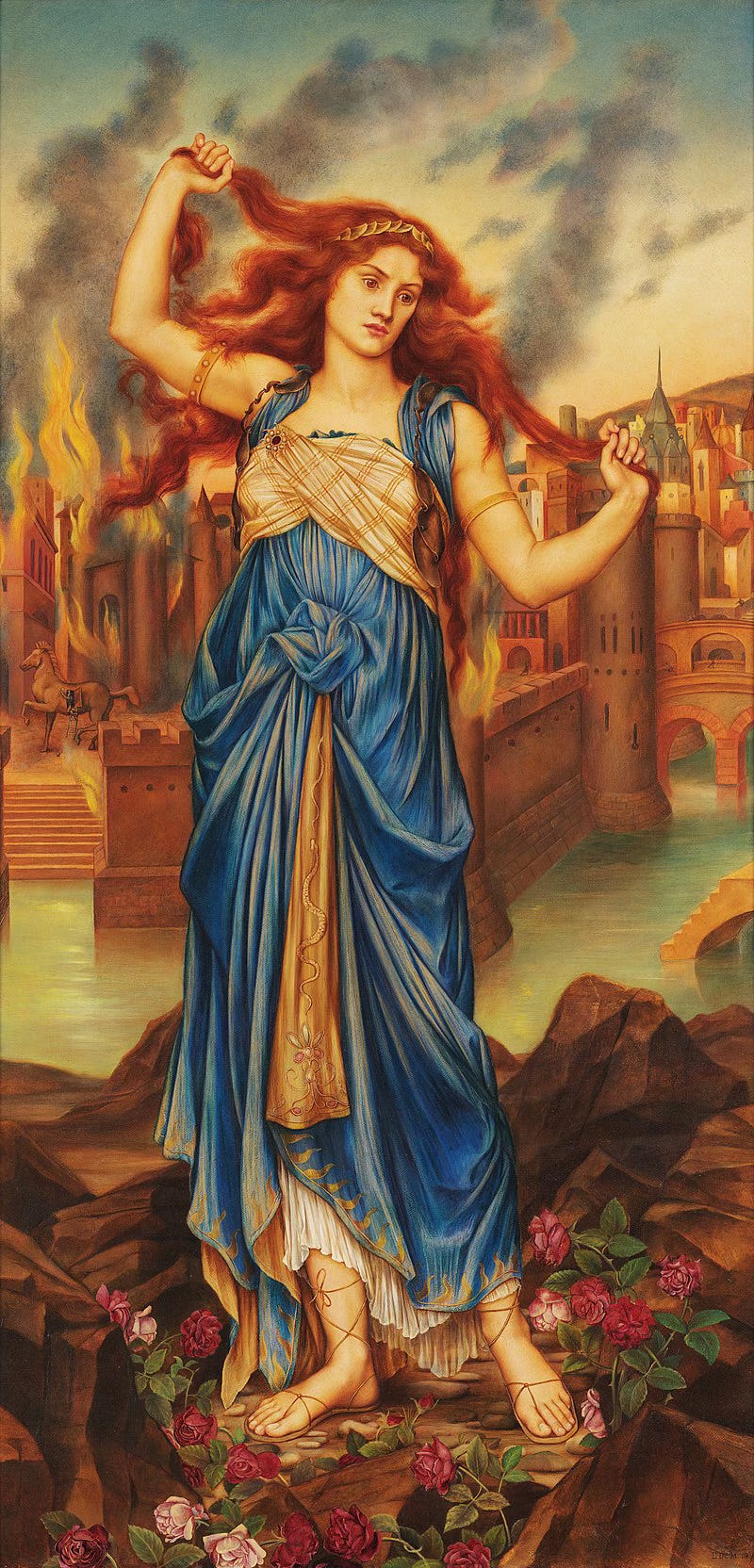
Cassandra, daughter of Priam and Hecuba of Troy, and sister to the hero Hector, was blessed by Apollo with the gift of prophecy. When she refused to sleep with him in exchange, he laid a curse on her that nobody would believe her visions. She was treated as a madwoman; locked up for her insanity. Though she told the Trojans that there were Greek soldiers inside the horse, they refused to listen.
Contemporary Cassandras may imagine themselves, standing as she did, before the destruction of Troy. As it burns, what does it feel like to be vindicated at last? The rage, the fury, the helplessness. The thousand “I-told-you-so’s” dying on her lips as she witnesses the death of her people.
We may just now becoming aware of own intuition, our own knowing, of living in a patriarchal culture. We may feel shame as we recognize, upon awakening, of the harm we’ve witnessed, participated in. We may feel afraid to speak up, seeing at last that our voices aren’t valued.
Perhaps we're just vaguely uneasy, anxious for no reason, sick to our stomachs no matter what we’ve eaten. We might feel uncomfortable with our family or friends when we weren’t before. In our dreams, we may find ourselves standing in a burning house while others calmly eat pancakes; or trying to drag our unwitting families to safety as a tornado approaches. We see the danger and we are helpless to warn others.
For those of us who are trauma survivors, our hypervigilance and sense that something is deeply wrong are being validated in a deep and resonant way— you may enjoy this piece that Toko-pa Turner wrote about the gift of second sight.
Can the curse be lifted?
Our intrapsychic reality— that is, how we feel about ourselves, and the world, inside— is every bit as important as our external reality. In fact, it is what shapes that external reality for us.

Once we’ve become aware of what we know, it matters deeply what we do with it. Satya Doyle Byock wrote recently about the dreams of resistance fighters in Nazi Germany, highlighting the ways in which our reactions to oppression affect us deep in our psyche.
We may feel depressed, powerless, isolated, and overwhelmed by external circumstances. But I believe firmly— and have seen both in myself and the people I work with— that if we can learn to work with our anger, finding our power, we will find a way to resist that feels right for us.
Finally, if you do identify as a Cassandra, you are not alone. I hope, if nothing else, this piece validates your experience and reminds you that although you may feel isolated in your community, you are in fact deeply connected to a sense of reality that they don’t dare see. Let your knowing be the gift that it is; a light of truth that shines in the darkness.
Thank you for sharing all of these important and pertinent points. I experience a lot of overwhelm/freeze response in relation to obtuse and terrifying political topics and staying informed is a struggle. Thank you for sharing about your client. It shows me how powerful movement practices can empower in other aspects of life.
Loved this post Laura. Yes, I am a Cassandra, never looked at it this way. And so often I felt the curse of knowing and seeing the unseen. It can be uncomfortable and I often feel misunderstood as an outlier because I don't conform to the group mind. But I realize the gift of living as a sensitive, intuitive being.