


Hi, subscribers! Thank you so much for reading. If you enjoy this piece, please don’t forget to like, comment, and restack— it really helps. If you can afford to do so, please consider upgrading your subscription as well. It supports my work, and you get free access to my online streaming site.
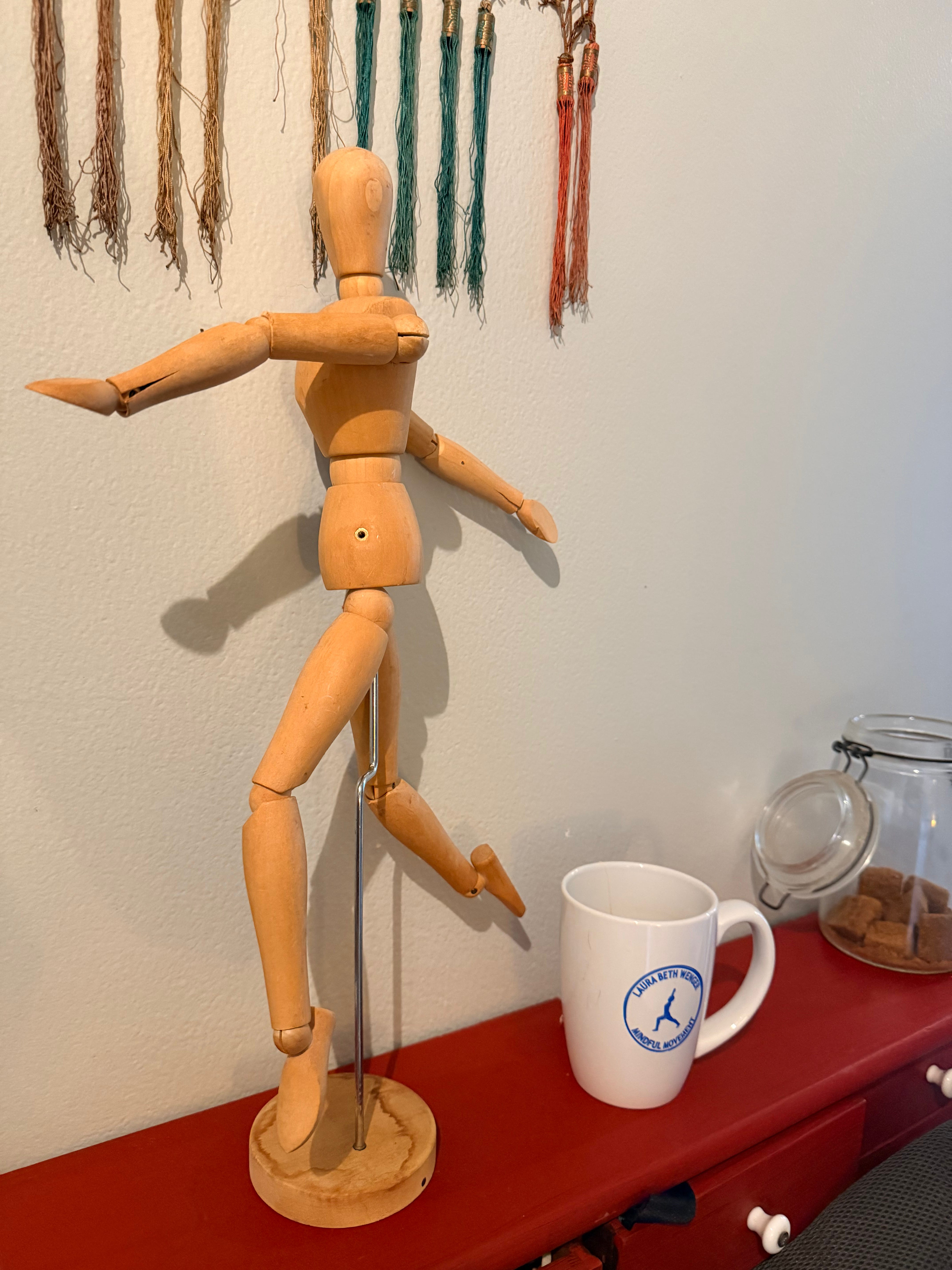
My client paused on her way out the door. She set down her empty tea mug, and began to arrange the artist’s model that sat on the shelf nearby as she talked to me. “I don’t know why this was so hard for me today,’ she said. “I keep wanting to justify why I struggle with what we’re doing. But I guess it doesn’t really matter.”
As she stepped away, I looked at the way she’d rearranged the wooden model, and I began to laugh helplessly. “Look at its limbs,” I said. “Is that right?” “Oh my God,” she responded. “No. I just can’t seem to GET it.”
Trauma & movement
Unless you’re someone who specifically works with the body, you might be surprised to hear that trauma- whether it’s the shock trauma of PTSD or the longer-term, pervasive trauma of C-PTSD— has a profound effect on how our bodies function and move.
But trauma affects more than just our minds or our emotions— it creates new patterns of breathing, movement, and posture. This isn’t a mistake, or some kind of design flaw— these patterns are either a part of a strategy to keep us safe in the world, or they are a side effect of some other physiological change that our bodies have taken on for survival.
These patterns in the body can include armoring of various kinds— a kind of continuous bracing against life’s challenges; breathing patterns (you can listen to my colleague Jennifer Snowdon and I talk about these here). One common stress pattern that I see is one of external rotation and spinal extension (you can read more about this here). But really, each of us has our own particular body signature, the ways in which our life stories are stamped into our patterns of moving, breathing, and being with others in the world.
Developmental trauma, “early walkers,” & adult movement patterns
In the case of developmental trauma, our movement patterns may simply never have had a chance to develop as they would have otherwise. Developmental trauma refers to chronic, early-life stress, or an environmental or caregiver failure during those early years which disrupts our emotional, neurological, and relational development.
Even under almost-ideal circumstances, things can go “wrong” in these early years that may be easily missed. One of the most important milestones that can happen in a child’s development is crawling. While parents may brag that their kids were “early walkers,” a child who does not spend adequate time crawling is missing a critical part of their development for both brain and body.
Contralateral movement: why does it matter?
Crawling is important for many reasons. It’s our body’s first iteration of contralateral movement. Contralateral movement is a pattern in which we move our opposite arms and legs in opposition— so, we crawl by moving our right knee with our left hand, and then switching to left knee with right hand, and so on. It also sets us up for proper adult gait, using the same contralateral pattern: our right leg steps forward as our left arm swings forward, etc.
Learning to crawl helps babies develop an internal rhythm that will guide them throughout their lives. It teaches us how to use our stabilizing muscles of the core: hip, abdominal, diaphragm, and paraspinal muscles. It gives us better balance and stability overall— something that can be noticeably missing in individuals who missed this step.
In the video below, I’m practicing a simple variation where we pick up the contralateral limbs, feel the wobbliness, and then take them for a crawl. If you try this with me, you may be surprised to see how very difficult it is. Even individuals who had an optimal developmental period and crawled well may have picked up some compensatory patterns over the years that make this hard.
And for individuals— like the client above— who were not able to learn to crawl due to what we might call “environmental failure”— it can feel almost impossible to know how to do this. They’re learning something that is fundamentally human, but feels, as my client says, “really wrong.”
The corpus callosum- the bridge between our brains
Contralateral movement—such as crawling and walking, which both engage opposite limb movements—engages the corpus callosum1, the structure responsible for interhemispheric activity. Connecting the right and left hemispheres of the brain, the corpus callosum underlies a wide range of cognitive and motor functions that depend on both sides of the brain working in concert, including reading, writing, balance, spatial awareness, and emotional and cognitive processing.
Its development and integrity have meaningful implications across the lifespan. In infancy, corpus callosum size is positively associated with rolling over—a precursor to crawling—suggesting its role begins early in motor development. Yet this development is not guaranteed: children who have experienced abuse during key developmental periods, or who carry a PTSD diagnosis, have been found to have a smaller corpus callosum than their counterparts23. A smaller corpus callosum, in turn, is associated with delays in response time4, and in elderly individuals, atrophy of this structure corresponds with decreased motor coordination, including mobility, balance, and proprioception5.
While research remains limited, there is some evidence that physical therapy—particularly when it includes aerobic exercise—may help prevent or delay this atrophy, pointing to movement itself as a potential protective factor for the very structure that movement depends on.
All of this is not enough evidence to suggest that learning to move contralaterally as an adult can ameliorate the effects of early childhood trauma on the corpus callosum6. In my experience, however, there is still tremendous benefit to re-learning these basic human patterns.
Learning to walk
So how are these folks moving through life, if they’re not walking with contralateral gait? To be fair, most of us don’t have anything close to “optimal” human gait, for a variety of reasons. We are profoundly asymmetrical; we have injuries that change how we walk; we carry something (like a phone )in our right hand all the time; we wear shoes that change our stride; we lack the strength in our core, hips, etc., to properly support us. Psychological patterns show up here, too, of course— we slouch, we shuffle, we sway. Intentionally or not, our walk conveys something about who and how we are to the world.
So there’s a lot of value to “re-learn” how to walk for all of us— because walking well is more than just how we move through the world. Walking contralaterally with a more optimal gait helps us to maintain our core and hip muscles. It creates natural stability to support our back and organs. It maintains healthy pressure in our gut and pelvic floor— so we don’t have digestive or reproductive issues. It’s not exaggerating to say that changing your gait can be profoundly life-changing for all dimensions of our lives.
In the video clip below, I’m demonstrating how we can practice contralateral movement in walking by stepping the back foot forward as we swing the arms (feel free to practice with me here- it’s five minutes of stepping your foot forward and back, and again, you might be surprised what you find).
It was a variation on this activity that had my client feeling so frustrated. What looked so simple was mind-blowing. Over and over again, she reverted to swinging the same-side arm forward with the same leg as her brain fought to hold on to a pattern that had been keeping her safe for many, many years.
A trauma-informed approach
Unwinding patterns of any kind can be a discouraging task— there are so many layers that need to be peeled back. In the case of C-PTSD, there are often additional barriers that need to be met with kindness and patience; we want to be mindful not to blast through a protective layer that has been guarding emotional vulnerability. Dissociation, frustration, rage, and overwhelming grief are common as we travel back with the client to a time period when they should have been able to learn how to move and breathe, but were simply not able to.
Even more critical is that practitioners— whether that’s personal trainer or body worker, therapist, coach, or physical therapist— have a unique opportunity here to “reprogram” the client’s brain through relational work.
The first 24 months of our lives are both when we learn to crawl, and when we form attachments that will create the neuronal foundation for affect regulation. That is, if we have what Winnicott called a “good-enough” attachment figure at that age, we’ll be better able to regulate our emotions as grown-ups. Clients who struggle with fundamental patterns- like the one we’re discussing— may also be likely to struggle with emotional regulation.
This is incredibly important: not only can we relearn movement patterns as adults, but we can also relearn attachment patterns by changing the underlying brain structures through psychobiological attunement. Clinicians who can successfully recognize, resonate with, and regulate their clients’ emotions are creating change in their clients’ brains that leads to better self-regulation7. This has profound implications for client work; we can address physical, mental, and emotional patterns on multiple levels simultaneously. In fact, for those clients who do live with C-PTSD, if we fail to address the relational patterns, we are unlikely to succeed at shifting any of the other patterns; it’s that foundational.
That incident with my client happened several months ago. She said of the experience of working through the contralateral exercises together, “I was surprised how emotional that was… how difficult.” She has continued to practice on her own— and she’s thriving in all kinds of ways.
I had left the artist’s model the way she left it, as a reminder to myself to keep it in mind for our work together. Just the other day as she was leaving, she paused again to look at it.
“Oh,” she said. “This isn’t right.” And without a second thought, she easily rearranged it to look like this:
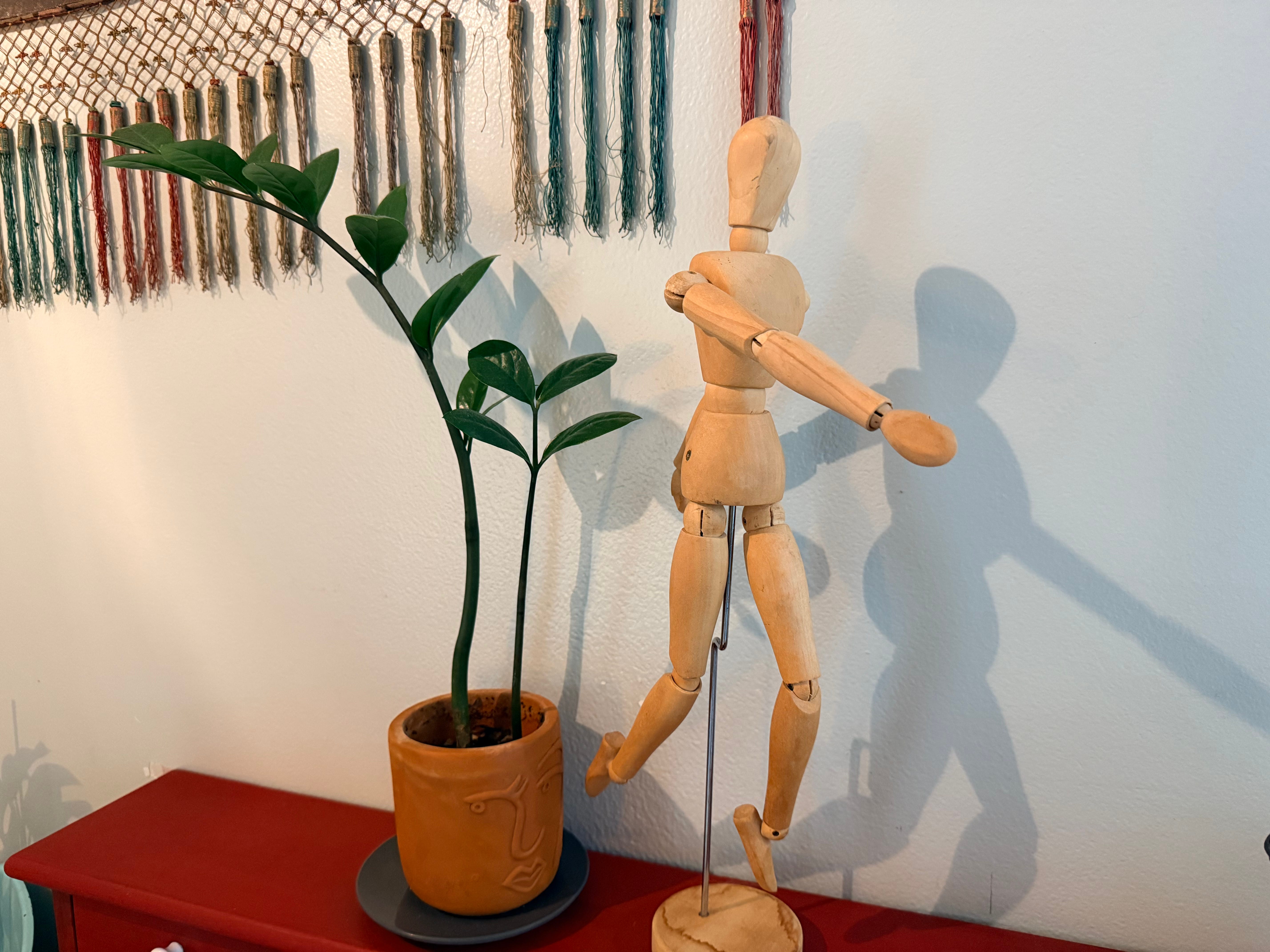
What more is there to say? The pattern she’d never gotten to learn was finally as natural and easy as it was always meant to be.
Although you will read some claims about this online— I haven’t yet seen a study that backed it up.