


“When we live outside ourselves, and by that I mean on external directives only rather than from our internal knowledge and needs, when we live away from those erotic guides from within ourselves, then our lives are limited by external and alien forms, and we conform to the needs of a structure that is not based on human need, let alone an individual’s. But when we begin to live from within outward, in touch with the power of the eroitc within ourselves, and allowing the power to inform and illuminate our actions upon the world around us, then we begin to be responsible to ourselves in the deepest sense…. Our acts against oppression become integral with self, motivated and empowered from within.”
—Audre Lorde, Uses of the Erotic, from Sister Outsider
One of my personal existential struggles is how difficult I find it to explain to people what I do for a living. Not because it’s so complicated— in fact, to me it often feels as natural and simple as breathing— but because it’s rooted in right-hemisphere knowledge and relational connection that is 1) difficult to put into words, and 2) not valued by our culture.
So instead, I swallow my own knowing, my value, my worth. “I’m a yoga teacher,” I say sometimes. Or, “I’m a personal trainer.” Half-truths that get me through a conversation, but which also devalue not only my sense of self, and the important relationships I share with my clients, but the entire right hemisphere; the quality of eros; the feminine principle.
As neuroscience catches up with what human beings have always known in their bones— that right-hemisphere oriented, relational attachment is the key not only to regulating our autonomic nervous system, but to maintaining our overall health— it’s gotten easier to explain the importance of the type of coaching that I do. Still, there’s a war in my psyche: the internalized oppression of patriarchal complexes that sneer at my embodied wisdom vs. the clear knowing of the healing power that unfolds between two humans in a right-brain-to-right-brain connection.
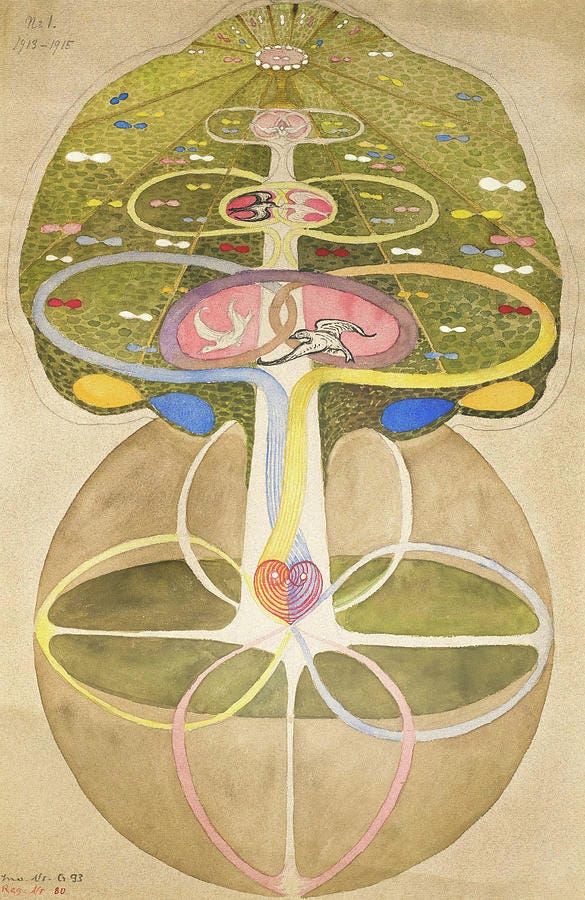
This battle is a microcosm of the larger battle that is being fought in the US, and across Western culture, today. Audre Lorde said, “The master’s tools will never dismantle the master’s house.” The left hemisphere, as much as we need it, has become overly dominant in our culture, and the patriarchy wields its tools with menace (as I hope will become clear as you read on). So, if you’re still with me, take a minute— close your eyes, wiggle your toes, savor a breath or two, if that feels okay. When you open your eyes, look around the room. Broaden your peripheral vision as you imagine yourself dropping down, or back, or into the right hemisphere of your brain. This is less about doing than it is about feeling.
The two halves of the brain: Eros & Logos
First, we need to review the essential differences between the left and the right hemispheres of our brain. Our left hemisphere prefers narrow, focused attention to detail. It divides the world into categories and parts, and simplifies things (it loves binaries!). It stands back from reality and organizes it in ways that it can grasp and manipulate. The left hemisphere sees the body in a mechanistic way, a series of parts. Jung saw these characteristics as logos, which he named the masculine1 principle, which judges, discriminates, and orders the world. He correlated logos with spirit rather than matter.
The right hemisphere, by contrast, sees the entire world as it is, full of complexity and contradiction (no binaries— think, “both/and”). It relates to the world with metaphor and empathy. It understands implicit meaning, humor, irony, emotional expression, and body language that the left hemisphere cannot. The right hemisphere is an embodied experience. Jung described these qualities as eros, which he associated with the feminine principles of love, intimacy, relatedness, and physical matter.
These concepts are drawn from Iain McGilchrist’s epic book, The Master and His Emissary. The video below is a great little introduction to his work— and it also illustrates how ideally we can use the left hemisphere (concepts, words, abstract thought) along with the right hemisphere (images, metaphor, creativity) for a more balanced experience of the world:
The left hemisphere as the domain of the patriarchy
“The principal horror of any system which defines the good in terms of profit rather than in terms of human need, or which defines human need to the exclusion of the psychic and emotional components of that need— the principal horror of such a system is that it robs our work of its erotic value, its erotic power and life appeal and fulfillment. Such a system reduces work to a travesty of necessities, a duty by which we earn bread or oblivion for ourselves and those we love. But this is tantamount to blinding a painter an then telling her to improve her work, and to enjoy the act of painting. It is not only next to impossible, it is also profoundly cruel.”
—Audre Lorde, Uses of the Erotic (from Sister Outsider)
As we’ve noted, the left hemisphere is crucial for functioning in the world. However, without the balancing influence of the right hemisphere, its mechanisms are destructive. In The Master and His Emissary, McGilchrist lays out his hypothesis that we are living in a left-hemisphere-dominated world, as demonstrated by the following:
Virtuality is more important than reality:
The human body and the material world become more conceptual.
Skill and judgment are discarded in favor of quantifiable processes.
Actual work is overtaken by the meta-process of documenting or justifying the work.
The living is modeled on the mechanical. We value production, speed, and precision.
Considerations of quantity replace considerations of quality.
Because the mechanical is the model for everything, we would value utility over morality.
Exploitation rather than co-operation would be the default relationship between humans, and between humans and the environment.
Talk of liberty, an abstract ideal (which the left brain loves) increases as individual liberty is curtailed: monitoring of personal information is the norm.
Control is key:
Death is the ultimate challenge to the left hemisphere's need for control, and becomes taboo. We become obsessed with certainty, security, and avoiding death.
Anger and aggressive behavior dominate-- these are the left hemisphere's domain-- and empathy of the right hemisphere cannot mitigate it.
In a left-brain dominant society, reasonableness is replaced by rationality. Common sense fails; it is based on intuition, which is a right hemisphere function.
People become increasingly passive.
Awe, wonder, spirituality are mistrusted, feared, mocked. Fundamentalism and dogma reign.
When I read through these, I feel both validated and deeply, deeply disturbed. Here is clearly laid out the link between the ideals of our patriarchal cultural complex and the very real ways it affects our day-to-day personal lives. It’s a tidy recipe for oppression, really. Is it any wonder that I feel a sense of personal devaluation, when my skills and temperament are all based on the opposite ideals?
Not with “the master’s tools”…
“Man’s advance towards the Logos was a great achievement, but he must pay for it with loss of instinct and loss of reality to the degree that he remains in… dependence on mere words.”
—Carl Jung, CW 11, Para 442
McGilchrist goes on to tell us that within a left-hemisphere-dominant society,
Priests, teachers, doctors, bodyworkers, or any altruistic professions, are devalued, misunderstood, discredited.
Value and meaning in life are elusive; we crave novelty and stimulation to replace them.
Ambiguity, nuance, "both/and" thinking, metaphor, poetry cannot be understood or tolerated.
Art becomes conceptual. Music is reduced to little more than rhythm.
The body is treated as a machine. The natural world is a resource to be exploited.
Embracing the eros-oriented, right-hemisphere principles of intuition, embodiment, spiritual connection, ambiguity, creativity, and empathy are as important part of a social justice movement as are left-hemisphere logos-oriented actions such as organizing and marching, or even changing one’s purchasing habits.
Satya Doyle Byock, in a recent post about the Archetypes of Resistance, lists the right-hemisphere roles of healer, prophet, cook, musician, and seedkeeper as important ones for times of social change. These are critical ways that each of us can and perhaps even must participate in revolution. Otherwise, we simply replicate the patterns that got us where we are today.
Embodied, right-hemisphere connection
“If a neuropsychologist had to choose three things to characterize most clearly the functional contribution of the right hemisphere, they would most probably be the capacity to read the human face, the capacity to sustain vigilant attention, and the capacity to empathize.”
Not long ago, Elon Musk said, “The fundamental weakness of Western civilization is empathy.” He was just saying the quiet part out loud— that patriarchal, capitalistic, left-hemisphere-dominated culture sees empathy not as a gift but as a flaw to be exploited.
Yet empathy isn’t optional for basic human health. It’s a proven neurobiological need, without which we cannot have a properly functioning immune system, digestive system, nervous system, etc. Those of us who are naturally better able to read human face and gesture; to sustain vigilant attention; and to empathize with others are doing front-line urgent care.
Empathy, and other embodied skills, are also mechanisms of change, both intrapsychically (in ourselves) and interpsychically (with others). The left hemisphere, with its self-referent, closed-circuit thinking, prefers not to let any new information in at all, whereas the right-hemisphere is open to all possibility. The Jung quote above reminds us that relying on words alone cuts us off from reality. We can only engage with others effectively insofar as we can empathize with their viewpoints.
In a left-hemisphere world, those with right-hemisphere gifts are likely to doubt themselves, or be forced to seek legitimacy through credentialing programs that will grant them a greater sense of safety. These are helpful in order to function in a left-hemisphere culture, but unless we eradicate the specter of patriarchal complexes within ourselves, we will continue to devalue ourselves, and the feminine principle, reinforcing oppressive cultural norms.
My ongoing, quiet revolution is to re-value the left hemisphere— which Audre Lorde calls “the erotic”— in myself. This is powerful work:
“We have been raised to fear the yes within ourselves, our deepest cravings. But, once recognized, those which do not enhance our future lose their power and can be altered. The fear of our desires keeps them suspect and indiscriminately powerful, for to suppress any truth is to give it strength beyond endurance. The fear that we cannot grow beyond whatever distortions we may find within ourselves keeps us docile and loyal and obedient, externally defined, and leads us to accept many facets of our oppression.”
—Audre Lorde, Uses of the Erotic, from Sister Outsider
“Masculine” and “feminine” here refer to principles rather than to genders; each of us, according to Jung, possesses masculine and feminine qualities.
I just read this through for a second time and it deeply resonates, thank you for writing it.
Reading the human face, being present and attentive, and empathizing are about connecting. Yes, we need more right-brained interactions! ❤️