Upcoming Learning Opportunities:
Breaking the Spell: A Fairy Tale Path through the Dark Woods of Trauma with Laura Wenger & Jane Clapp 12/2.
Better Breathing for Trauma with Jennifer Snowdon & me January 30
In the movement world, when we talk about “compensation,” there’s a faint but inevitable derogatory connotation. “Her accessory breathing muscles are compensating for the fact that her diaphragm doesn’t move properly” “He’s quad-dominant— doesn’t know how to hinge properly, so he compensates.”
And in popular culture, when we think about compensation as a psychic fact, it also seems to me that there’s an air of judgment around it. “He drives a big truck— must be compensating for something.”
Yet what we’re missing here is an incredibly beautiful fact: these compensations are occurring because our system— whether physiological or psychological— understands that it needs something to make it feel complete; to work properly; to be whole. We don’t choose to do this consciously (in most cases); it simply happens, and helps us to continue to function as whole individuals, despite an imbalance somewhere in our lives.
Body & psyche as self-regulating systems
This may be more obvious to us when we look at people’s bodies: our primary goal is to stay alive, to keep breathing, to be safe. Our bodies will help us to accomplish those goals in whatever way they can. If we aren’t able to sense our hamstrings, we lean forward; our back muscles and hip flexors will compensate so we don’t fall over. And in the earlier example, it’s really fantastic that we’re able to use our compensatory neck muscles to help us breathe— that’s how we’re meant to breathe when we’re under stress.
From a nervous system point of view, fight, flight and freeze are all compensatory systems. If I’m not able to fight, I’m going to run. And if I can’t do either, freeze might just save my life. These actions keep us whole.
This is true not only in the body, but in our psyche. In fact, it’s a fundamental tenet of Jung’s work that the psyche is a “self-regulating system that maintains its equilibrium.” When we are missing something, we can be sure that there is another part of us working to compensate. We might make jokes about the big truck, but we also understand intuitively how it might be true.
“The psyche is a self-regulating system that maintains its equilibrium just as the body does. Every process that goes too far immediately and inevitably calls forth compensations, and without these there would be neither a normal metabolism nor a normal psyche. In this sense we can take the theory of compensation as a basic law of psychic behavior.” —CG Jung, CW 16, par 330
So, if we’re thinking about vehicles, here’s an interesting example from my own life: during one of the darkest times of my life (depressed, lonely, working at a call center), I drove a bright yellow Volkswagen Beetle with eyelashes over the headlights (and beetles on the taillights!). This was a completely unconscious choice— I told myself that it was the last Beetle on the lot so “I had to take it.”
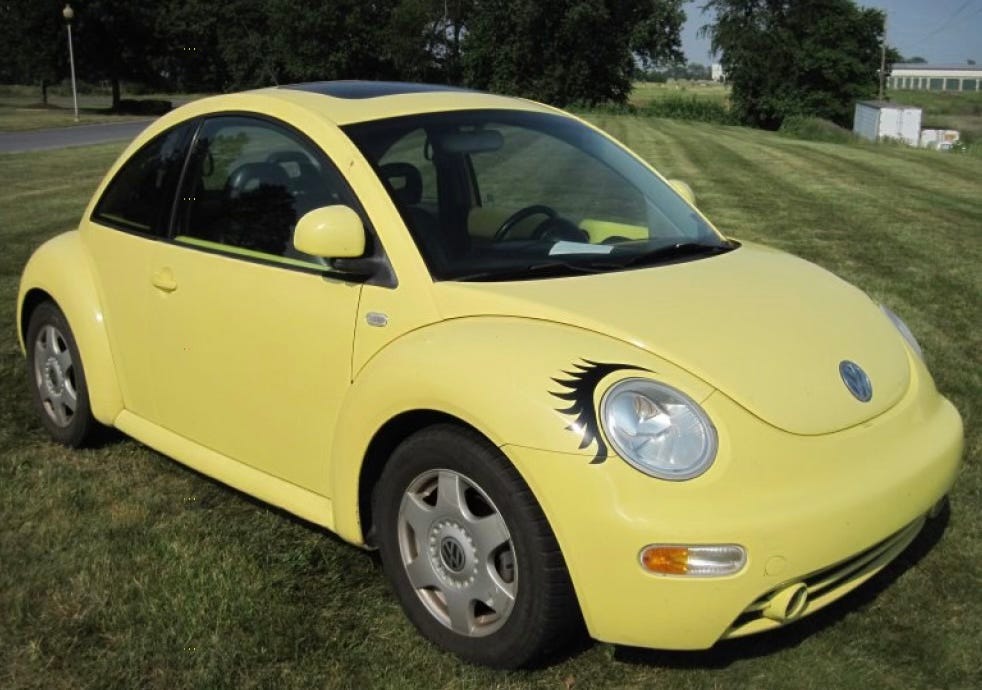
It’s clear to me now, though, what a fantastically compensatory action this was. Part of me wanted nothing more than to crawl under the covers and languish— but another part of me desperately wanted to be seen, to be joyful, to be the kind of girl that drove the happiest car in town.
Compensation isn’t less-than
As we’ve seen in the physiological examples, compensation is often the only way that a person can survive. In my mind, this doesn’t make compensation “less than” some other way of operating, but a brilliant mechanism that allows us to thrive. I couldn’t see without my compensating contact lenses. My dog limped until we compensated for his luxating patellas with a compensating knee surgery. I broke my big toe in college— and while I’ve never been as stable on that foot since, I am incredibly grateful that my body figured out how to compensate so I could walk.
In the realm of the psyche, compensation plays a similar role. I don’t have children of my own, but I compensate in the way that I love my partner’s kids, and my dogs. I never got to do gymnastics as a child— but I compensated later with yoga and other movement practices. I never had a sister, but I have created strong friendships with women that support me in a way I imagine a sister might. All of these feel to me like beautiful compensations that keep us from feeling a longing, a lack, or a sense of something missing.
This is a teleological approach— meaning, there’s a design, or a purpose, in everything that happens; that all symptoms, strange as they may seem, physical, mental, or emotional, are part of a larger design.
What happens when things are really out of balance?
What about when we do feel a longing, or have a sense that something is missing? According to Jung, this in itself is a compensatory function— along with other symptoms, like some kinds of depression— that are trying to get our attention so we can balance things out.
“Neurosis is really an attempt at self-cure. … It is an attempt of the self-regulating psychic system to restore the balance, in no way different from the function of dreams— only rather more forceful and drastic.”– CG Jung, CW 18, par. 389
Further, he said, “the symptomatology of an illness is at the same time a natural attempt at healing.” (CW 8, Para 31) These symptoms— and they can include somatic ones— can feel truly terrible. In fact, the more terrible they feel, the more we can be sure that there’s something big or important missing. This is one of the many reasons I love Jungian psychology— it humanizes us and de-pathologizes symptoms, because it understands that they are an important part of the self-regulating system.
This is a teleological approach— meaning, there’s a design, or a purpose, in everything that happens; that all symptoms, strange as they may be, physical or mental or emotional, are part of a larger design.
Cues, clues, & final thoughts
Of course, there are compensations that aren’t great, right? I don’t always want to be breathing with my accessory neck muscles if I don’t have to, after all— and sometimes the reason people are seeking help is because the compensation has become so uncomfortable, or they’ve gotten injured as a result. In these cases, we may want to make adjustments so that the system can find a balance that feels better (or is more sustainable, healthier, etc.).
Still, I think it’s important that we recognize compensation as a healthy and important mechanism. Recognizing that our system is always moving toward wholeness can help us to contextualize things that might otherwise feel “off.” When we’re eating more than usual, or using more substances than we might normally do; when we find ourselves opening the door to a pile of Amazon packages we didn’t mean to order; when we’re working all the time, or over-sleeping for work four days in a row— we can step back and say, what is this compensating for?
Jung’s teleological lens helps me to apply an attitude of curiosity and compassion, both in myself and in my clients. If there’s an excess of something on one side (too much weight in the right leg; too many nights without sleep; too much emotion about something that seems small), I can zoom out and ask questions about where there is a deficit elsewhere in the system. This is often a key to understanding an imbalance that may need to be adjusted.
Jung believed (as I do) that each of us is guided by the archetype of the Self— our internal God-image (in whatever form that takes, including a secular one), which is the organizing principle that both maintains our psychic homeostasis or equilibrium, and which guides us on our path— the unique individuation process each of us must undergo. By understanding symptoms and compensation as important functions in that system in my client relationships, I can allow their own embodied experience to guide us, rather than trying to impose an external “fix” that wouldn’t ever really work.