


“You see, life wants to be real; if you love life, you want to live really, not as a mere promise hovering above things.” —CG Jung, Zarathustra Seminar
One cloudy winter day, I looked out the window of my third-grade classroom, and watched all of my classmates doing our semi-annual mile run. I’d successfully feigned illness (I suspect the gym teacher didn’t care enough to doubt my lies), and I felt a sense of deep relief, streaked with shame. What was wrong with me, I wondered, that I hated to run when everyone else didn’t seem to mind? Why was I, a goody-two-shoes-straight-A’s-kind-of-kid, willing to lie to avoid something that was over so quickly? I felt myself, as Jung said, hovering above things, cut off from others, and from this body.
“Running the mile” was just one of many physical activities that loomed with dread on the academic calendar. The Presidential Physical Fitness Awards1 (don’t get me started on this) were another. Almost forty years later, I can still feel the sense of panic in my throat, along with a hot hit of shame in my chest, that comes over me at the memory of having to “attempt” pull-ups; the failure to climb the rope to the ceiling; being picked last for any team sport. Just. Sheer. Hell.
The lack of “education” in Physical Education
I know I wasn’t the only kid who hated gym class. Sure, there were natural jocks, but most of us were kind of middle-of-the-road athletes. But unlike reading, or math, or art class, there was no actual instruction provided in our gym classes. And while I was a natural jock when it came to things like reading and writing, I struggled with things like body awareness (i.e., proprioception— knowing where my body was in space), understanding the rules to games (we were not a sports-watching family, so I had no idea what was happening in a game of flag football), and a balanced sense of interoception (having too much awareness of my own heartbeat and body temperature made them feel scarier than they were). And I was just a pretty average, healthy-enough kid. There were others who skewed even further from the “President’s” Physical Fitness Standards than I did, of course.
What was being taught in these gym classes? I’m not clear on whether or not anything was actually learned by anyone else, but what I learned was how to get out of gym as often as I could. I skipped a whole year in high school with a doctor’s note about painful periods. I feel no remorse for these lies. It was torture.
It’s never to late to learn-
I hope it goes without saying, but we all have really different experiences in our bodies. I wasn’t born a gifted mover, but I wasn’t just a clumsy dork, either— I needed to learn how to know what my body was doing and where it was in space, and an environment that allowed me to do that on my own terms. Feldenkrais would have been a great modality for someone like me.
I also needed less aggressive competition. I know this works well for a lot of people, and I don’t want to take that away from you— but for me, the very thought of having to compete against someone else, or to have to be part of a team that competes— that was so incredibly stressful that it overwhelmed me. The feeling of shame and panic was so big that it short-circuited my ability to even hear instructions, let alone hit or catch a ball. I remember softball games where I shuffled backward again and again to the back of the line, praying the teacher didn’t notice I hadn’t yet batted for the team.
As far as activities like running, push-ups, pull-ups, and rope-climbing— while these should be things humans know how to do naturally, even as kids, we have brain and body variations that can make these difficult, especially if they’re only practiced once or twice a year in a Lord-of-the-Flies environment. A lack of stability in my body (a sports podiatrist at the University of Pennsylvania later told my mother, “she’s got the flattest feet I’ve ever seen”) meant that running felt terrible in my body. Not only physically, but mentally and emotionally— a panic-stricken, hyperventilating, dash to the death.
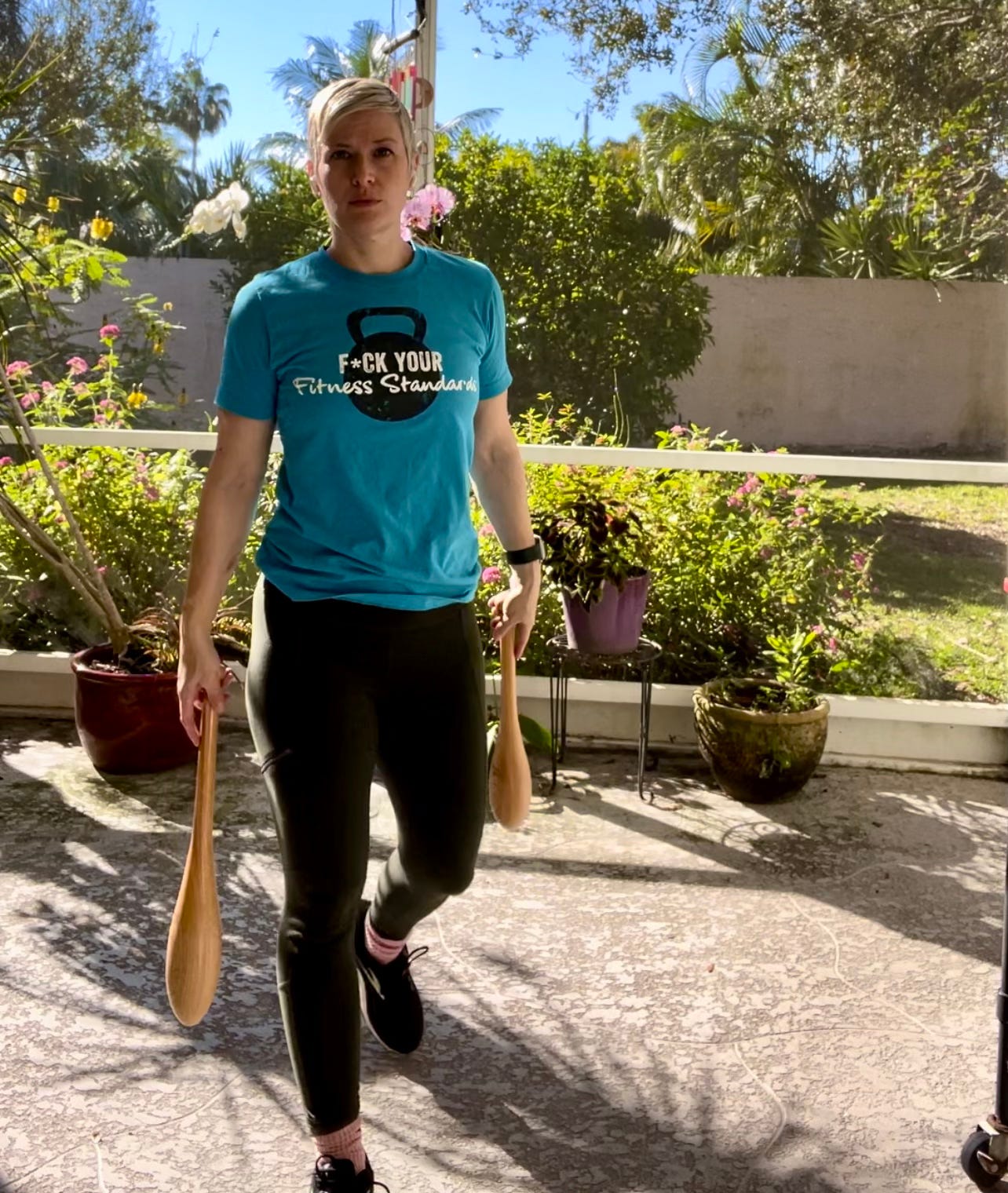
Now, as part of my client work, I act as a non-traditional trainer, emphasizing the mind-body connection. Many of my clients come in with similar backgrounds to mine: they know they should exercise, but they’ve always hated it, or they’re uncomfortable at their local gym or studio, or their history of trauma creates other obstacles.
It doesn’t have to suck
Relearning our relationship with movement is often surprisingly fun— but we often have to set aside those early gym class “lessons,” which mirror our culture’s ideas about productivity and activity. We often have to slow things waaaaaay down— establishing trust, not just with the other person, but with our body. We have to learn what “no” feels like in our body— in the form of pain, or an involuntary movement, or dissociation, or a feeling of panic— so that we don’t override it. Just learning to bounce and catch a ball with someone else can be a profoundly transformative activity— sure, it improves hand-eye coordination and body awareness, but it also goes a long way toward establishing self-trust and the relational repair we might need if we’re a trauma survivor (or even just that kid that was always picked last for kickball— more than likely, that qualifies as a trauma survivor situation anyway).
If we live in a body that has less natural stability, whether that’s due to hypermobility, injury, or something else, or in a body that’s endured some kind of trauma, we need to learn what safe(r) feels like in our bodies. Simple breathing and moving drills can actually be like the playtime we may not have gotten to enjoy as kids— again, an opportunity not just to train our bodies, but to rekindle a relationship to pleasure in our bodies that isn’t often emphasized in movement spaces.
And for those of us who have always associated the sensations of an active body (elevated heart rate, shallow breathing, rising body temperature) with the experience of stress, danger, alarm, etc.— we can learn how to recognize the difference between activation and alarm, so that exercise doesn’t have to feel stressful.
Listen, it’s your body
I think the biggest thing that PE didn’t teach me is any kind of bodily autonomy.
I learned that to move my body in a formal setting, I had to do what someone else said, and that my inability to do it well was a personal failure. As opting out was not a choice, I had to act immorally (as I felt it at the time) in order to take care of myself. This is not a great setup for life.
The fitness industrial complex recreates these norms for us in our adult life. We are expected to conform to certain standards of body shape and composition; we’re told to walk a certain number of steps per day; we are given guidelines around how much to eat, and what those meals should consist of. A failure to succeed at wellness or fitness is our personal failure.
All of these external guidelines, imposed by our culture and reinforced internally as perfectionistic standards, cut us off from our own embodied experience and personal power. They keep us preoccupied with the inane task of losing and gaining the same five pounds over and over again, while larger systems quietly plunder our freedoms.
We are not taught to respect our bodies or their needs, or to seek out movement practices that we enjoy (gardening, walking on the beach, playing with your dog, making sidewalk art with the neighborhood kids). We’re not taught to value pleasure in our body (if anything, the implication is that if we’re experiencing pleasure, we’re probably doing something wrong). We lose our connection to feeling power and anger in our bodies— which we very much need if we want to make change in our lives, in our world. The personal is not just political.
In the spirit of autonomy, then, I don’t care what anyone does with their body. If you’re happiest on the couch, I am cheering you on. You probably need a nap and I hope you get one. I do, however, very much, care that all of us are at least educated about how to live well in our own bodies— how to use them to live. As Jung said in the quote at the head of this piece, ”if you love life, you want to live really.” It is only through these bodies that we are living; my hope is that we can all experience life more fully in them.
If you didn’t grow up in the US, chances are you had a different PE experience, and that’s great! You can read about the Presidential Physical Fitness Test on Wikipedia here.
Really identify with this Laura. Middle school and high school gym class were not good experiences, especially when I had to change into a red one piece snap front bloomer shorts outfit to participate. Hideous and ugly, felt like an institutional uniform even though I went to a public school. Very shaming to the body. Just changing for gym class was terrible. And I was similar to you, I didn't like competive team sports, I was always last to be picked too. And my panic and anxiety about having to perform in any physical fitness events made me blank out, like you I couldn't even hear the instructions. I did well in academics and creative arts. I did ballet after school at a studio. Also I loved to ice skate on ponds near my home. I acted out plays with kids in neighborhood, held seances in my chicken coop. Climbed trees in the apple orchards. Built forts in the woods with my brothers. Drew and wrote poetry. But as far as learning how to move my body in a healthy, joyful way was not taught in school. Wow, what a flashback!
I have mixed feelings on this.
As far as I am concerned, it is completely unacceptable that our education system doesn't require kids to learn about their bodies through physical education. Kids need to be taught that it is NOT okay to always do nothing with one's body, and NOT okay to live on couches or spend their entire free time stupidly staring into 7 by 3 inch rectangles, otherwise known as "smart" phones.
I respect your own experience and those of others who have had similar experiences growing up.
The best solution is some sort of middle ground.
Kids who have experiences like the ones you allude to should be allowed to pursue phys-ed in non-competitive environments, in ways that are unique. But they must be made to try such things and taught why exercise is important, and what happens in the long run for people don't. In particular, the various consequences of morbid obesity.
Going the other way: look up the "La Sierra High School Fitness" system to see how depraved the current PE education system is. Read up on what the students said about its effects (during a time when they were trained to follow instructions rather than dictate the terms of their schooling). Those who feel so inclined should be allowed to compete, encouraged to pursue physical excellence, and be recognized for such excellence, since this is what the 'real' world will demand from our children.