


Hi all! As so often happens, I had so much to say here that I couldn’t get it all into one post— so this the first part is a more philosophical look at the mind/body split. The second part is now published here. I appreciate your reading, liking, sharing, and commenting— it helps other folks who may be interested in these topics find me. Paid subscribers also get access to my online streaming classes with new content added monthly. Okay, on with the post!
I was 10 years old when Madonna taught me what it means to live in a “material world.” We didn’t have cable TV at the time, so I never saw the video— (cue dramatic tone) until today:
The four-minute plot line is a simple one: A wealthy producer wants to woo the beautiful young actress, but overhears her saying that she doesn’t want mere material gifts. He throws aside his fancy gestures and pretends to be poor, eventually winning her heart and driving off in a vintage pickup truck.
So this is a lesson on cultural materialism: a preoccupation with physical possessions and wealth, and with the lifestyle and appearance that goes with it.
But there’s another type of materialism that’s not unrelated; it’s just a little more existential.
Philosophical materialism refers to the idea that matter is the fundamental substance of reality— that nothing exists beyond the material world. This is a left-hemisphere domain, which values reason, and measurable facts, and verifiable information.
Mind/matter split: a cultural wound
The two concepts sound different, but at their heart, cultural and philosophical materialism are about things you can see, grasp, measure.
If we consider the etymology of the word materialism, we find “matter.” The word itself comes from the root mater: “origin, source, mother.” Matter is physical, earthy, tangible; it’s related to our bodies, which we use to literally touch and explore the world around us. I hope it’s not too big a reach to say that, in its origins, matter is also about the feminine ( mater, “mother”). In this sense, matter is the brain’s right hemisphere, the feminine principle, Jung’s Eros.
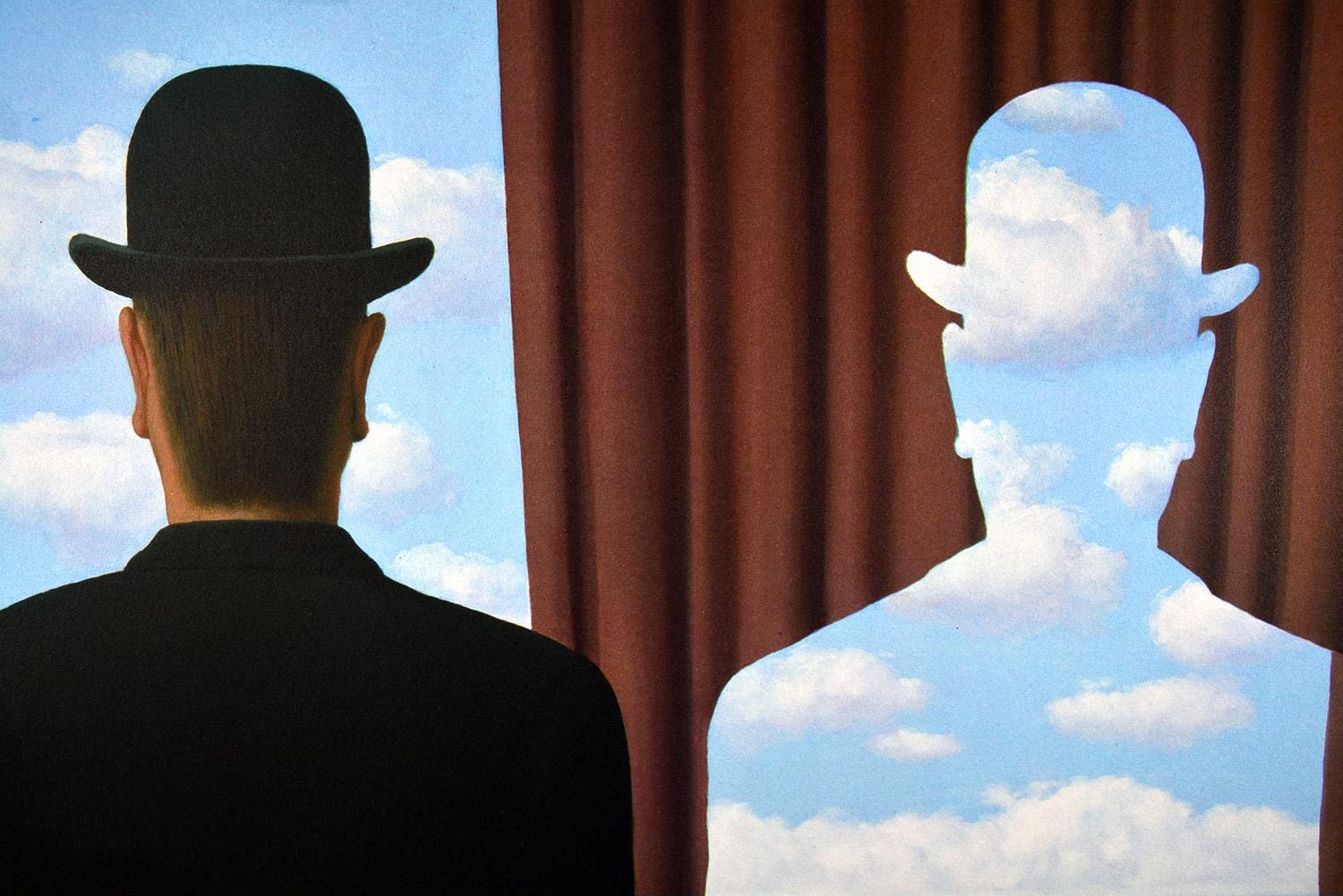
With the advent of the Scientific Revolution in the 17th and 18th centuries, Western culture began the long and messy divorce proceedings dividing matter and mind. Rationalism, which says that reason is the primary source of knowledge, converged with materialism (the idea that nothing exists beyond the material world).
Not only, now, are mind and matter split, but mind is prioritized over matter. Descartes’ “I think, therefore I am,” is a declaration that will pave the way for future behavioralists who believe that “mind over matter” is the key to a successful life. The left hemisphere, with its preference for reason, logic, and verifiable facts— ironically, which can only come from observation of the material world itself!— becomes dominant. This is Jung’s Logos, the masculine principle.
(More about this mind/body, left/right split at the link below:)
For embodied resistance, embrace the radical right (hemisphere)

“When we live outside ourselves, and by that I mean on external directives only rather than from our internal knowledge and needs, when we live away from those erotic guides from within ourselves, then our lives are limited by external and alien forms, and we conform to the needs of a structure that is not based on human need, let alone an individual’s.…
Recovering meaning
“What is split off, not felt, remains the same. When it is felt, it changes! Most people don’t know this… If there is in you something bad, sick or unsound, let it inwardly be and breathe. That’s the only way it can evolve and change into the form it needs.”
–Eugene Gendlin, Focusing
Lest we romanticize too much, let’s be clear that The Scientific Revolution was a necessary and beneficial step in our evolution as a species. I’m a big fan of not dying unnecessarily of preventable diseases. There were, however, some unexpected consequences. In splitting mind from matter, for example, I believe that in some sense, meaning was lost. An overly-rational, or materialistic worldview leaves little room for wonder or speculation about the divine. When we’ve reduced everything to particles and facts, what is left to stir our soul?
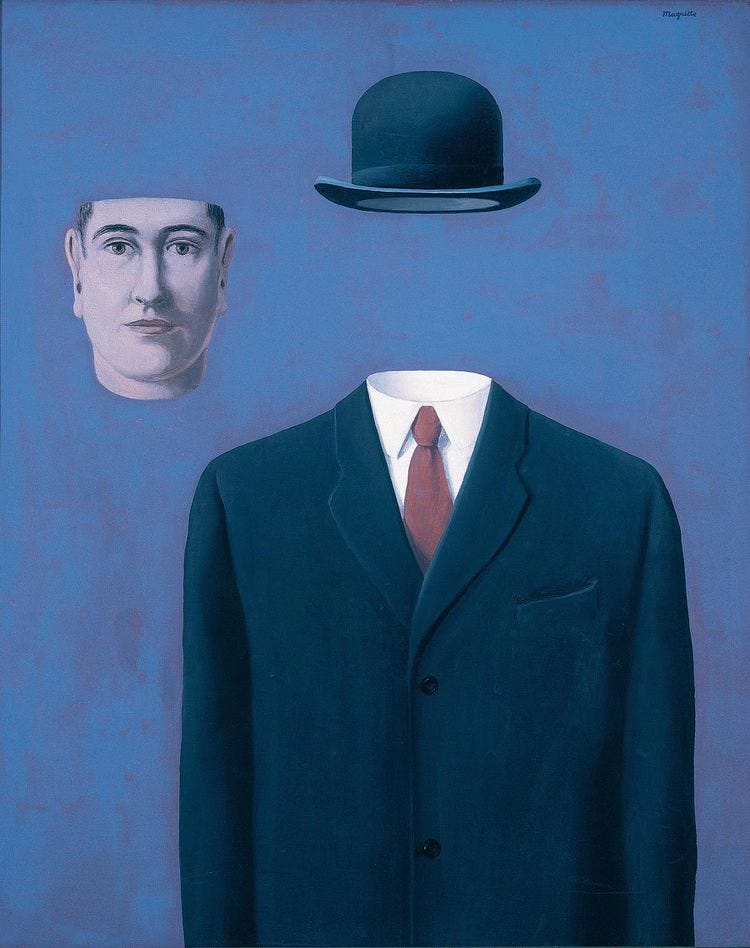
Here we come to Jung, who aimed, in his own way, to restore this split. He wrote extensively about what he called “primitive” cultures1, and how they did not differentiate meaning from matter. He used the term participation mystique to refer to the way in which these cultures “projected” meaning into inanimate objects. Speaking of an individual from this culture, Jung says,
“He lives in such ‘participation mystique’ with his world, as Lévy-Bruhl calls it, that there is nothing like that absolute distinction between subject and object which exists in our minds. What happens outside also happens in him, and what happens in him also happens outside.” 2
Jung suggests that in order to achieve individuation, we must withdraw these projections in order to become more conscious. Yet even this suggestion carries a judgment, coming as it does from a lens that values a left-hemisphere, logical view over a right-hemisphere, experiential one. Perhaps we might say instead that these cultures recognized that the material world has fundamental meaning— and that our role in becoming more conscious is not necessarily to differentiate from it, but to recognize the layers of meaning that are inherent within every dimension of our material experience?
Jung’s Transcendent Function & the mind-body split
“Whatever you experience outside of the body, in a dream for instance, is not experienced unless you take it into the body, because the body means the here and now.”
— C.G. Jung, Visions Seminar
While I may not agree with the language he uses, or the judgment he casts, the ultimate goal of Jung’s individuation process is a reuniting of opposites; a recognition, and integration, of unconscious content to create a greater, more conscious whole.
In other words, Jung asks us to bring mind and matter together to make meaning. He termed the mechanism for this the “transcendent function,” not because it transcends the human experience, but because each opposite can transcend itself to become something new (you can read more about this here).
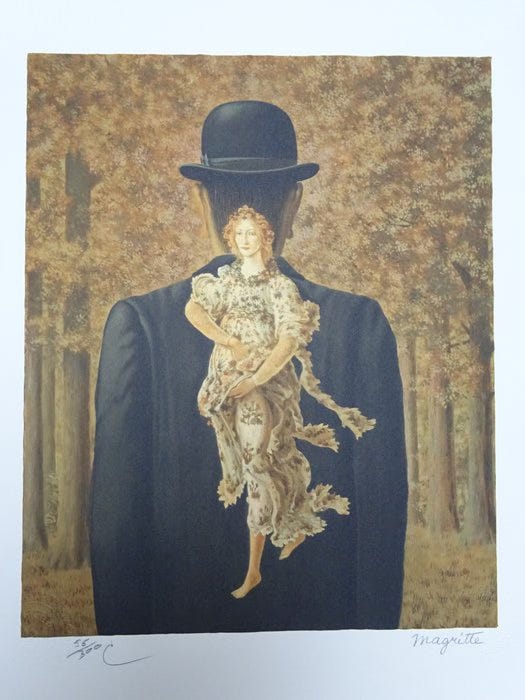
This is also the mechanism at the heart of many somatic modalities, including NARM. We are using our awareness of the body to explore the unconscious attitudes, thoughts, and feelings stored in our tissues. Merely intellectual (left-hemisphere) processes become real when they are experienced through the (right-hemisphere) body. As we bring them into awareness, they can be processed, digested, metabolized into new ways of being; we heal the wound of our mind-body split.
A postscript on somatics— matter matters
The consequences of the great mind/matter split are still unfolding in ways I find fascinating. In researching etymology, I considered the difference between the following:
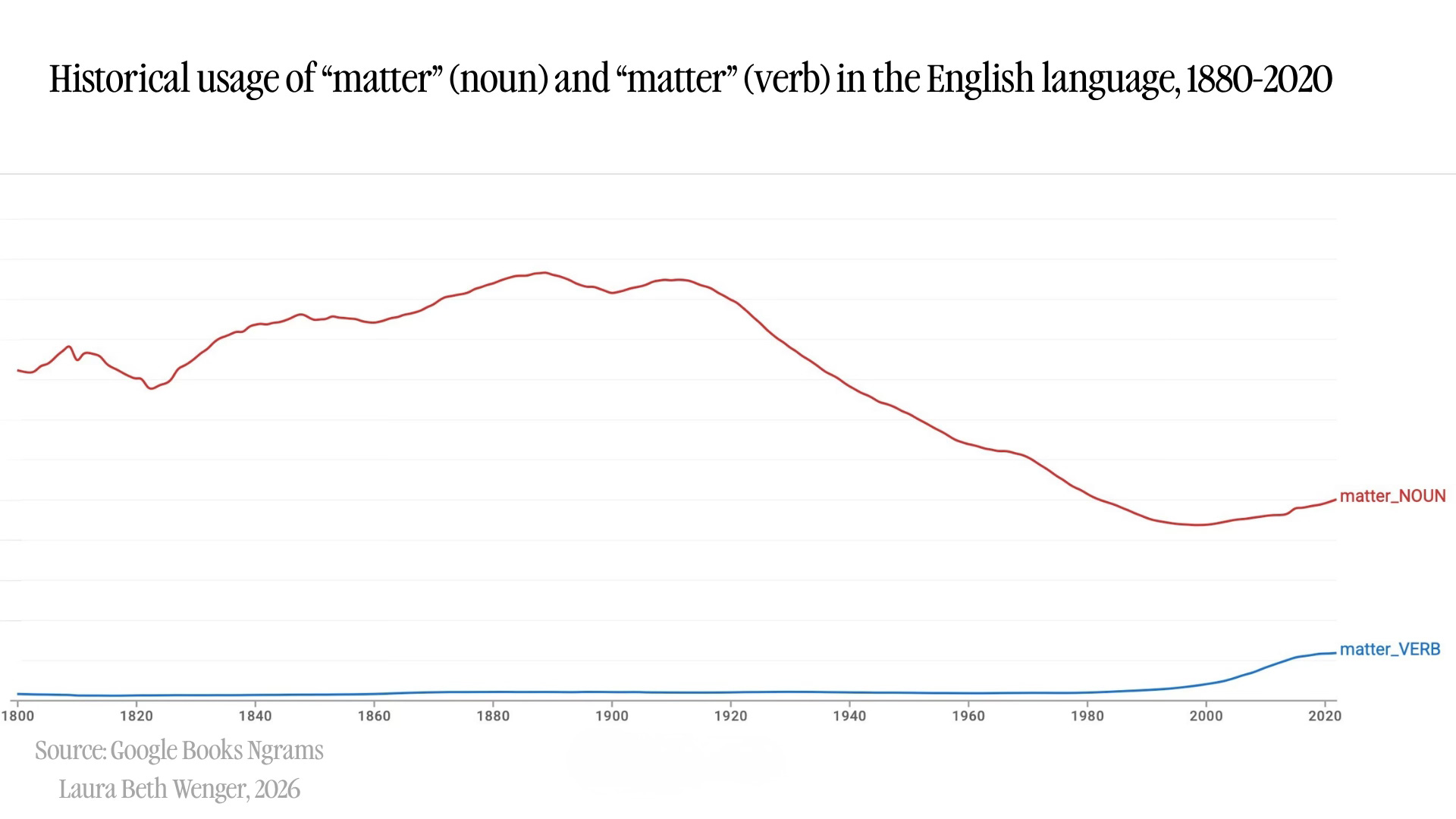
Matter (noun): Physical substance or material that occupies space and has mass, composed of atoms or particles.
Matter (verb): to be important, or to affect what happens.
Now, I’m not at all pretending this is scientific, but just for fun, let’s take a look at historical usage of the 2 (since 1800). Interestingly, use of the word “matter” as a noun has decreased since the 1920s. But sometime in the 1990s, things started to “matter” more, as a verb. What does this mean? I don’t know. But I’ve been holding it in mind as I write this, especially thinking about “meaning.” I think, at least in the English language, we want things to matter more.
This also led me to be curious about the rise of “Somatics” as a field. This graph shows Google trends on searches relevant to the topic. There’s been a massive jump in the past few years, as people are seeking different ways to support themselves:
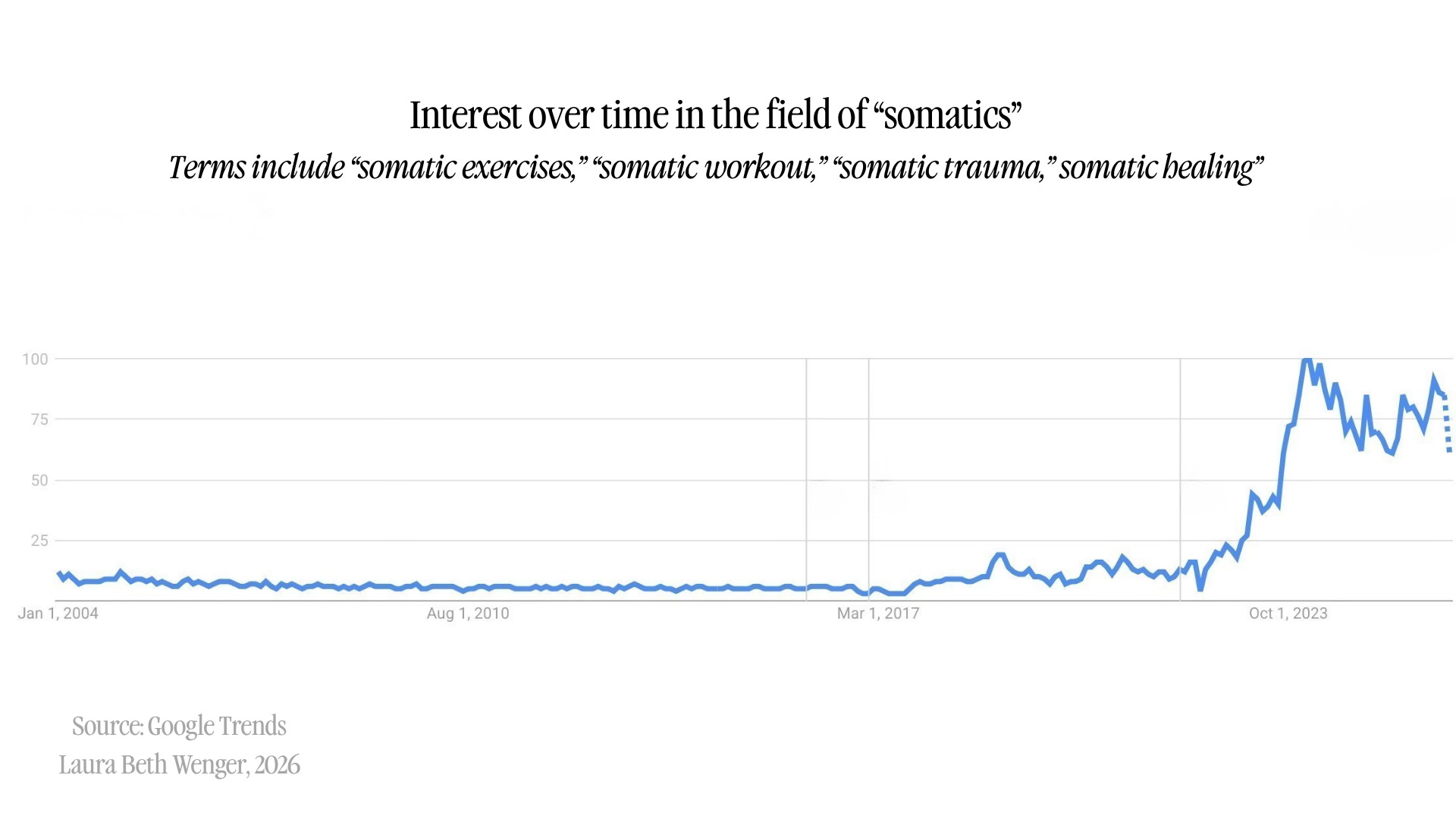
Somatics isn’t a new modality. If anything, it’s the oldest modality. Long before we had words, we had bodies that we moved in instinctual ways. Again, I’m not trying to take us back to the Paleolithic, but just to say: our bodies are designed to support us. We’ve just gotten to a point in our human history where we’ve found a need to codify basic movements and internal awareness.
One of my clients said to me recently, “I had to grow up and pay mega dollars to learn how to do with my body all the things I was told not to do as a kid: shaking, rolling around, fidgeting.” Somatics, like so much of the right-hemisphere’s domain, has been co-opted by our materialistic culture. What was once ancestral knowledge is now commodified, its price point out of reach for the average human.
Returning one last time to that Madonna video— I can’t help but reflect that it takes a wealthy man to cosplay a poor one to win this beauty’s heart, and that is no mistake. The great privilege of the ultra-rich is that they can pretend they don’t care about possessions, declaring, like Madonna herself, that she was never actually materialistic at all. What does it say about our relationship to matter, to the body, to the physical, that the ultimate marker of wealth— what matters most on a collective level— is being able to change your body beyond recognition? The cultural wound cuts deep.
Here one of Jung’s greatest gifts is also one of his gravest errors! He speaks of these cultures in a way that often infantilizes and exoticizes them.
Jung, C.G. The Structure and Dynamics of the Psyche. Collected Works, Vol. 8. Princeton: Princeton University Press, 1960.