


If you want to learn more about how patterns of traumatic stress affect our systems, you might be interested in the upcoming 4-week series on ‘Better Breathing for Trauma I’m cohosting with my colleague and friend Jennifer Snowdon. Read more and register here. Okay, on with the post!
“It is hard for me to follow those who are not experiencing satisfaction in their lives. So much of our ability to be satisfied gets co-opted, manipulated, by other people, by institutions, by systems, that say satisfaction isn’t real, the only thing that matters is survival.”
—Prentis Hemphill, Finding Our Way podcast
Over the past month or so, we’ve been exploring the landscape of the human nervous system. If you want to catch up, you can read about the Window of Capacity here and, for those unicorns who don’t adhere to simple rules, the “Faux Window” of Capacity here.
All of this begs the question— if we ARE stuck in a perpetual state of activation (or, on the flip side, a low-energy state of disconnection)— “What are we supposed to do about it?”
I remember asking a similar question. There was a time, when I was running the yoga studio, that my stress level was so consistently high that my nerves were always jangling. The slightest thing-- a car horn at a traffic light, an unexpected text-- would run through me like a gun shot.
I’d also lost the ability to access any kind of normal range of emotions. At one particular low point, cleaning up after a final evening class, I walked into the front lobby and found an especially disgusting mound of trash spilling out of the bin. Instead of sighing, rolling my eyes, or saying, “oh God, now this,” I found myself reflexively smiling at the trash. Yes, dear reader, you read that right. I actually flashed a fake smile to the trash can because I had trained my system to deal with unpleasant people, tasks, work, with a big old smile to hide my emotional exhaustion. At that moment, standing alone in a yoga studio, smiling at the garbage, I thought, “Holy shit. I have got to change something.”
Homesick for a place we’ve never been
In my Buddhist tradition, we are taught that each of us has an inborn longing to reconnect with our true nature. Like birds know how to return to their nest, the teachings say, we too know how to return to our Buddha nature, our innate knowledge of that place within us where we are fundamentally okay.
NARM speaks in similar language to describe the experience of complex trauma: “It’s like being homesick for a place we’ve never been.” Even though we have lived our entire lives in a state of dysregulation or depression, we still know on some level that there is something else, something better, easier, more satisfying.
Yet if we are stuck in a “Faux Window” of capacity, or just feel like we can’t even imagine what real ease, rest, or satisfaction would feel like, this can be quite tricky— like trying to imagine a color we’ve never seen. We don’t have a map to get there, or a conceptualization to work with.
This can be particularly irritating when we are told that something should be relaxing. Yoga teachers often make the (unintentional) mistake of inadvertently suggesting that students “should” be experiencing something. “This should feel good,” or, even, “Enjoy a few moments in child’s pose.” What happens if it doesn’t feel good, or we can’t enjoy it, or our system just won’t let us relax? I find that students tend to shame themselves, assuming that the problem lies within. Looking around the room during Savasana, if we’re not able to settle our systems, can be an isolating experience. Everyone else can rest, we think. Yoga isn’t for me. Or, worse: I’ll never be able to relax.
I believe that each of us does have a natural “homing” system— this longing to be at home, satisfied, comfortable, at ease with ourselves. While it may be harder for some of us to find our way there, it’s not impossible. And it’s really important that we try.
This is not a luxury. This is our natural state; our birthright. This isn’t something we get to do when we’ve finished our chores, or when we’ve achieved our social justice goals. If we cannot find this kind of satisfaction, in fact, we will never be able to truly help others; we’ll have burnt ourselves out long ago.
A naturally fluctuating system
So— how do we begin to find our way “home?”
Our nervous system responds to stress by providing us with necessary physiological resources (elevated heart rate, stress hormones, etc.) to drive us toward the top or even out of our “window” in order to handle the stressor. After it’s completed, we naturally cycle back downward into our “rest and digest” physiology inside the window.
It’s normal and healthy to be “activated.” A life lived only inside our window of capacity would be incredibly boring, and we would struggle to effect change in ourselves and in our lives. In fact, the ONLY way to increase our window of capacity is to push up against its edges.
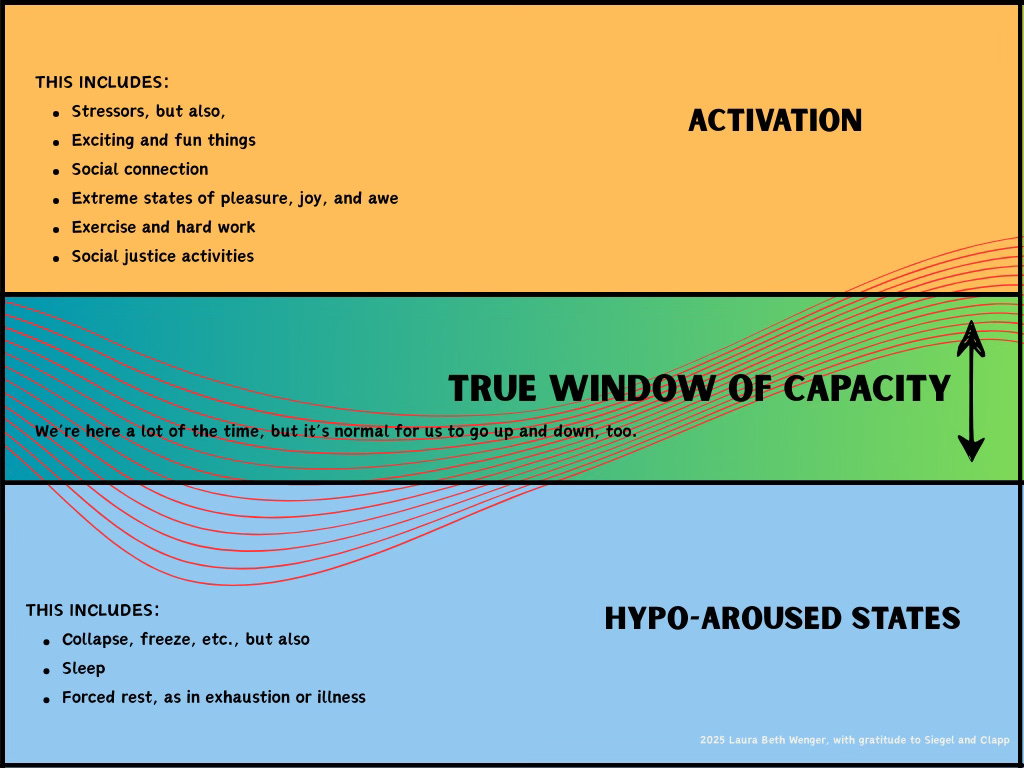
You might recall from this post, in fact, that when we’re training the nervous system, we deliberately introduce a stressor and then allow ourselves to recover from it. The natural cycle is expansion and contraction— or, up, and then down— over and over again.
Still with me? Okay, hang on, because I’m about to tie a few things together.
Your complexes and you
If you happen to be someone who is “stuck” in an activated state, or who struggles to ever feel like you can “sit still;” who “doesn’t know how to have fun;” or who desperately wants to feel joy, pleasure, or satisfaction, but just can’t seem to make it happen, this cycle of expansion and contraction is especially relevant.
Our complexes, as Jung noted, are directly tied to our physiological experience. One of the hallmarks of a complex is that it has a specific “feeling tone.” When we’re in the grip of a complex, we may experience some intense physical responses in our bodies. Or, conversely, we may feel completely disconnected from them, because the complex is running the whole system!
Let’s go back to Laura, circa 2014, smiling at the trash in the yoga studio.
One of my most pervasive complexes is what we might call a “perfectionism and productivity” complex. It has always driven me to do more, to do it better, to work harder, to multitask, to only do something if it has a quantifiable benefit or purpose. This complex is also tied in to my sense of personal value— if I’m not being productive, then I am inherently unworthy. I know many of you can relate.
This complex was so successful, in part, because it worked insidiously with my nervous system physiology in a way that I have seen countless times since in myself and my clients.
The general formula is:
POSITIVE STATE MOVES YOU INTO WINDOW OF CAPACITY → NEGATIVE COMPLEX RESPONSE MOVES YOU BACK OUT
Here’s one variation:
After a long day of work, you sit down to watch a show on Netflix. Your nervous system responds positively. “Ahh!” it says. “Now we’re going to get to relax and really feel good.”
After a while (sometimes immediately!), the complex reacts: “What are you doing? You’ve got stuff to do! You can’t just sit here!”
In this case, the complex doesn’t let us stay in the restful part of the window of capacity, but drives us back out of it, up-regulating us back into activation.
Another common trick of the complex is the shame down-regulation method:
You take some time for a “guilty pleasure” (note the language) activity, like playing a video game or reading a mystery novel. Time passes and you’re enjoying yourself so much I don’t notice.
Finally, the complex breaks through. “LOOK WHAT TIME IT IS. You just wasted an hour on that and you’ve got nothing done. What’s wrong with you? This is why the house is a mess/our life is a wreck/we never meet our goals.”
In this variation, the complex won’t let the individual enjoy the pleasurable part of the window of capacity. It dampens the mood with shame, pushing the individual down into a hypoaroused state of depression.
It’s worth noting that all complexes have a positive and a negative aspect (or “pole,” as we sometimes say). Having a productivity or a perfectionism complex work for us is incredibly beneficial at times.
That’s why our complexes have the potential to bring more balance to our whole system, if we can work skillfully to integrate them. They’re always trying to nudge us one way or another. As we can see here, they actually do that by pushing us into different physiological states— often against our conscious will. But knowing that they can do this is incredibly powerful, as we’ll talk about in the next section.

Microdosing satisfaction
It wasn’t long after Trash-Smile-Gate that I began seeing a somatic psychotherapist. I’d sit on her couch for one hour each week and tell her how stressed I was, how jumpy, how irritable, and that I just couldn’t seem to relax.
It was difficult for me at the time to even settle my system in that very welcoming, safe office. As I got more comfortable, this became a different problem. “I feel good now,” I said to her, tearfully, one day. “But I’m just going to go back out there and get activated all over again!” (Do you recognize the complex, here, saying, “This isn’t working, you’re wasting your time, you shouldn’t even bother”?)
What she said to me then was pivotal:
“It still matters,” she said. “It still counts that you have this hour to feel good, to feel at home in your body.”
I’ve never forgotten this. I came to see that every time I practiced dropping into that sense of ease in my body, I was expanding my capacity to stay there. The more often I came home to myself, the more easily I’d be able to find my way there again. Although I didn’t know it at the time, I was creating new neuronal pathways in my brain, learning how to be comfortable, safe-enough, satisfied.
For some of us, finding satisfaction is no problem. But for those of us who struggle with chronic activation (or hypoarousal), or who ping-pong between the two, never landing in that sweet spot in the middle— we can actively practice what I’m calling “microdosing satisfaction.”
In the video below, I’m setting up these dominos just so I can have the pleasure of knocking them down. It’s sped up, but you can see that I fail the first time, but I keep going. When I finally do get that moment of pleasure, I take a moment to feel it in my body.
What’s not pictured (because it’s invisible) is the thought that comes after: “What a waste of time,” or, “I can’t believe how long that took you.”
Remember our formula? For those of us who struggle with satisfaction, with finding our way “home,” we have to remember that:
POSITIVE STATE → NEGATIVE COMPLEX RESPONSE
This can be tricky to see at first because we’re so used to it it’s almost invisible. Once we start seeing this pattern, though, it can be quite comical in its regularity; our old broken record trying to keep us in line. We don’t need to try to stop it, or do anything with it (in fact, the more we try to shut it down, the louder it gets)— just acknowledge it. That’s enough to start to make change on its own.
Choose your own adventure
So what do you actually DO to “microdose satisfaction”? You don’t need to go buy dominos, unless you want to. Remember, we’re not trying to make big, sweeping change— we’re looking for tiny moments that feel good in our body and nervous system, and letting them accumulate over time.This might be a first sip of morning coffee, with an extra pause to notice how much you enjoy it. Or a really funny meme that you text to a friend. Or a moment, petting your cat, feeling its velvet fur under your fingertips.
Activities I’ve done with clients that feel satisfying include:
Bouncing a ball in perfect rhythm for as long as we can
Putting a puzzle together, savoring that moment of perfect fit!
Creating a doodle drawing or coloring a mandala
Learning a new skill or choreography
Taking a walk and feeling how our arms swing with the opposite leg
It is not, as they say, rocket science. In fact, it’s so damn simple that the biggest challenge is our complex telling us, “that’s a waste of time.”
Did you notice that voice coming up as you read through the last few sentences? If so, see if you can just notice it, rather than identify automatically with it— and then you can make a choice.
Is it really a waste of time to experience satisfaction in your life? Or is this the way we finally start coming home to the lives we’re meant to live?
Love the idea of microdosing satisfaction, without saying it's a waste of time! Why waste that moment!