


“One of the great problems of history is that the concepts of love and power have usually been contrasted as opposites—polar opposites—so that love is identified with a resignation of power, and power with a denial of love…. What is needed is a realization that power without love is reckless and abusive, and love without power is sentimental and anemic. Power at its best is love implementing the demands of justice, and justice at its best is power correcting everything that stands against love.”
—James Baldwin, “Where Do We Go From Here?”1
Sometimes, when I sit down to write this weekly letter, I feel a kind of wild despair. How do I get these thoughts and feelings out of my head and into some kind of organized shape? How can I translate these abstract blobs of experience into a language that expresses something clearly?
As I sat here this morning staring at this screen (and then again, off into space), it occurs to me that my personal struggle mirrors the larger issue humanity is facing: how do we bring our two split halves back together?
I’m not speaking here necessarily of the political Far Left and the Far Right (though we will see that they do line up rather nicely), but of the masculine and the feminine principles that should be balanced in each of us: Eros and Logos.
Eros is less verbal. It relates to the body, love, relatedness, abstraction. It uses our right-hemisphere brain; it values feeling; it sees the big picture. It is potentiality, and the principle of connectedness.
Logos, the masculine principle, has to do with the mind, power, discernment, clarity and directedness. It is left-hemisphere thinking, seeing in details and parts. It is the principle of force.
The act of writing— like any creative act, like conception itself!— requires both principles in equal measure.
Power out of balance
“Where love reigns, there is no will to power, and where the will to power is paramount, love is lacking. The one is but the shadow of the other.”
—CG Jung, CW 7, par. 78, “The Problem of the Attitude-Type”2
We are living in a time where the principle of power is dominant. Where a blatant lie can take precedence over a truth; where the tools of technology are used to alter the reality of our lives. Where wars and divisiveness are the norm, and relationality and compassion are decried. A man held the door for me the other day at a local store. Our eyes met, and I smiled as I thanked him, before glancing down at his shirt. “Wokeness leads to weakness,” it said. Power split from love.
Carol Gilligan (whose groundbreaking work demonstrates how young boys are taught to be “heroic,” detached and unempathetic, while young girls learn to be selfless and nurturing), explains that
“If you want to elevate one group of people over another, you have to undercut our relational capacities as human beings. You have to stop the person at the top from feeling empathy for the people at the bottom.”3
How familiar this feels.
Love and power together
“(C)ultural values do not drop down like manna from heaven, but are created by the hands of individuals. If things go wrong in the world, this is because something is wrong with the individual, because something is wrong with me. Therefore, if I am sensible, I shall put myself right first.”
—CG Jung, CW 10, par. 329, “Civilization in Transition.”4
It’s unusual for me to write so much about Eros— I tend to focus on cultivating power, Logos. This is because for myself— and for many of my clients, and readers— Eros is already predominant. Instead, it is our power that lives in our personal shadow, which needs to be reclaimed so we can become more whole.
This is critical work: as Baldwin says, “love without power is sentimental and anemic.” To simply lament how evil the “other” is without addressing our own imbalance is nothing short of hypocritical.
At the same time, in the larger culture, it is the principle of Logos that has been dominant— and yet, Eros is pushing back in a way that is clearly threatening.
Take, for example, the 2026 US Super Bowl Half Time show— an event so threatening to white patriarchy that an alternative had to be provided. The performance itself was Eros on full display: art, music, multicultural expression, intergenerational connection, and that clear sign, stating simply, “The only thing more powerful than hate is love.”

The statement itself, though, is paradoxical. According to our definition of Eros, love on its own is not power. It is relationship, connection, and creative potential. The Super Bowl Half Time show was such an impactful experience not due to Eros alone, but because it combined the power of Logos— planning, organization, direction, purpose, thinking— with the connecting, feeling relationality of Eros. The same is true of the Minnesota anti-ICE protests. Eros alone cannot effect change. The Beatles said, “All you need is love,” but in truth, we need power combined with our love to generate something new.
I like the way James Hollis suggests we think about this for ourselves:
“(R)egardless of one’s sexual identity, we all have two tasks: nurturance and empowerment, whether you’re female or male. You have to always be asking yourself, what nurtures me? What feeds me and supports my journey and what opposes it? And secondly, what is my empowerment? How do I get permission and the courage to risk taking my life into the world and engaging that risk?”5
Protecting oneself from emotional contagion
In Buddhism, Eros and Logos could be seen as the concepts of “emptiness” and “clarity.” Emptiness refers to the fact that all phenomena are inherently non-existent, pure potential. Clarity means that anything can arise within that potential. Eros and Logos could also be stated as prajna (wisdom, feminine) and upaya (method, masculine). The union of the two is shown as syzygy, yab-yum, two deities in union. Images like this one helped Jung to arrive at his conceptualization of the two principles.
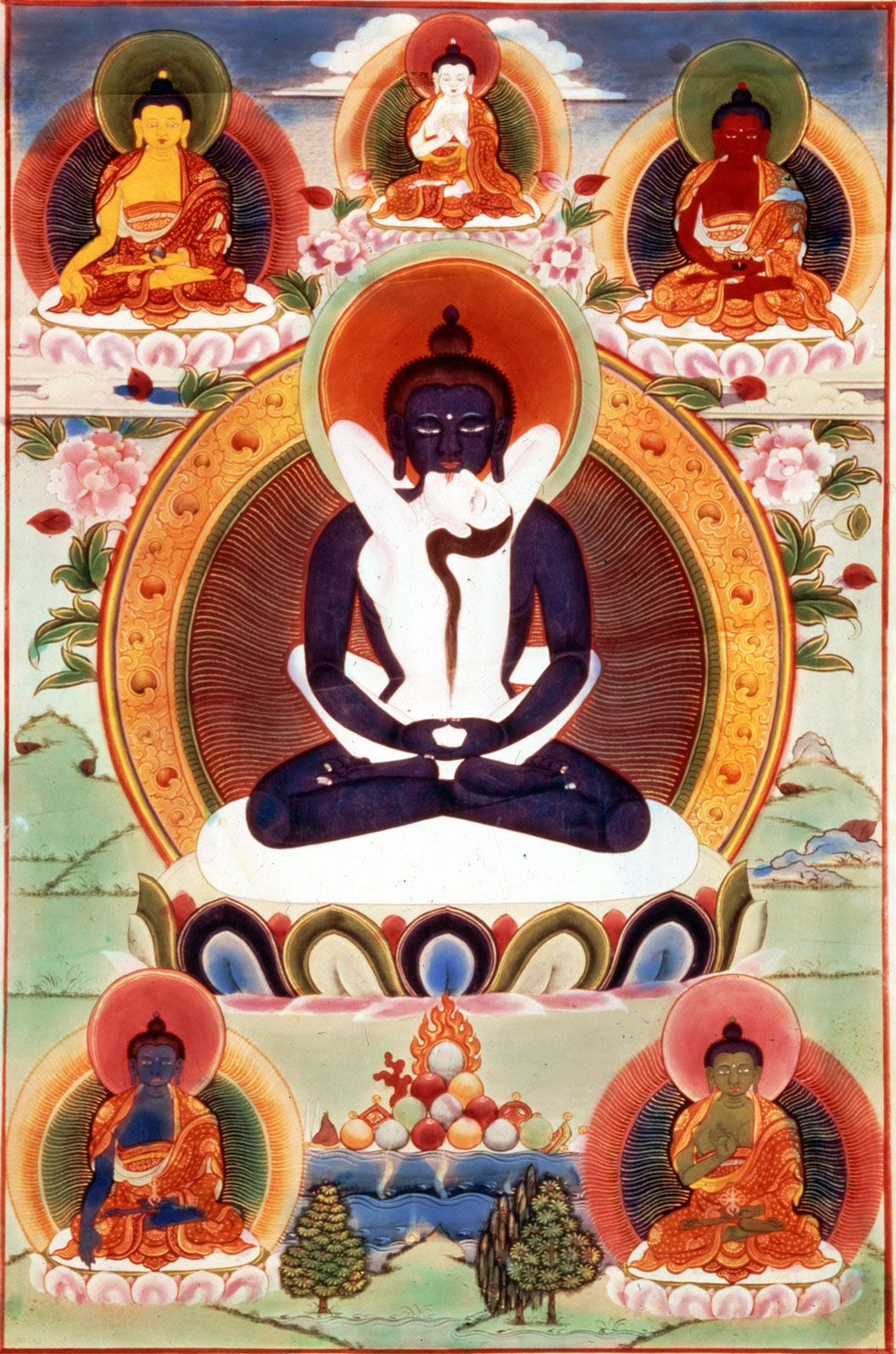
Mingyur Rinpoche, my primary Buddhist teacher, frequently says, “the best protection is no protection needed.” Perhaps he means by this that when we understand that reality is inherently empty, and that anything can arise within it— your most heartfelt wish, or your deepest fears— we no longer need to grasp so tightly to our sense of safety. And when we understand ourselves as dynamic beings, an ever-fluctuating interplay of masculine and feminine, endlessly creating new possibility with one another, we can both take ourselves less seriously, and recognize the potential impact of our actions in an interdependent world.
There is no opportunity to stand apart from the rising tide of danger we are in as a species. We can attempt to avoid the news, or social media, but simply leaving our house or picking up our phone subjects us to the swirl of others’ anxieties and fears. If we are ourselves uncertain, we are more vulnerable to emotional contagion, getting swept up in mass emotions we never intended.
“The best protection" we can find is to cultivate an awareness of ourselves, especially that which lies in our own shadow. By growing familiar with those less comfortable, younger, awkward parts of ourselves, we become more whole. We are less fearful. We are more effective agents for change.
The questions Hollis suggests above are a good starting point:
What nurtures me? What needs me and supports my journey, and what opposes it?
What is my empowerment? How do I get permission and the courage to risk taking my life into the world and engaging that risk?
I look forward to hearing where this takes you.
Until next time!
xo,
Laura
Baldwin, James. “Where Do We Go from Here?” Speech presented at the 11th Annual Convention of the Southern Christian Leadership Conference, Atlanta, GA, Aug. 1967.
Jung, Carl G. Two Essays on Analytical Psychology. Translated by R. F. C. Hull, 2nd ed., Princeton University Press, 1966.
Green, Penelope. “Carefully Smash the Patriarchy.” The New York Times, 18 Mar. 2019, www.nytimes.com/2019/03/18/style/carol-gilligan.html.
Jung, C. G. Civilization in Transition. Translated by R. F. C. Hull, Princeton UP, 1970. The Collected Works of C. G. Jung, vol. 10.
Hollis, James. “Spectral Visitants: The Place of Dreams in Therapeutic Praxis and Personal Life.” Oregon Friends of Jung, 27 Sept. 2025, Portland, OR. Lecture.