


Upcoming Events:
We’re down to the final two spaces remaining for Jungian Somatics- Movement For Trauma with Jane Clapp & Laura Wenger (starts 9/9)
Now open for registration: Better Breathing for Trauma w/ Jennifer Snowdon (& me!) 10/4.
Jungian Somatics Dream Method- 2 day online immersion this fall
“Dreams are the impartial, spontaneous products of the unconscious psyche, outside the control of the will. They are pure nature; they show us the unvarnished, natural truth, and are therefore fitted, as nothing else is, to give us back an attitude that accords with our basic human nature when our consciousness has strayed too far from its foundations and run into an impasse.” (CG Jung CW 10, par 317).
In my last post, I talked about how dreams can be an important source of information from our unconscious mind. But how do we begin to understand the cryptic messages they send? What does it mean to dream that you are being chased by a tiger on a bicycle? Why is your great-aunt Essie baking a mud pie in your backyard? And what does it mean that you cheated on your partner… with your boss?
While dreams can be incredibly complex and mystical, there are a few key concepts that are invaluable in helping to understand their messages. Even if you never want to “work with,” or interpret your dreams, I find that understanding these basic concepts of Jungian dream interpretation can alleviate much of the shame and fear that surrounds our dream life. When we understand that dreams aren’t literal, and that they are often quite helpful, we can be more curious and interested in what they have to say.
1. Dreams aren’t literal; the language of dreams is symbolic.
Speaking through our dreams, our unconscious mind uses symbols to represent concepts that hold layers of meaning specific to each of us. Jung said, “a symbol is the best possible formulation of a relatively unknown psychic content.” In other words, your unconscious is speaking to you as clearly as it can, using the same part of our brain that understands symbolic imagery. This brief TED talk on the art of the metaphor may be helpful in understanding why that’s such a powerful means for communication.
When we dream of flying, it’s not likely that we’re going to sprout wings, but that we may be “flying high.” Giving birth in a dream may not mean we are going to become pregnant, but that there is something new in us wanting to come to life. Driving a car very fast doesn’t mean that you’re going to get a ticket, but it might be telling us something about being out of control.
Similarly, people that appear in your dreams may represent the actual person (an objective interpretation), or they may represent something in your own psyche (a subjective interpretation). Often, they could be both. You may find this helpful when considering your own dreams so that you don’t get hung up on the individual details: think of people as symbolic as well.
Finally, if you’re dreaming about sex, murder, death, or defecation— please don’t stress. These are all common themes in dreams, and generally are symbolic for ways of dealing with parts of ourselves and our lives (such as integrating something new, letting go of something we don’t need, or dealing with unwanted or uncomfortable material). Relax— you’re totally normal.
2. Dreams show us a more complete viewpoint of our situation.
“In each of us there is another whom we do not know. He speaks to us in dreams and tells us how differently he sees us from the way we see ourselves. When, therefore, we find ourselves in a difficult situation to which there is no solution, he can sometimes kindle a light that radically alters our attitude.” (CG Jung, CW 10, para 325).
Our conscious mind is only part of our entire psyche. In the diagram below, we can see that the top half of the circle represents our conscious mind, where our persona operates, and our ego is most active. The bottom half of the circle represents the unconscious mind, which is active during dreamtime.
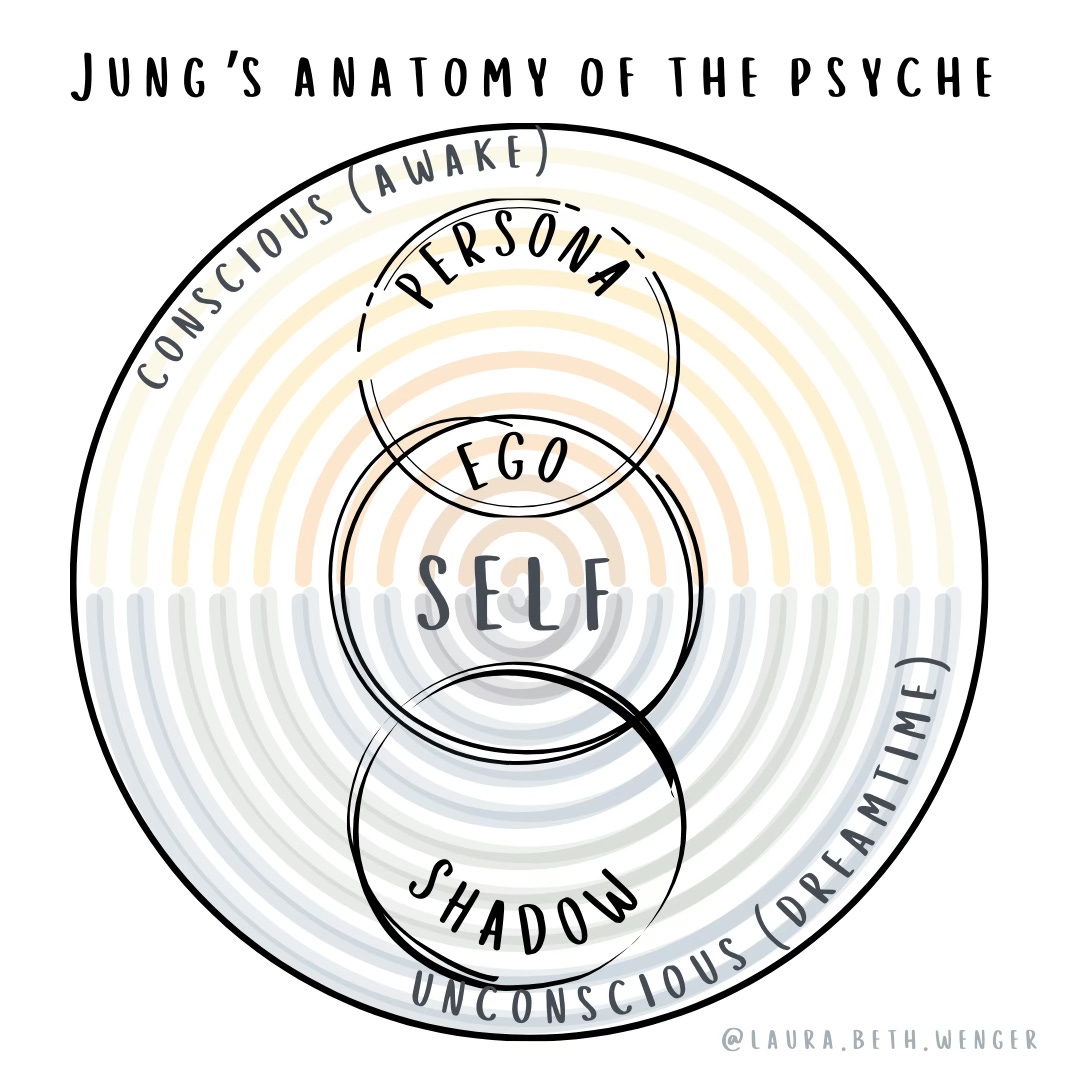
The function of dreams, according to a Jungian interpretation, is to help us to become more balanced, expanding our point of view to show us our current psychic situation as it sees it in the moment. Looking again at the diagram, our psyche is trying to expand our circle of awareness— our ego— to include more of the unconscious material, the shadow.
Imagine you have a friend who is taking pictures of you when you’re not looking, and then showing them to you later— you will see angles that you wouldn’t have been able to see yourself. We may not find the images flattering, or we may find that there are some unexpected glimmers we hadn’t noticed.
One way that dreams do this is through compensation, in which a dream shows an exaggeratedly opposite viewpoint— for example, if we have a colleague on a very high pedestal, our dream might show us that colleague on their knees in the mud, or collecting trash, to help balance our one-sided conscious view.
Dreams also function by complementing, adding missing pieces that our conscious mind is missing. An example here might be dreaming that we are able to do something that we’ve thought we wouldn’t be able to do in our waking lives— acing a test or speaking brilliantly in front of a crowd.
In either case, dreams do not generally tell us things we already know. If something in a dream seems quite obvious, it is worth pausing and reconsidering as there is generally something we’ve been missing. As Marie-Louise von Franz said, “Dreams don’t waste their own spit.”
A note of caution on “prophetic” dreams— while it is possible that we may receive information from our dreams that we may not consciously be aware of, and which can be helpful, we should be mindful not to treat our dreams like some sort of Ouija board or oracular device.
On this topic, Jung said: “It would be wrong to call [dreams] prophetic, because at bottom they are no more prophetic than a medical diagnosis or a weather forecast. They are merely an anticipatory combination of probabilities which may coincide with the actual behavior of things but need not necessarily agree in every detail… a dream results from the fusion of subliminal elements and is thus a combination of all the perceptions, thoughts and feelings which consciousness has not registered because of their feeble accentuation” (CW 8, par 493).
3. Your personal associations are the ones that matter.
Let’s say you have a dream of a white stallion galloping onto a freeway. Your first inclination may be to google “white horse symbolism.” Stop right there, dreamer. The most important associations to a symbol are the ones you hold in your own psyche.
Rather than turning to the internet or a dream dictionary, the first thing we should do is to ask ourselves, “what does a white stallion mean to me?” Write down any associations you have. Perhaps for me a white stallion represents beauty, freedom, strength. But another person might recall being thrown from a white horse when they were young, and have a sense of terror at the image. If you get stuck with your dream imagery, you can ask yourself, “if I had to describe this symbol to someone from another planet, how would I explain it?” This can help to elicit more information.
When you’ve exhausted your own associations, then it may be helpful to turn to a symbol dictionary (like this one), or to spend some time reading or researching the image to see what feels impactful to you. Mythology, movies, and other information from the collective can be helpful in what Jung called amplification— helping us to better understand what the symbol may mean.
Finally, this leads to a final and crucial point. Your dreams are specifically yours, created just for you. Be cautious about taking in others’ thoughts and interpretations of your dreams. One hallmark of a “correct” dream interpretation is that you will have a felt sense of “aha! That’s right!”— it hits home in a satisfying way, like a piece of a puzzle sliding into place.
I hope this has been helpful as a scaffold to better understand how to look at dreams from a Jungian perspective. In my next dream post, we’ll take a look at some specific steps you might take to work with your own dreams. I’d love to hear any thoughts, questions or comments you might have— please let me know!
Ah yes. I have that one.
Thank you! What’s your favourite symbol book?