


Not long ago, I had to make an appointment to arrange a background check for myself. From the moment the man barked at me on the phone, to the brusque way he muttered, “Two-hundred-dollars-you’re-done” after he took my prints and information (I had to say, “What?” twice to him to understand that he was asking for payment), the man’s interaction with me positively fascinating. There was no attempt at all at showing care. Let me be clear: it didn’t feel rude to me.1 He was simply so completely uninterested in making me feel comfortable in any way that it was kind of… great. It didn’t feel personal, or even problematic— but it made me recognize, by their absence, the countless (hundreds?) of micro-actions (body language, postural mirroring, tone matching, explanations, a little humor, a just-right touch when picking up another person’s hand) that would have performed, had I been doing his job.
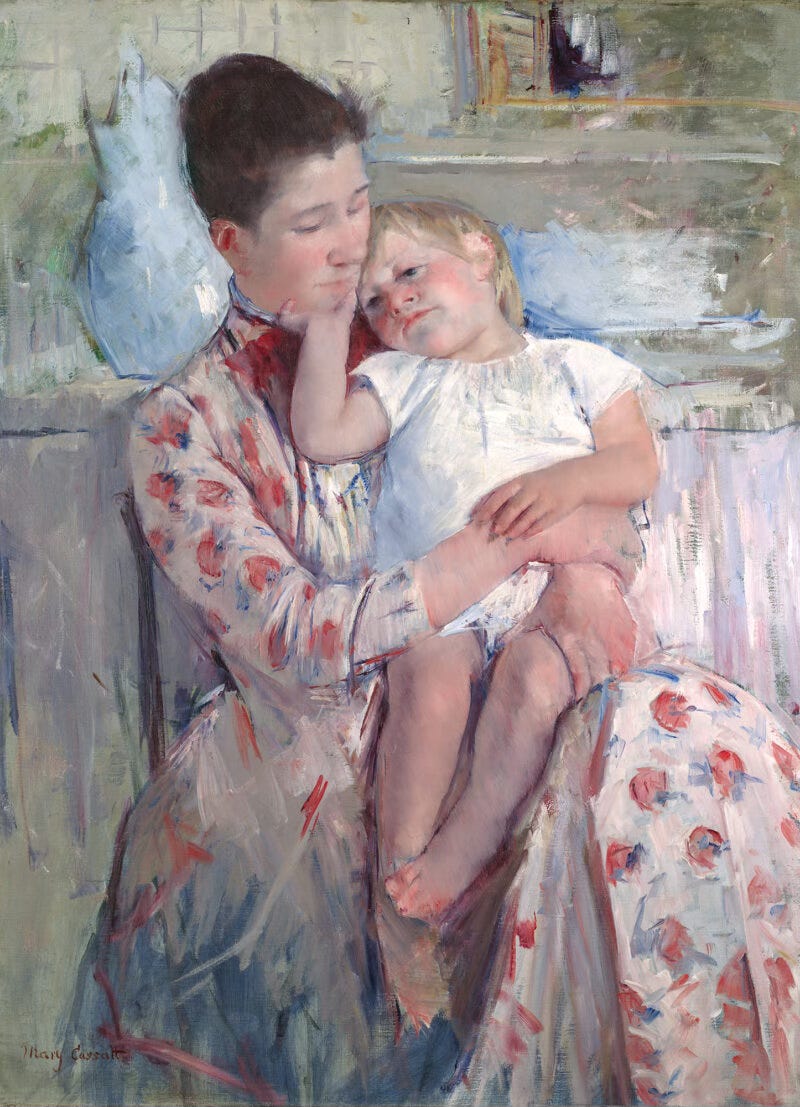
Some of us seem to “care” more than others
I’ve been thinking a lot about the uneven burden of caring, or maybe I want to call it feeling, in our current culture. So many of my colleagues, clients, and friends, who are highly sensitive, intuitive, emotionally intelligent humans, are in distress (emotional, psychological, and even physiological) given the horrors of our daily news (concentration camps, critical medical and food aid decimated, freedom of speech denied, the rolling back of basic human rights, the destruction of the most basic environmental safeguards). “If I don’t care, who will?” they say. And well-intentioned liberal social media shrieks at all of us to say more, do more, you cold, unfeeling bastards— although the only people they’re reaching are the ones who already feel too much, and who are being crushed under the weight of their helplessness.
Some of us do feel more, or care more, than others, at least consciously. And then too many of us feel guilty about it, as though, by being affected by the atrocities of the daily news, we’ve done something wrong. We accuse ourselves of having inadequate boundaries, being too much of a sponge. We may have learned to hate ourselves for what we think of as our people-pleasing, or fawning attributes— but deep care, authentic feeling, isn’t necessarily synonymous with a “trauma response.” We can be good at feeling, and at reading and responding to others, without it being some kind of pathological trait, or diagnosable problem to be solved.
(In fact, I have to add, “people pleasing,” or fawning, like any trauma response, is a healthy response to an unhealthy situation— rather than being maladaptive or problematic, it’s a highly adaptive survival skill). The shame that is so often associated with being able to meet others’ needs in this way is rooted in our culture’s derogatory attitude toward the feminine, which it associates with relational care. But more on that later.)
Who does the work of caring in our culture?
Just as our own psyches are always working toward balance, any relationship, or group, or system will move toward balance, too. That’s a nice way of saying it, but we could also say: we compensate for each other. If numbers aren’t your strong suit, you might ask your partner to balance the checkbook. In a political system, one party might feel strongly that it has to care for human rights, while another is strongly concerned with the erosion of core values. Systems want to move toward balance.
In thinking about this, I revisited an old post I wrote about emotional labor (“Dissociation for hire”), where I found this quote from sociologist Arlie Russell Hochschild says that “(emotional labor) requires one to induce or suppress feeling in order to sustain the outward countenance that produces the proper state of mind in others—in this case, the sense of being cared for in a convivial and safe place. This kind of labor calls for a coordination of mind and feeling, and it sometimes draws on a source of self that we honor as deep and integral to our individuality.”
I was also drawn to research about “affective labor,” which is not the same thing:
Affective labor is “is labor that produces or manipulates affects2.... One can recognize affective labor, for example, in the work of legal assistants, flight attendants, and fast food workers (service with a smile). One indication of the rising importance of affective labor, at least in the dominant countries, is the tendency for employers to highlight education, attitude, character, and "prosocial" behavior as the primary skills employees need. A worker with a good attitude and social skills is another way of saying a worker is adept at affective labor3.”
The cultural labor of “caring”, to me, while not quite answered by either of these, seems to overlap with both emotional and affective labor; it draws on similar skill sets, or characteristics. Or at least, in my mind, there’s a Venn diagram of the three, and the people in the middle are pretty tired.
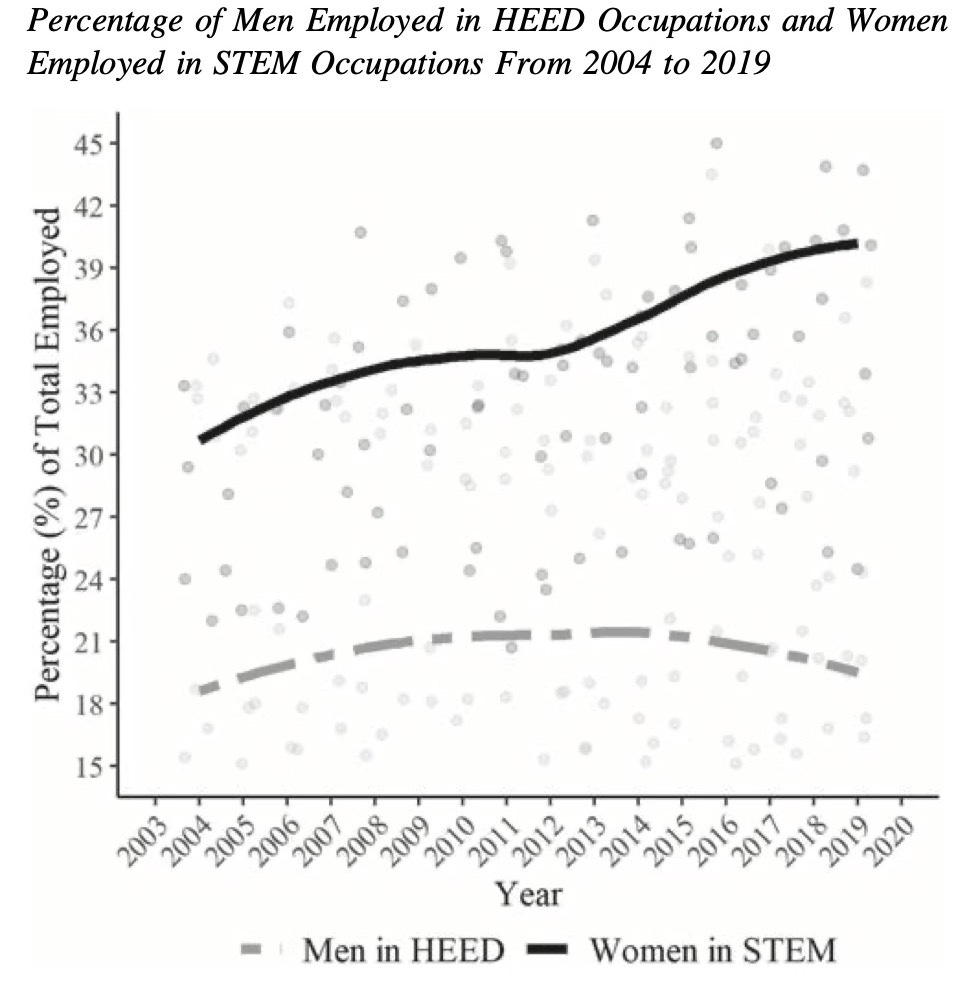
The diagram below is from an article entitled “Gender Segregation in Culturally Feminized Work: Theory and Evidence of Boys’ Capacity for Care4. While it’s cool to see that more women have entered STEM (Science, Technology, Engineering and Math) professions, it’s also powerful to see that fewer men have entered HEED professions (Health Care, Early Education, and Domestic roles). These roles continue to be “feminized”— and lower-paid. HEED roles are caring roles, in which both affective and emotional labor are implicit.
Caring work and the devaluation of the feminine
The groundbreaking work of Carol Gilligan5 demonstrates how, within patriarchal cultures, men and women are acculturated to think about morality in different ways. At early ages, we are indoctrinated into gender roles that dictate our behavior. Men, she says, are taught to prioritize individualistic, logical thinking, while women are taught to value interpersonal relationships and care. At the same time, she demonstrates, girls are penalized for not scoring well on classic morality tests, because they were designed for men.
If this masculine/feminine split sounds familiar, that’s because it is. The “masculine” values align with what Jung called Logos, which he said was concerned with “discrimination, judgment, insight.6” By contrast, he referred to the “feminine” as being primarily associated with relating and wholeness7. Jung’s theory was that the masculine and feminine are principles that should exist in each of us, apart from gender. But our culture— like Jung himself, occasionally— often conflates the two. We
Just as young girls are penalized for not getting morality “right,” so are women penalized by our patriarchal culture, as demonstrated by the pay differential between STEM and HEED work. And the feminine, as a whole, continues to suffer:
“…the gender binaries and hierarchies of a patriarchal order compromise basic human relational capacities. By splitting reason (masculine) from emotion (feminine), the mind from the body, and the self from relationships, the binaries undercut our ability to think about what we are feeling, to know what is happening in our body, to stay in touch with other people, and thus to navigate the human social world. By doing so, they set the stage for and justify the hierarchy that privileges the masculine over the feminine (reason over emotion, the self over relationships, justice over caring). At once idealized and devalued, the feminine falls, in effect, off the map of human experience.”
—Carol Gilligan, In a Human Voice
The cost of caring
Our culture needs care work, in every sense. It needs parents to attune to their babies, or they will die. It needs HEED workers to tend to our children, and our elderly, and the domestic tasks of daily living. And yet this feminized work is devalued; paid wages so low that many of these laborers must work more than one job to survive.
We also need humans to care about the larger web of relationships; to understand that it matters— more than I can express— how we treat each other; that human rights are upheld; that our natural resources be preserved; that our non-white, or non-Christian, or non-dominant-caste neighbors are valued equally.
And yet, I think, it also matters that, if we are someone who is really, really good at relating to others, at caring for others, at responding to others— that we make sure that we’re not unconsciously trying to compensate for other’s lack of care. Imagine a relationship (you probably won’t have to think too hard, if you grew up in a patriarchal culture) where one partner is always doing the care work; the other partner does none. It’s important, for the relationship to survive, that one person isn’t compensating completely for another’s deficits. We must hold each other accountable— with kindness and clarity— for the work of caring.
For me, personally, this means that when I think about the suffering of the world, I am not saying to myself, “I have to care, because nobody else does.” This kind of emotional martyrdom is not only ineffective, it’s self-destructive.
The truth is that I know most Americans (and plenty of our overseas neighbors) care, a LOT, about what’s happening right now; opinions are shifting. Those of us who were “born to care” can and should continue to care deeply; but we owe it to ourselves not to burn out; and we owe it to others the opportunity to show their care, too.
If I had the sense that he knew how to do those things, or that he felt they were meaningful, and was deliberately denying me that experience, I might have felt he was being rude. This was not that.
“Affect” here, for those who aren’t familiar with the term, refers to emotion, feeling, or mood. So, affective labor is concerned with helping other people feel better.
Michael Hardt and Antonio Negri, Multitude: War and Democracy in the Age of Empire (New York: The Penguin Press, 2004), 108.
Puzio, Allison, and Talia Valshtein. “Gender Segregation in Culturally Feminized Work: Theory and Evidence of Boys’ Capacity for Care.” Psychology of Men & Masculinities, vol. 23, no. 3, 2022, pp. 271–284. https://doi.org/10.1037/men0000397.
I highly recommend her brilliant and easy-to-read books: In a Different Voice ; Why Does Patriarchy Persist (with Naomi Snider); and In a Human Voice.
Carl Gustav Jung. “The Personification of the Opposites.” Collected Works of C. G. Jung, vol. 14, edited by Gerhard Adler and translated by R. F. C. Hull, Princeton UP, 1970, pars. 224f.
While Jung did, at times, struggle with Logos, Eros, and actual human gender, his underlying theory is that the principles of Logos and Eros exist in both men and women, and that our goal is to balance them more evenly in each. In this sense, when I reference “the masculine” or "the feminine” it is separate from gender. In fact, it is the conflation of these with gender that is often problematic in a patriarchal culture.
Per usual, I love the way you put your thoughts and feelings here…it’s palpable and so very important to be seen. Thank you.
This one hits close for me and gave me a lot to consider, pertaining to my own personal experiences and in the greater world.
It feels like we are losing touch with caring and kindness. Some of it is from too much technology and screen time; we've forgotten about eye contact. And human touch was impacted by the pandemic and where our breath, shaking hands and hugging became threatening to our well-being. We have not recovered from the distance we created. And with the onslaught on the daily horror show of our political system dividing and conquering, care and kindness is not respected in our cruel world. We can continue to do our part in small ways reaching out and touching the heart and soul of humanity, one connection at a time. It makes a difference. ❤️