


Upcoming Events:
A Few Spaces Remaining For Jungian Somatics- Movement For Trauma with Jane Clapp & Laura Wenger (starts 9/9)
Jungian Somatics Dream Method- 2 day online immersion this fall
I was tempted to subtitle this, “The Shocking Truth Big Pharma Doesn’t Want You To Know,” both to be funny, and actually, because it’s true. This piece is one of the most important ones I’ve ever written, IMO. I hope you’ll give it a read and share it with someone— it really will change how you think about “research.”
Our culture places a high value on science, logic, and rationality. Although I think we often lean too far into this left-hemisphere thinking (to the exclusion of embodiment, intuition, and anything that can’t be “proven”), there’s no denying that science and reason have helped us to advance tremendously as a culture.
Still, I think there’s a bit of a catch here, and it’s a big one. As consumers, we’ve become complacent, lured into a false sense of comfort by phrases like “studies show,” or “evidence-based.” What we fail to recognize as laypeople is that the science presented to us in the form of clinical trials and research studies does not necessarily reflect the objective and fair observation process we might expect.
For example, many of us may not know that research scientists are not required to publish the results of their unsuccessful studies.
Timothy Scott, in his revelatory article “Tricks of the Trade,” tells us:
“If ‘32 double-blind studies’ found Effexor worked well, it is likely that approximately 38 double-blind studies found Effexor did not work better than a placebo or found that the placebo was more effective than the antidepressant. That estimate is based on information gained from an analysis of all drug studies submitted to the FDA, which were responsible for the approval of various selective serotonin reuptake inhibitors (SSRIs).”
In other words, we are only presented with the information from those trials that showed that the drug worked well— we never even know about the failed efforts. Take a minute and consider that— wouldn’t that change how you thought or felt about a drug? If it succeeded 32 times and failed 38— that’s not a great track record!
Beyond Bias
Most of us probably are aware that these trials are often sponsored by pharmaceutical companies that have a vested interest in their drugs performing well enough to be approved. There’s tremendous pressure on the researchers to outperform the alternative in these studies, and they do this in some pretty sneaky ways.
One common practice is to either increase or decrease the competing dose to a higher amount (causing more side effects), or a lower amount (making it less effective) than would be given in actual practice. So, hypothetically, if researchers are attempting to prove how well their new drug stands up against Tylenol, they might give just 1/4 of a Tylenol tablet to the control group— far less than the bottle suggests you take. You might be thinking “there’s no way this happens,” but you can read about it here (NSAID trials) or here (psychotropic trials).
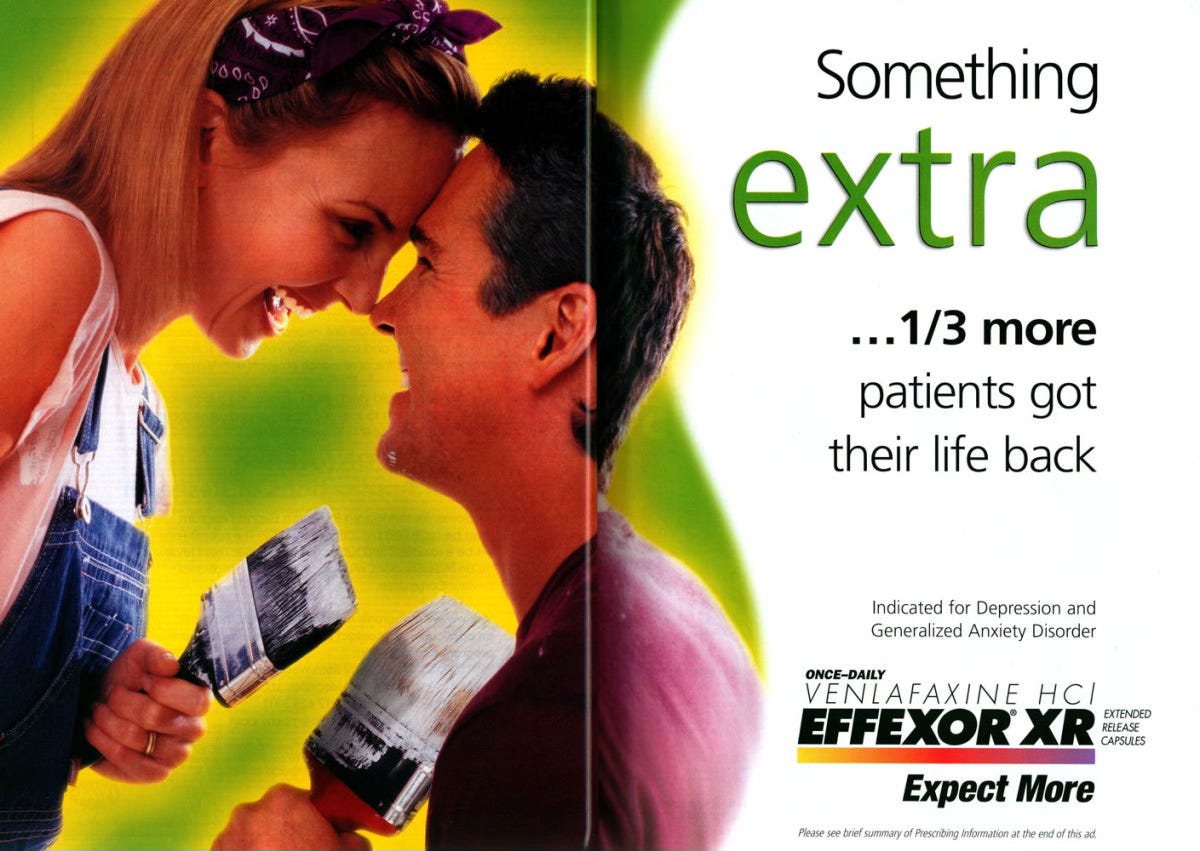
Another deceptive method is to exclude study participants who would be likely to experience adverse side effects-- even if they ARE the target population. As a former SmithKlineBeecham executive said, "Rarely do [patients used in drug trials] reflect the exact clinical profiles, including use of concomitant medications, of the patient population to whom the drugs will be administered after marketing.”
We should also understand that these trials can remove participants who are not responding well to the treatment, and replace them with new participants! In other words, researchers can keep trying their treatment on people until they find people that respond well to it-- without noting those excluded participants in their final numbers. This 2002 report by Kirsch et al. notes that Prozac and Zoloft used this technique in trials submitted to the FDA. They note, “Approximately 80% of the response to medication was duplicated in placebo control groups… Improvement at the highest doses of medication was not different from improvement at the lowest doses.”
A House of Cards?
These are just a few of the dubious scientific techniques that are used to help bring new drugs to market. (I strongly recommend the Timothy Scott article mentioned above, “Tricks of the Trade,” for a thorough overview of these practices). Perhaps even more troubling is that all of the studies mentioned above were published in “respectable” journals like the New England Journal of Medicine, which inspires a sense of trust that is not founded in reality.
Additionally, medical and mental healthcare providers tend to boast that they are grounded in “best practices” and “evidence-based care.” Compounding this, insurance companies and other managed care providers typically only cover treatments that have been “proven” -- meaning that our options are limited to modalities and pharmacological solutions that may not be terribly helpful at all.
Healthy Skepticism
I’m not suggesting that we throw our pills out the window, or abandon Western medicine. Please don’t do either of those things! Medicine saves lives. Science is a good thing.
Instead, it may be beneficial for us simply to recognize that most of us have a conditioned bias; that we unconsciously believe that a drug that has been “proven,” or that a provider who uses “data-driven” methods is automatically safer or better.
Asking questions of our healthcare providers; reading research papers ourselves; researching alternatives— these are all options that are within our grasp.
I value science, logic, and rationality just as much as I value intuition and embodiment. These discouraging facts don’t mean we need to throw out the baby with the bathwater-- it means thinking more critically about what we accept as “scientific fact,” and what level of care we are actually providing or receiving.