


At first I thought this post might be for the overachievers— the ones who think that healing comes only from journaling, meditation, and that pile of unread books by Gabor Maté. What if the thing you’ve always avoided, thought was “lazy,” or a waste of time— was actually holding a part of your healing story?
But this post is also for those of you who just enjoy a good show, and aren’t necessarily working hard on any kind of healing journey. Is it possible that some of your favorite shows have been working on you unconsciously? Or that there might be more to your viewing habits than meets the eye? Let’s take a look.
It’s a curious fact that many of my clients who are committed to working very hard on themselves— who are always reading a new self-help book, or researching their attachment types— are actively avoiding one of the most effective trauma-healing technologies I know: watching television.
“I just feel like, I should be doing something productive,” they say. “I’m not good at just sitting.” “It feels lazy,” another one tells me. I get it. Many of us— myself included— have a hard time making a conscious decision to sit down and watch something purely for entertainment purposes.
So, for those of you who feel this way— let me appeal to your productivity complex by telling you that storytelling, myth, plays, and yes, even television serve a critical function for human mental health. Look, I know how deeply this goes against some of our cultural messaging about too much “boob tube” or, in modern parlance, “screen time.” I’m not suggesting you quit your job and move onto your couch full-time, but I believe that watching some shows, or movies, is a brilliant use of your time. Still not sure? Here are three reasons why.
1. TV shows offer a unique means for us to process our own experience (sometimes, without ever having to talk about it ourselves)
“Through tragedy, the great Athenian poets were not articulating a pessimistic or fatalistic view of human experience; nor were they bent on filling audiences with despair. Instead, they were giving voice to timeless human experiences—of suffering and grief—that, when viewed by a large audience that had shared those experiences, fostered compassion, understanding and a deeply felt interconnection. Through tragedy, the Greeks faced the darkness of human existence as a community.” —Brian Doerries1
Have you ever watched a series, or a movie, or even a really good commercial, and just felt like, “whoever wrote this really gets it”?
The ancient Greeks— 2,000 years ago— invented the tragic play as a means by which the audience could recognize their own experience, process it together, and then move forward with their lives, feeling lighter (Brian Doerries, who I quoted at the beginning of this post, actually uses these ancient plays as a means to help veterans (and others) “bear witness to the experience of war.”)
But the technology of processing-by-proxy is something we all have access to, and it works regardless of our interest in actively processing our emotions, our history, our traumas. Ask somebody who their favorite Ted Lasso character is, for example, or which was their favorite scene, and we can start to understand who they are and what they’ve lived through.
Empathy is inherently embodied. We feel what others are feeling by mimicking their micro-expressions on our own faces, or mirroring their body language (a reason that I am not drawn to take Botox, myself— it inhibits our ability to create those expressions, and therefore to empathize with others). As we watch characters on-screen, we are not just watching— we’re feeling with them. We not only recognize the familiarity of their struggles, we feel what it’s like to be experiencing those struggles ourselves. And we can feel with them what it’s like to survive those struggles; to make different choices; to not only survive but to find new hope on the other side. New possibilities can emerge for our own lives.
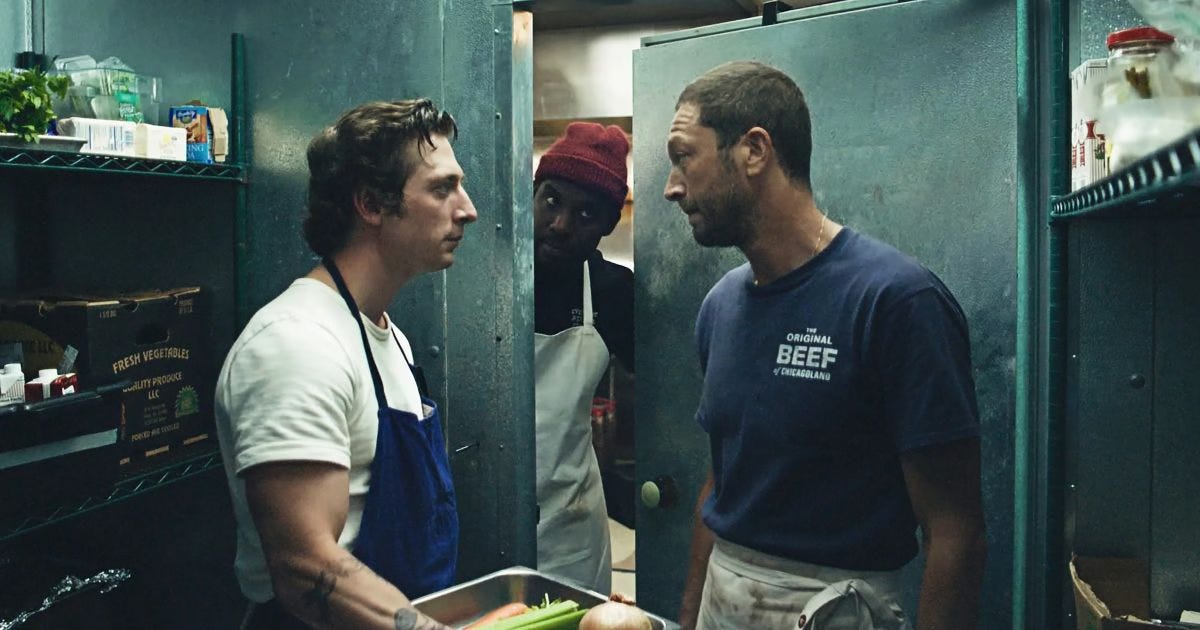
Watching Season 3 of The Bear, this past month— or should I say, sobbing through each intense, tightly-shot scene— I recognized my own past shame and fear; how it got in the way of honest connection and love. It dawned on me in a visceral way, watching each character stumble along, how much our very human ways of protecting ourselves are inevitably (though unintentionally) harmful to our loved ones. And best of all, I felt tremendous— almost unbearable— hope; at the ways in which these flawed people were willing to try, and try again, to grow up and do better. It healed some of my relationships in ways that the other party will never know (nor do they need to). That’s the power of this storytelling technology.
2. Stories help us reclaim our personal myth
“When you locate yourself in an archetypal pattern, what happens is you begin to see your life mythically, the wonder and the awe of being part of something that is timeless. And it actually shows you that the threshold you are crossing, however, difficult it may be, has a meaning. And that others have walked it before you many times, and that there is something wise in you that is tracking the way.” —Toko-Pa Turner2
In this quote, Toko-Pa is actually referring to the language of metaphor and symbols as they appear in dreams— but it also speaks beautifully to the experience of resourcing ourselves through myths, modern or ancient.
Star Wars offers a “classic”3 example of modern myth telling. In this beautiful and brief interview between Bill Moyers and George Lucas, the Star Wars creator shares how he explicitly intended to include elements of great myths. More recently, it doesn’t take much to see Andor as a hopeful blueprint for revolution against the relentless evil (Fascist) Empire.4
While Star Wars is more obviously a myth than, say, Severance, Succession, or The White Lotus, if we scan through the casts of any popular series, it doesn’t take long to place the hero/ine, villain, kindly old man/crone, fool, etc. Or perhaps, as in Andor, we find it easier to identify with the larger themes that speak to our personal pains and passions. Asking ourselves, who are we drawn to? Who do we despise? What in this is resonating with me? may give us clues about our own sense of purpose and meaning— or lack thereof.
The phrase “Main Character Energy (MCE)” speaks volumes to this phenomena: are we living our lives as though we are the hero in our own tale? Or have we “lost the plot,” feeling lost, confused, and meaningless? Connecting to the stories and characters that stir us can offer a way back to our own path— especially when we’re feeling lost.
Can't Start a Fire Without a Spark

“The meaning of my existence is that life has addressed a question to me. Or, conversely, I myself am a question which is addressed to the world, and I must communicate my answer, for otherwise I am dependent upon the world’s answer.”
3. We’re reminded of our larger connections— even if we haven’t left the house
“In the case of psychological suffering, which always isolates the individual from the herd of so-called normal people, it is also of the greatest importance to understand that the conflict is not a personal failure only, but at the same time a suffering common to all and a problem with which the whole epoch is burdened. This general point of view lifts the individual out of himself and connects him with humanity.” —CG Jung5
While the ancient Greek plays were created to be shared in community, many of us watch our screens in isolation. At the same time, as we see our shame, our pain, our story laid bare, we can recognize that our suffering is universal; that our conflict is not “a personal failure,” but a reminder that we’re connected, as Jung says, with “humanity“ as a whole.
And then we may find ourselves texting with friends about a show we’re watching, or listening to the official podcast, or even talking to our therapist about why it’s impacting us so much. We might look up the soundtrack, or make and share our fan art with other stans. If you’re me, you’ll also find and read the book it’s based on, and then devour every other book the author ever wrote.
When we let ourselves be touched through these stories, we’re connecting not only to the show, or movie, but to the deeper layers of meaning that thread through all our lives.
Questions for contemplation
What movie, or series, have you been watching lately— or is there one that’s really captivated you, that you return to again and again? Or…
What was your favorite movie (or play, or musical, or book) as a kid? Write down the basics of the plot (or tell a friend). Is there anything there that feels meaningful now?
Which characters do you love, or resonate with? Which make you cringe? What is it about them that you love, or hate, or can’t stand to watch?
Do you have a scene or episode that stands out to you? You loved it, or you hated it? Recalling it now, what do you notice— an emotion, or a sensation in your body? How is it to feel that? Is this familiar, or does it remind you of something in your life, current or past?
Bryan Doerries, The Theater of War: What Ancient Tragedies Can Teach Us Today (Vintage, 2016).
Toko-pa Turner, “Metaphor: The Language of Kinship,” Substack, 19 June 2025, https://substack.com/@tokopa/p-166271622.
That’s how old we all are, the 70s are “classic.”
Writing this, I was prompted to look up Marva’s stirring speech from Season 1, Episode 12 and cried so hard my dog had to leave the room. 😂
Jung, C. G. The Symbolic Life. Vol. 18 of The Collected Works of C. G. Jung, translated by R.F.C. Hull, edited by Gerhard Adler and Michael Fordham, Princeton University Press, 1976, para. 232.
Yes to this Laura. After childhood, TV was not a part of my busy life in work and play, then some with sit-coms- Happy Days, Friends on reruns later, Seinfield...Casablanca was my favorite movie, I played the VHS so much it wore out, then post VCR days bought the CD which also wore out. My TV was a 13 inch with built in VCR, I taped Oprah while at work. In September 1999 I joined a fitness center owned by two for profit hospitals- state of the art and outpaitent cardiac and stroke patients came there. I got hooked on a new soap, neve had watched them, to stay on the treadmill an hour since I typically had a 70-80 year old bypass patient on the one next to me. Inspiration. After 7 years Passion was cancelled but several actors were picked up by Days of our Lives- yep, I have watched that daily, M-F since 2008. I got Netflix in fall 2020 when friends convinced me it was NOT a cable channel, and no, I did not need a TV- I gave away mine on March 31, 2017 when I moved into my apartment and learned a Netflix, and later, Peacock subscription grants me ample viewing time away from my ayurveda studies. I recently watched 21 episodes of Hell's Kitchen disgusted at the horrible attitudes of most of the chef contestants and their host- there is a story in there waiting for me to write. More later, love this!
I absolutely love this concept! It resonates so deeply with me. I have been watching a lot of 50's post war movies as a way to see how to maneuver better in the midst of fascism. The third man, the stranger are a few of these examples (mostly because a young Orson Wells just does it for me haha) in order to see how to weed out fascists from our midst. And I am gravitating more towards these older movies because of black and white, the shots are longer, the plots are slower and the action is less explosions in your face; a simple way to circumvent the social media effect of short scenes, grab your attention with loudness and brightness and colors.