

Hi readers! Just a quick note to let you know that Jennifer Snowdon and I will be offering our four-week Better Breathing For Trauma course this April. Join us for a different look— beyond “hacks” and “fixes”— at how the physiology of stress affects breathing, and how we can work with it. More info and register here.
In a recent post, “This is Your Nervous System on Fascism,” we reviewed the Window of Capacity model of the nervous system, and introduced the basic concept of nervous system training as a means to help us hold steady in the face of increasing external stressors.
While this model can be helpful to understand how and why we might respond to stress, there is a danger in offering oversimplified explanations or “solutions” that will only leave people feeling worse when they don’t feel like they “fit” or “work.”

Humans, like all animals, present in endless variations and possibilities. There are, among us, exceptional individuals that are rare, and extraordinary. They are not easily classified; their systems are specialized, adapted to survive in environments that would otherwise have killed, maimed, or used them for their own nefarious purposes.
These humans are the unicorns of the nervous system world. Some hide in plain sight, their magical properties disguised for daily living. Others live in the fringes of the forest, choosing how and when they will interact with others, knowing the potential danger that lurks in their fellow beasts.
These unique humans do not fall tidily into the model I offered a few weeks ago. This week, I invite you to consider this topic both from a slightly different model, and through the imagery of The Unicorn Tapestries, a vivid series of 16th-century tapestries that depict the hunt and capture of this mythical creature. I hope that these symbols will work on us at a deeper level to counteract an oversimplified clinical understanding that is prevalent in today’s discussion of nervous system and mental health physiology.
Hyperfunctional nervous systems
“The nature of survival physiology is that it’s meant to function somewhat like a runaway train. Once it’s initiated, we are almost powerless to stop it because we can’t afford to deliberate at length about whether there may be a more rational explanation for what’s going on, or whether the threat may not be as severe as first thought. We are instead driven by the survival imperative to simply respond immediately. When our own lives are at stake, we can’t afford to take chances.”
-Kain, K. L., & Terrell, S. J., Nurturing Resilience
Imagine a creature that is born, pristine and perfect, into a dangerous time and place. Raised by wolves— or left to raise herself— or, with two loving parents who lived under the constant threat of discovery, forced to move from place to place— he never knows the safety of a stable home. How does this unicorn survive?
She learns to be ever-vigilant, ready to flee, or fight, at the first sign of peril.
He develops an extra-sensory capacity to feel what others are feeling— so that he can sense danger before it strikes.
She becomes a shape-shifter, disguising herself to any environment, so that she can “pass” as needed in a hostile climate.
He learns to prioritize survival above all other needs.
The cost for these adaptations is quite high. Meaningful connection, finding one’s life purpose, even getting a good night’s sleep are all impossible for the hunted unicorn. Still, it endures. It has honed its survival skills to the sharpest edge.
The unicorn, you might say, has a hyperfunctional nervous system.
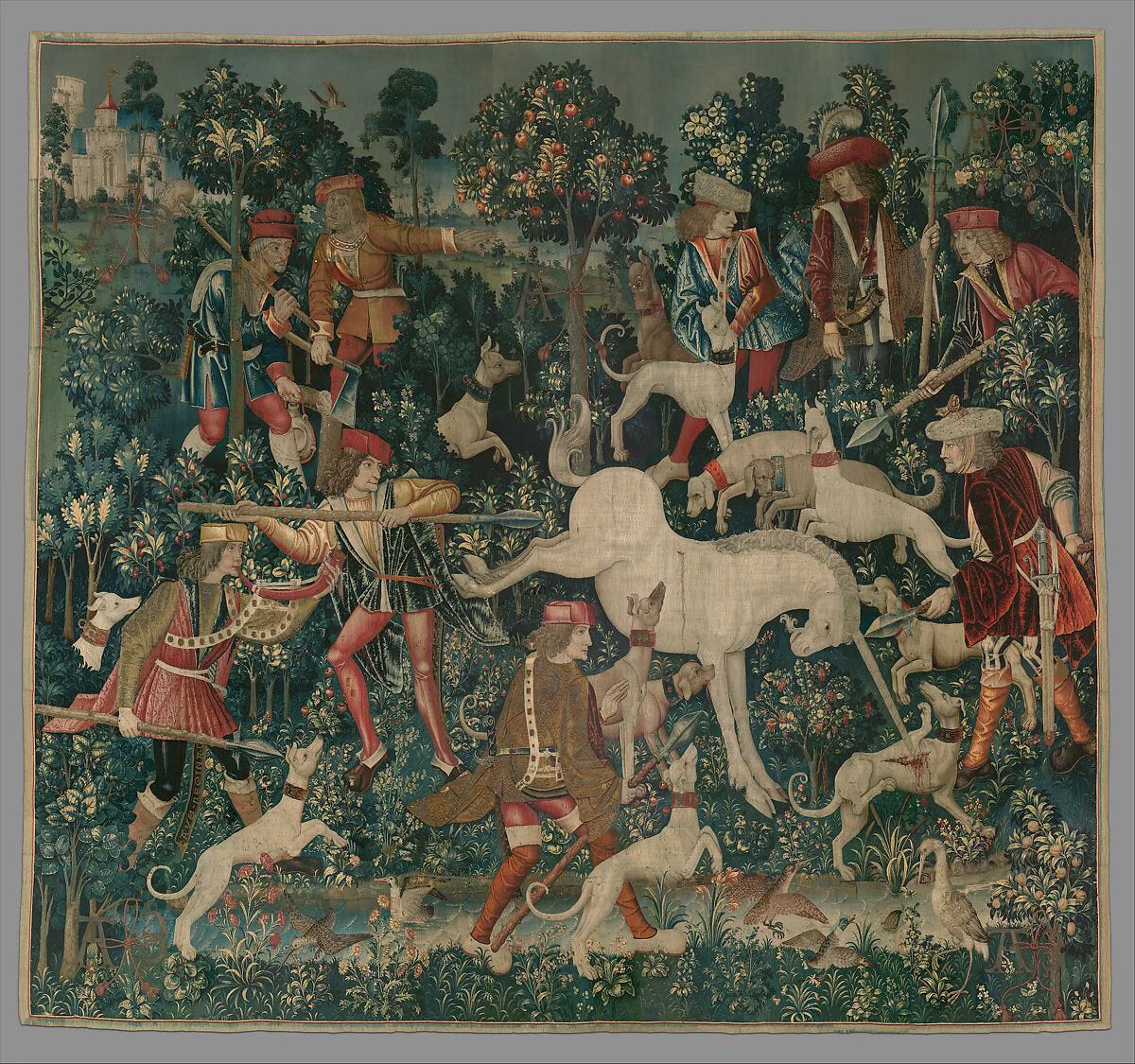
What makes perfect sense from a survival point of view becomes something else entirely when the unicorn is captured and scrutinized under clinical care. Survival strategies are seen as problematic symptoms. The beautiful, elegant design of its carefully shaped nervous system is dissected into disorders, abnormal, dysregulation. What should be prized, respected, held with reverence, is degraded, shamed, and pathologized.
This, as much as anything else the unicorn has endured, can prove lethal; a different understanding is needed.
The “faux window” of capacity
For some of us, discharging stress (that is, moving back into our window of capacity), is as simple as going for a walk. We easily find our way back to an “okay-enough” state.
For wild unicorns, that window of capacity is so small, so elusive, that we may never even have found it. As we start to approach that window, we jolt ourselves back into vigilance— not safe!— never able to rest.
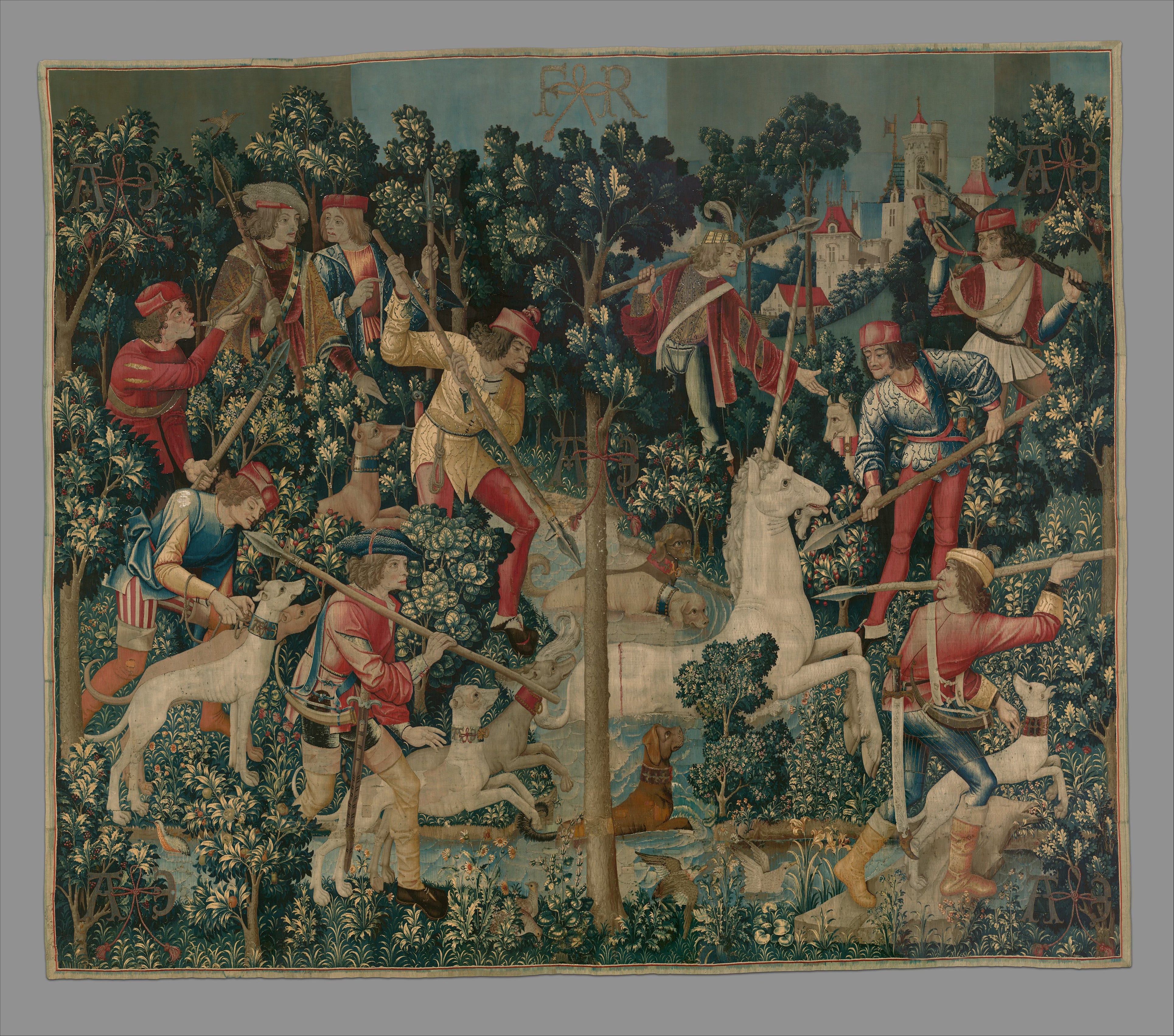
These folks don’t respond to simple interventions because their nervous systems aren’t simple. This can be deeply frustrating, as their sense that something is wrong is reinforced by professionals who misunderstand them, offer “fixes” that don’t work, and throw up their hands in despair, further traumatizing the individual.
Kathy Kain and Stephen Terrell, in their book Nurturing Resilience,1 introduce an adjusted model that I have found quite useful to understand what might be happening for these folks: the “faux window” of capacity.
Consider our modern-day unicorn. In the model below, we see that for these individuals, the “true” window of capacity is quite narrow. These individuals have adapted to a state of constant overstimulation, or shutdown, or they oscillate between the two, never safe enough to experience a state of ease and rest that would come from the organic process of nervous system regulation.
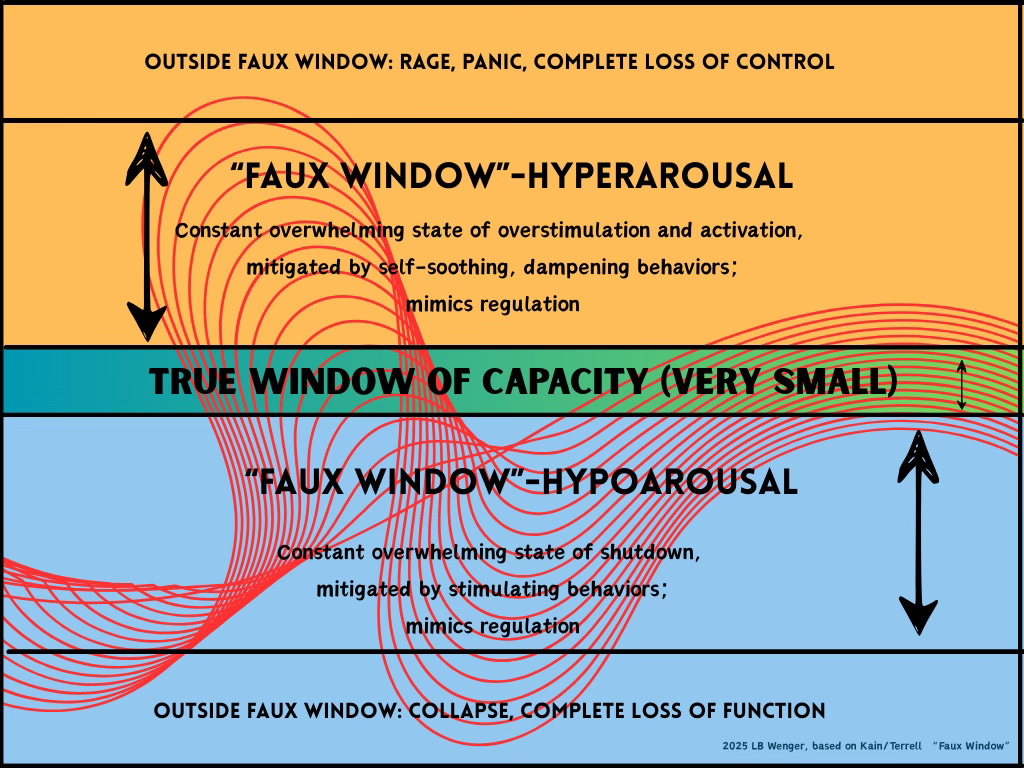
These hyperfunctional individuals are often hiding in plain sight. On the hyperarousal side, they’ve learned how to self-soothe or dampen the effects through behaviors (eating disorders; addiction, etc.) that mimic regulation— but don’t actually bring them into their window of capacity.
For those in the hypoarousal “faux window,” depressed, dissociated or shut-down states are mitigated by behaviors that stimulate or mimic arousal, so that they can function in their daily lives.
In a culture that values workaholism, perfectionism, and even disordered eating, these traits are often celebrated— in the same way that parents appreciate a “good baby” who doesn’t cry, not recognizing that it’s learned to shut off its protests. Our unicorns are perfectly disguised.
It works, until it doesn’t
“In the Faux Window, we create a sense of stability and regulation of arousal by narrowing our range of responses, but that narrowing means we can’t access the resilience that is affiliated with having flexibility and the full range in our response systems— what we would have with a healthy Window.”
-Kathy Kain and Stephen Terrell, Nurturing Resilience
Survival biology has a high energetic cost. In mimicking regulation, rather than actually achieving it, the whole system works harder than one who is able to periodically rest. It is exhausting for the body and a drain on the spirit. There is no extra life force available for creativity or spiritual connection.

When the system’s equilibrium fails, the unicorn is driven out of the faux window, sometimes into a catastrophic response. These individuals are prone to chronic illness2, and a host of “mystery symptoms” which can lead them from doctor to doctor, looking for help. Or their strategies become more problematic than supportive, and they’re forced to seek help for what becomes (often multiple) mental health diagnoses. And there are some unicorns who are discovered (outed? rescued? captured?) early in their lives, shuffled in and out of institutions, medicated, therapized, and chronically misunderstood.
Co-regulation is key
Underlying all of these symptoms, below this survival strategy— is a nervous system that never had an opportunity to develop. More fundamental still is the human soul that has been deprived of real connection and understanding. It is only through that human connection that these nervous systems can shift their patterns to finally, really, rest.
For folks who are living in the “faux” window— our unicorns— the standard interventions just don’t work. In fact, they can often further entrench the nervous system by reinforcing existing patterns. Yes, teaching them to use a particular breathing technique to “regulate” may offer some much-needed relief— At the same time, if we are only offering external tools to manage symptoms or to override their natural response, we are reinforcing patterns of faux regulation. True regulation— the only place in which their systems can recharge— remains out of reach. It’s a dead giveaway that this is happening when the person comes to rely so heavily on an intervention that they can’t function without it. This is yet another survival strategy.
In working with a more complex system like this one, patience is key— for both parties. Rather than rushing to apply interventions, simply practicing presence with the individual is what will begin to create change. For helping professionals, it’s important that we address our own issues with helplessness here, as well as our own nervous system patterns and habits. I have learned that the harder I work, feeling like I need to do something, the more I get in the way of the process.

That’s because what is missing for our unicorns— what has, perhaps, always been missing— is true coregulation with a consistent, stable, grounded, empathetic other, in a safe-enough environment.
Coregulation:
“encompasses the mutual adaptation between partners in response to one another’s biology and behavior. Coregulation operates at both biological (hormonal and nervous system) and behavioral (affective and cognitive) levels and plays a crucial role in the development of self-regulation”.3
Nervous system development is completely dependent on coregulation. We learn to regulate ourselves by first coregulating with a caregiver. This forms the pathways and patterns that will lead to a healthy and responsive nervous system. This is true in nervous system growth, as infants, but it is equally true for nervous system repair.
Speaking of this phenomenon, developmental researcher Allan Schore says,
“The skill of being with patients over long periods of time is key here. The key to making changes in the patient is not what you say to the patient or do to the patient. It’s how to be with the patient. Especially while that person’s being is in a dysregulated state.”4
Coaches, personal trainers, and other movement professionals are perfectly positioned for this work. We have the opportunity to coregulate while playing or practicing simple movement skills; exactly the way that our nervous system is meant to develop in early life.
Coregulation here isn’t a complicated skillset; most of us do it quite naturally. At its simplest, it’s the experience of being with the other in a non-judgmental way, allowing them to have their own experience within a safe-enough environment. This means that any good trauma-informed coach, somatic practitioner, or movement professional can facilitate change in the other’s nervous system as long as both parties can be patient enough to allow the process to work (of course, as a NARM-informed practitioner, I’m biased, but I believe that their model is almost miraculous in how well it works here).
A window by any other name…
In the image below, we see our unicorn at peace, a calm expression on his face. He is recovering from his wounds. While he is enclosed in a small fence, this is one he could easily jump over. The fence in our metaphor symbolizes the safe boundary that now exists between him and the world, and which lets him truly settle into rest.
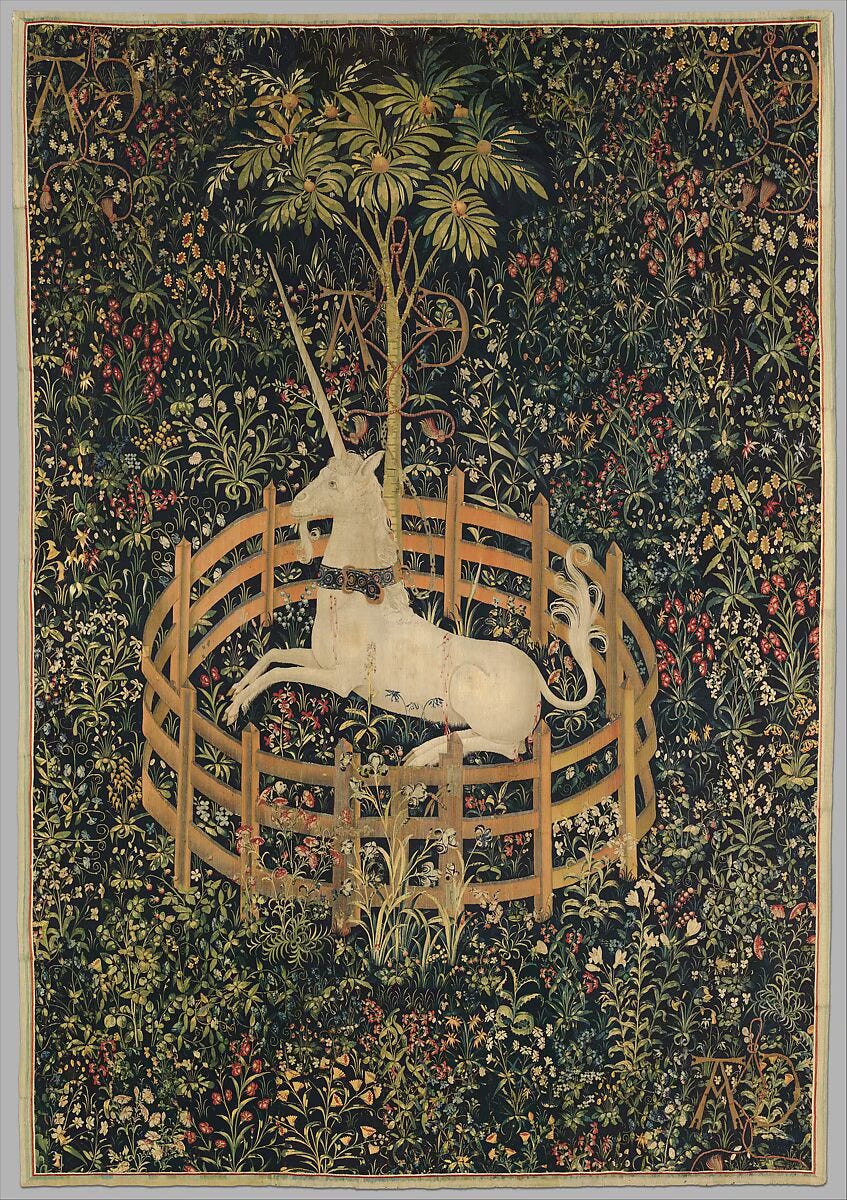
I have a reproduction of this tapestry in my home. It’s a reminder of both the exquisite, magical beauty of our feral nature, and the need for safe harbor.
The Unicorn Tapestries depict the hunt and capture of the unicorn, which may symbolize the pursuit of love, or the Christian myth— or both, of course. I’ve taken some liberties with the symbolism for this post, but the same archetypal truth applies. While the hunters stamp through the woods with their hounds and horns, cornering the beast, driving it into a frenzied defense— it is only, finally, through the touch of a “maiden”— that is, through Eros, relationality, pure empathetic connection— that the unicorn is “tamed,” though he still retains his beauty and magical form.
xo,
Laura
Kain, K. L., & Terrell, S. J. (2018). Nurturing resilience: Helping clients move forward from developmental trauma—An integrative somatic approach. North Atlantic Books.
https://www.thelancet.com/journals/lanpub/article/PIIS2468-2667(17)30118-4/fulltext
Bornstein, M. H., & Esposito, G. (2023). Coregulation: A Multilevel Approach via Biology and Behavior. Children (Basel, Switzerland), 10(8), 1323. https://doi.org/10.3390/children10081323
Huberman, A. (Host). (2024, November 11). Dr. Allan Schore: How relationships shape your brain [Audio podcast episode]. Huberman Lab Podcast. https://www.hubermanlab.com/episode/dr-allan-schore-how-relationships-shape-your-brain
Thank you, Laura. You have articulated several observations I've had but haven't been able to explain.
Love this !