

The care and tending of my nervous system is a big part of my life.

Like a delicate, hothouse orchid, or a high-strung chihuahua, my nervous system requires tender care, thoughtful nourishment, early bedtimes and mindful exposure to stimulation.
I didn’t always know this about myself, actually. When I was younger, I didn’t understand why I became cranky or irritable with others after too much stimulation; why I would have to go to bed just to escape from a social event in my own living room; why I would have to compulsively eat, or down a drink, or chain-smoke cigarettes. I didn’t realize how much distress I was trying to manage. I just thought something was wrong with me.
Not all nervous systems are created equal
Judging by the fireworks that were still going at 1 am this New Year’s Eve, not everyone has a nervous system like mine. While I laid in bed feeling as though each BOOM detonated directly in my solar plexus, I have to assume they were enjoying the excitement and stimulation that can only be found by blowing shit up at midnight.
What makes one person love that adrenaline rush while another person dreads it? Some of it might be a function of our extraversion or introversion. Introverts, Andrew Samuels says, are “energized by the internal world1,” while extroverts get their kicks from their external life. A character in Netflix’s The Four Seasons puts it succinctly: extroverts get happy “from the outside in.”
So while an extrovert may delight in a roller coaster or a loud concert but feel restless during an hour of journaling, an introvert may find outer stimulation exhausting and contemplative time deeply restorative.
Of course, people who have experienced PTSD—sometimes called “shock trauma,” involving one or more discrete traumatic events—or CPTSD, which involves chronic and prolonged stress, often have a very different relationship with their nervous systems. One hallmark of PTSD, according to the DSM-5, is hypervigilance: a persistent need to stay alert, paired with an exaggerated startle response— making fireworks a true nightmare.
And in cases of developmental trauma—repeated patterns of misattunement, instability, or environmental failure during early life—the nervous system can become something else entirely. More on that in our next post.
The Window of Capacity model
Many of you may already be familiar with this model, but for those who aren’t, it’s a helpful way to understand nervous system regulation. It’s based on Dan Siegel’s “Window of Tolerance.” I prefer the term Window of Capacity, a formulation I learned through Jane Clapp’s work. “Capacity” emphasizes strength and agency, whereas “tolerance” can imply passive endurance within an oppressive system.
Here’s a silly example to illustrate. Imagine you’re at home watching your favorite show, relaxed and at ease—well within your window. Suddenly, a bear appears in the doorway. (I warned you— it’s silly.)
Your nervous system immediately mobilizes: heart rate increases, stress hormones flood your body, and you enter a hyperaroused state—ready to fight or flee. Alternatively, if escape or defense feels impossible, you might freeze. You’re immobilized, playing dead, in a hypoaroused state.
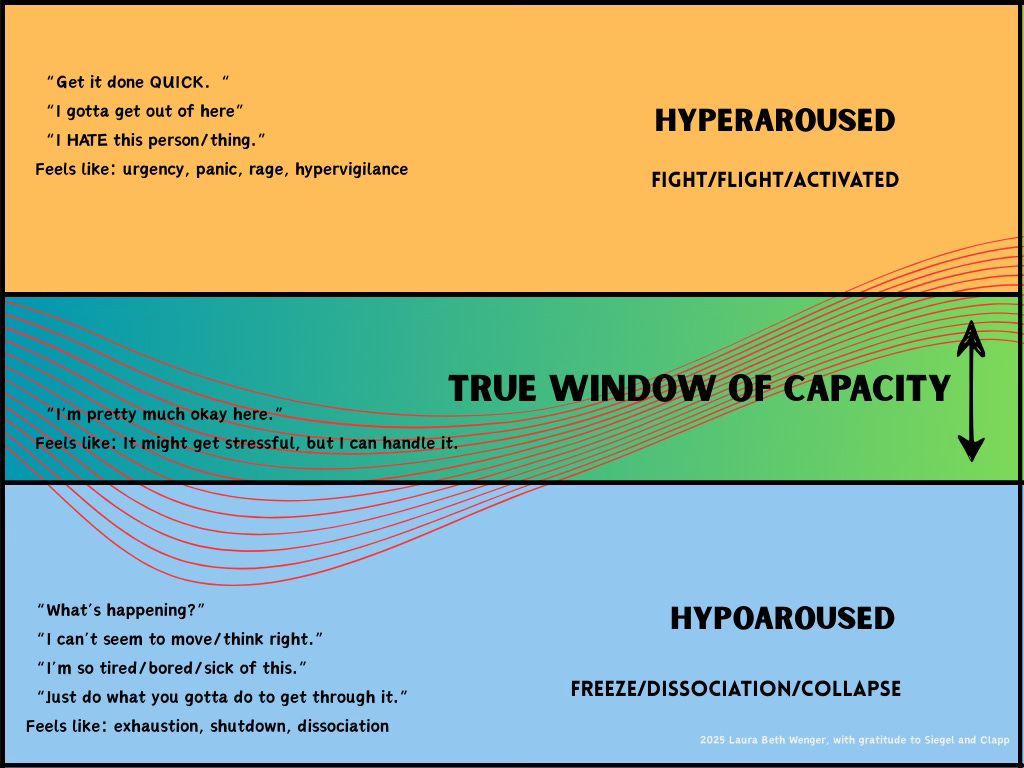
Suddenly, the bear pauses and removes its head. It’s not a bear at all—it’s your friend in a costume playing a terrible joke. You laugh (or throw something at them), the stress resolves, and you return to your window of capacity.
Shaking it off
If you’ve ever seen a dog “shaking it off” after a stressful event— like chasing a squirrel, or barking at the mail carrier— you’ve seen the basic nervous system response in action.

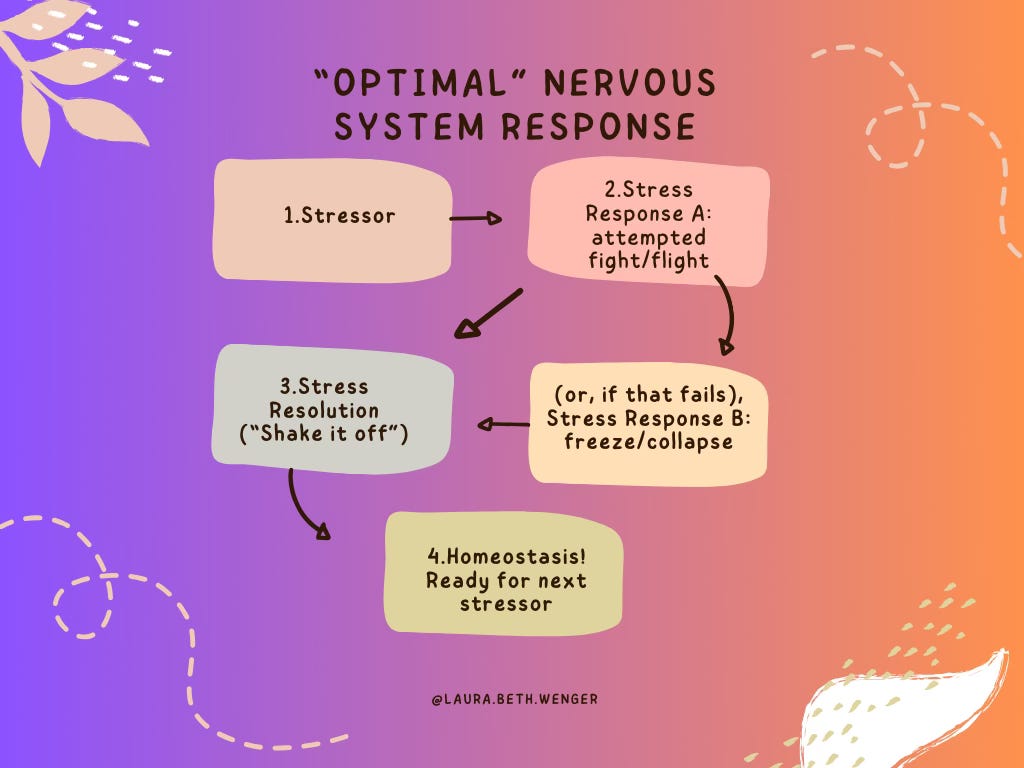
Our nervous systems evolved to handle simple stressors this way.:
We’re exposed to a stressor (a bear);
Our systems mobilize (body temperature goes up, heart rate increases, stress hormones flood our system);
We deal with the stressor by escaping or conquering it, or “playing dead;”
The stress is resolved, we “shake it off,” the stress hormones dissipate, and
We’re back at homeostasis, ready for the next stressor.
Enjoy a pretty graph about this below:
But of course, it’s not always this simple.
Your nervous system in 2026
Today, our stressors aren’t bears. They’re financial strain, conflict with a child, a cancer diagnosis, or living with a marginalized identity in a hostile culture.
These stressors don’t resolve neatly. They can’t simply be shaken off.
As a result, many of us live in chronic hypervigilance—an ongoing sense of threat even when we’re objectively safe. Others live in exhaustion and shutdown, unable to summon the energy to do the very things that might help. Unrelenting stress prevents us from returning to our window of capacity. We never fully rest or replenish before the next demand arrives.
You may already see the problem with a simplistic reading of this model. In a culture shaped by healthism, it can imply that stress is something we should be able to control—and that failing to regulate ourselves is a personal failure. Like those old “this is your brain on drugs” commercials, an oversimplified model suggests we just need to keep our egg out of the frying pan.
But in 2026, we are all in the frying pan.
The threats of global fascism and environmental collapse affect all of us.
Some of us have been sizzling on the heat for decades already. The illusion that we can escape the frying pan is one that has been reserved for those with greater privilege; but that dream is now fading for all but the hyper elite. Unless you are living in complete isolation in a cave in Tibet,2 your nervous system is feeling the strain of global events. It’s what it means to be human in our times.
Hang on, though, it’s not all doom and gloom.
Balancing the allostatic load
“Allostatic load,” a term coined by Bruce McEwen and Eliot Stellar, refers to the cumulative physiological wear and tear our bodies endure. It includes not only “negative” stress—political, financial, environmental—but also “positive” stress: travel, socializing, exercise, even a glass of wine.
When I work with someone whose nervous system is stuck outside their window of capacity, one of the first things we explore is their allostatic load. What is stressing the system? Which stressors can be reduced—late nights, excessive screen time, overtraining, that third or fourth drink?
The nuance is important here. Sometimes those hard workouts, or that workaholism, is what’s holding someone together. Sometimes screen time is their only social connection. The work is distinguishing what is genuinely resourcing from what is straining the system.
This insight has to arise from within. In my experience, people often know what their nervous systems need—we just have to slow down enough to listen.
The moral neutrality of stress
Stress, believe it or not, is neither good nor bad.
Hans Selye, who pioneered stress research in the 1930s, came to regret the negative connotation that the word “stress” has. Although it never became popular, he coined the term “eustress” to refer to the type of stress that we need to grow and change.
In fact, as researcher Kelly McGonigal shares below, even negative stress does not have to be detrimental to our health— unless we believe that it is.
If you get nothing else out of this article, I hope that you take this away: how we think about stress has a powerful effect on how it affects us.
Training our nervous systems
Stress is a necessary ingredient for growth.
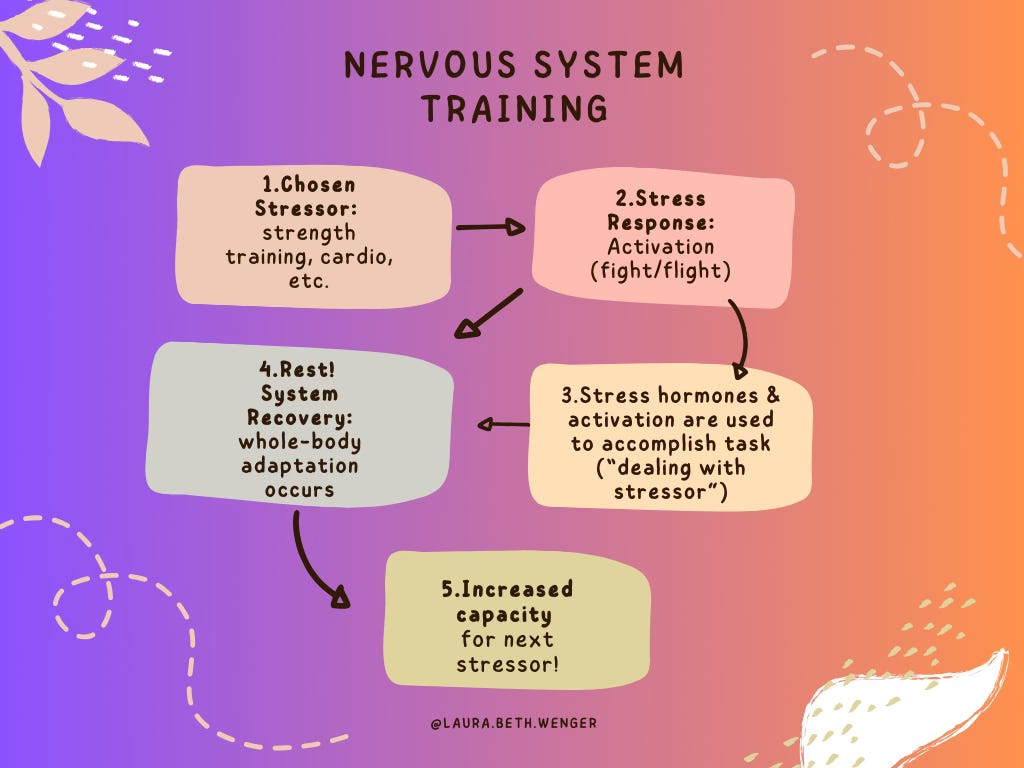
Bones strengthen when we load them appropriately—this is Wolff’s Law. Muscles adapt through the SAID principle: Specific Adaptation to Imposed Demands. Too little stress leads to atrophy; too much leads to injury. Growth happens in that just-right zone.
Our nervous systems work the same way.
In the post above( you don’t need to watch it, unless you want to hear more about this), I described two characters: “Sweaty Betty,” who thrives on constant pushing and may be stuck in hyperarousal, and “Steady Freddy,” who avoids activation and may be stuck in hypoarousal. It’s a crude oversimplification, but it helps illustrate how different systems need different inputs.
For Sweaty Betty, the work may involve learning to tolerate slower states—long walks, gentle strength training, creative practices—learning to find safety in rest. For Steady Freddy, the work may involve carefully reintroducing activation—movement, play, relational engagement—so that arousal no longer feels inherently dangerous.
Both need to learn rhythm: when to push, when to rest, and how to balance movement with other life stressors. This is how we expand our window of capacity.
Yes, I made another chart.
Freeing ourselves so we can free others
This is a simple-enough process, but because humans are so darn complicated, it isn’t always easy. And the outside-of-our-stressors— life be lifing, as they say— can mean that it’s really hard to figure out how hard, or when, we should push ourselves (I talk more about this here, and how I use HRV- heart rate variability- as a helpful metric).
Still, there’s an elegant, instinctual wisdom to this system. Learning to listen and respond to our bodies in this way means that we have not only increased capacity, but increased vitality— life force!— to support the work we are meant to do in the world.
When we are faced with burning, life-or-death issues like the collapse of democracy or genocide, or state-sanctioned murder, it may seem like the very last thing we should be focusing on is our physical and mental health. Believe me, I get it. Literally, people are dying, and I’m suggesting you take a walk.
Yet so many of us are teetering on the verge of burnout and exhaustion. We’re caught up in complexes of overwork, productivity and saviorism that keep us from replenishing our own resources. We need to free ourselves, so that we can help free others.
Nervous system training isn’t a luxury— it’s the only way to make our work sustainable. The alternatives— burnout, exhaustion, chronic numbness— do little to further our cause. If we are called to this work, as I think we all are, now— for democracy, for freedom, for our planet— this type of training is not a luxury but a necessity.
Samuels, A. (1985). Jung and the post-Jungians. Routledge.
If you are, save me a spot.
This is an interesting topic. When I was young, I was in the yoga world, which is a world of very sensitive people. We all had various sensitivities and eventually, a yoga class became a strange environment where people tried to avoid all possible sensitivity triggers for everyone. Obviously, this didn't work.
Then when I took yoga teacher training, my instructor suggested that our sensitivities were actually a maladaptive state. He suggested that we should develop resilience. He implied that if you were "overly sensitive", you were doing something wrong.
In the end, I've landed in the middle. Yoga attracts hypermobile people who have clinically demonstrable sensitive nervous systems (which is why the yoga crowd tends to be very sensitive). At the same time, learning resilience and nervous-system management is very important.
I think one of the biggest keys is compassion. No matter where your nervous system is, you need to be kind to yourself and the others around you (who may be wired differently)
Thank you, Laura.
Essential as the out come of not finding this balance often leads people to the work I do. “Broken” nervous systems hurt. Thank you for this thoughtful piece Laura. ❤️