


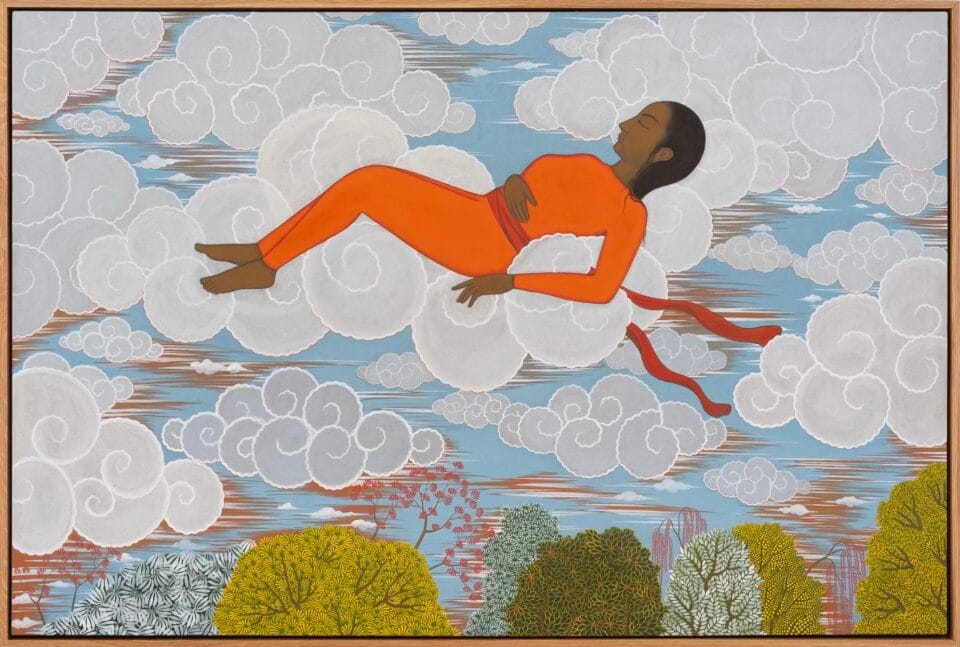
“This is what I know: without imagination you never see the truth about anything. Without imagination you think you see more truth, but in fact you see less.”
—Philip Pullman, The Book of Dust: The Rose Field
“I realized for the first time this week that I have a choice about whether or not to be happy. I never understood what people meant by, ‘happiness is a choice.’ It wasn’t for me. But now I feel that choice.”
—Client N.R., in a recent session
I worked for over a decade in a dreary corporate cubicle environment. What the atmosphere lacked in natural lighting was compensated by “inspirational” Stephen R. Covey posters and a library of books like “Who Moved My Cheese.” Of course, it’s easy to see now why this was not an environment in which I could thrive. Oh, I really tried! I followed the Covey Principles; I completed the corporate training; I tried, and tried, and tried, and ultimately failed, to succeed.
I thought I would always be depressed. I thought there was no better career path for me, and that if I just bought the right suits and got the gel nails and brought home a bigger paycheck, that this is good as it gets. I told myself that happiness was a choice, but I couldn’t seem to actually choose it.
I was utterly stuck because— and here’s the point— I couldn’t imagine anything better.
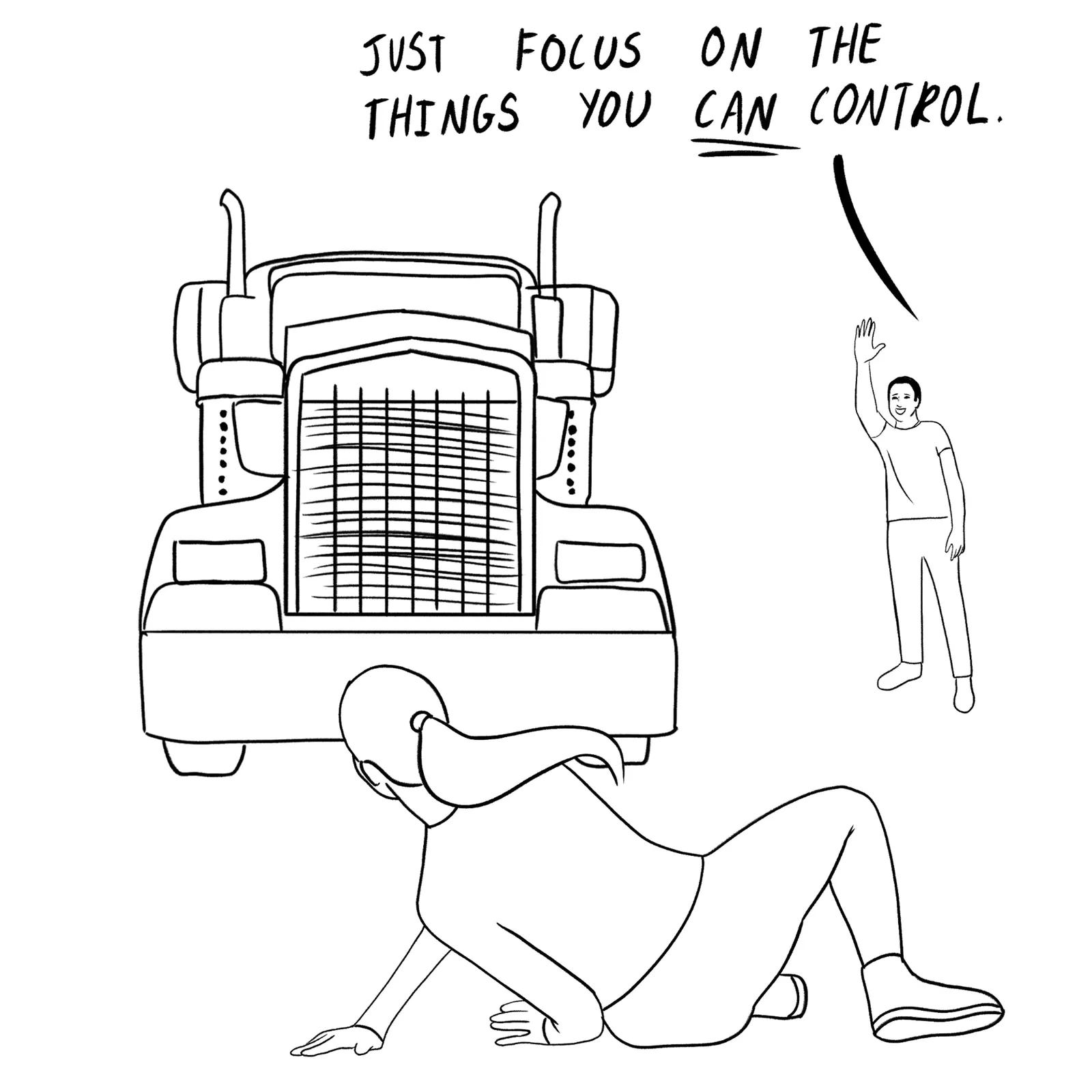
We don’t all experience the same sense of choice
“Sometimes we are very compromised in our sense of choice. And it can be devastating… when the therapist implies choice. And you don’t feel choice. It can be so painful. So I think one big element of trauma-informed work is to respect the fact that subjectively we don’t experience choice in these places, and we really need somebody (to understand that)… (W)hen we hang in there in a relational space with somebody who doesn’t push for something else to happen, then what we call agency really slowly comes in a little bit.”1
—Tobias Konermann, Transforming Trauma Podcast
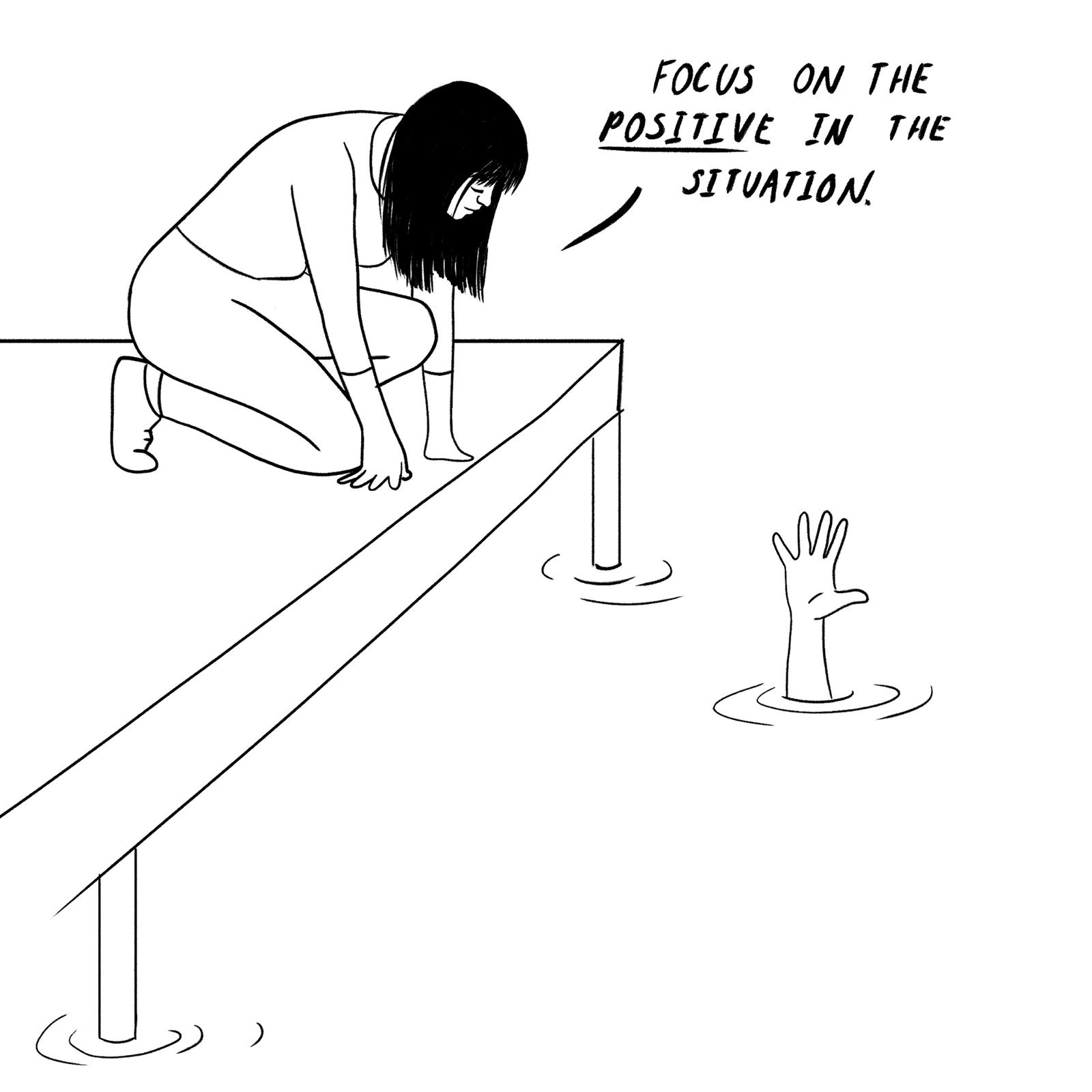
Speaking from personal experience— if you are someone who does not experience an inner sense of choice, there are few things as painful or invalidating as being told by a helping professional that you should be able to make a different choice, or feel differently, about something. Obviously, if we could, we would, right?
Despite outer appearances, we do not all have equal access to inner freedoms. Our personal, cultural, or generational history, our complexes, our social position, can all contribute to a sense of being limited internally. While we may know intellectually that there are other options, they don’t feel possible for us.
I remember very specifically the moment in which I first felt the power of choice. I had recently ended a relationship and was feeling resentful and depressed about the outcome. I was attending a weekend meditation retreat on emotions- alone—, and ran into a friend I hadn’t seen in months. When they asked, “how are you?” I felt the habitual pull to say, “Not great, I’ve been really depressed about X,” etc.— and then something shifted, like a stuck bike gear finally shifting into place. I felt that a different response was available to me— that I didn’t need to feel the way I’d always felt; that I could be somebody different— someone who wasn’t depressed at all. This was completely new.
What had previously felt impossible had become possible.
What does meditation have to do with imagination?
How had I arrived at the possibility for happiness? Toward the end of my corporate career, I was introduced to yoga, and then meditation. I found both of these tremendously helpful as a way to see myself, and my life, from a different perspective.
At first, I thought that meditation was just sitting with things “as they are.” This is the essence of shamatha meditation. We practice being with our lives with non-judgmental awareness. This is incredibly simple, but not at all easy— I had to recognize the many layers of discomfort that I was experiencing and let go of the ways that I wanted to distract myself from these. As powerful as this can be, it’s only the first step in a longer meditation path.
I was incredibly fortunate to fall into the Tergar community (the studio where I did my training— and which I eventually purchased, and ran for ten years, was owned by a man who’d recently found Yongey Mingyur Rinpoche’s work and was excited to bring the Joy of Living practices to Stuart, FL). At the time, I was not excited about meditation at all— sitting still wasn’t something I was into— but it was required as part of my yoga teacher training. And although I didn’t know it, the tradition that I was learning was an especially unique branch of Tibetan Buddhism, Vajrayana Buddhism.
Meditation is more than just an intellectual practice
While Westernized secular meditation (with its rationalist lens) has enthroned mindfulness as the be-all, end-all of meditation, there is a rich tradition of symbolic, devotional, and imaginal practices that have been practiced in Vajrayana Buddhism for the past thousand-plus years— and which inspired Jung in his own understanding of imagination and spirituality. Vajrayana Buddhism builds on a whole-hearted acceptance of our messy and problematic lives, just as they are, and it goes further by encouraging us to work creatively to use each moment as an opportunity to “wake up” to non-dual awareness.
One of the core techniques that is woven through this tradition is imagination. In Tibetan Buddhism, we visualize specific imagery or Buddhas; we imagine ourselves as the Buddha; we follow specific rituals, imagining ourselves giving away our possessions, or becoming skeletons. While many of these can feel quite esoteric, it’s likely that many of you have practiced a very basic Vajrayana imagination technique, ton glen— in which we breathe in other’s suffering and transmute it into healing, joy, happiness. I’ll share a version of this in an upcoming Substack so we can practice together.
All of these techniques loosen our habitual mind-states and patterns. They take advantage of our brain’s natural plasticity to create new pathways and possibilities. They offer embodied practices that allow us to practice being different— and in doing so, we can be different.
Embodied Imagination Practice
“To transform and become who we intend to be more often, we have to practice being who we are becoming.”
One of the reasons that imagination practices are so powerful is because they allow us to circumvent old safeguards set up by our psyche and body. This includes pain pathways, which may activate prematurely in order to prevent the possibility of pain, even when there is no danger or risk. By deliberately deciding to “pretend,” “play,” or “imagine,” we give ourselves the safety to work within our own defined parameters of what is possible or not.
Even better, we can do all of this without ever referencing old trauma, injury, or pain, simply by exploring in an embodied way. This is a “bottoms-up” (embodied) or “inside-out” (internally directed) way to explore that I often find is effective in a way that “top-down” (cognitive) or “outside-in” (externally directed) methods are not.
In the short practice below, I invite us to explore what it might be like to move if our hands are flying, or swimming through the air; and then I invite us to explore what happens when we imagine that the air gets THICK, difficult to move through. If you enjoy this practice, be sure to follow Elke Schroeder, the movement exploration teacher who inspired this exercise.
Seeing more truth, not less: happiness as choice
The Pullman quote at the beginning of this article resonated strongly for me- been there, done that. The left hemisphere, with its strongly rationalistic, self-referencing bias, would have us believe that the way we see things is the way they are. “This is as good as it gets.” What a clever trap this is (and how well it works for larger, oppressive systems, if each of us buy into this limitation). We think that we can think, or optimize ourselves, into freedom). But as Pullman says, “without imagination, we think we see more truth, but we actually see less.” We’re missing an entire realm of possibility.
In this sense, those of us in the helping professions (or maybe just those of us who want to work more skillfully with other humans) have a difficult role. We must follow Konermann’s advice, “hanging in there in a relational space,” holding the possibility that greater choice can emerge for the other, without implying that they should be able to make that choice now. We have to be open to the (humbling) idea that we don’t know exactly what’s even possible for the other person. In doing so, we give them the space to discover their own path to choice, and happiness. This is how individuation works.
Kammer, B. (Host). (2023, September 4). How NARM expands the psychotherapeutic landscape with Tobias Konermann (Ep. 141) [Audio podcast episode]. In Transforming Trauma. Complex Trauma Training Center. https://complextraumatrainingcenter.com/transformingtrauma/episode-141/
Tull, D. E. (2022). Luminous Darkness: An engaged Buddhist approach to embracing the unknown. Shambhala Publications.
In the 70s I learned about creative visualization. Coming close to my 70s I’m learning about the Buddhist approach to imagining the future we want. Thank you Laura! I look forward to the practice above later today. I appreciate your offerings 🩷
Loved the movement practice!