


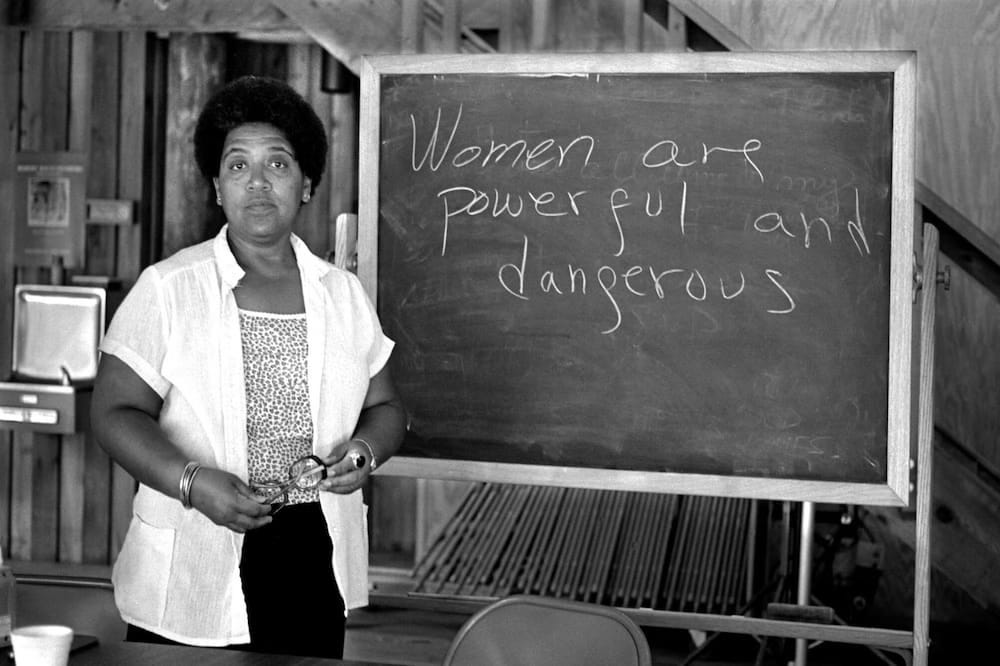
“Power properly understood is nothing but the ability to achieve purpose. It is the strength required to bring about social, political and economic change.”
—Martin Luther King Jr., Where Do We Go From Here (1967)
In last week’s post, “This is Your Nervous System on Fascism,” we reviewed the Window of Capacity model, and introduced the basic concept of nervous system training as a means to help us hold steady in the face of increasing external stressors (this week alone has been full of them, from Davos to Minneapolis).
I have more to say about that model— and how it isn’t always a perfect fit for everyone. In fact, I had a whole post written— but as I sat down to write this morning, I found that there was something else “that wanted to come into the world through me,” as my favorite Jungian analyst, James Hollis says.
I want to talk about power.
The language of “regulation”
So much of what we learn about the nervous system— especially online, where there is little room for nuanced or balanced conversation— is framed in language that is overly clinical and potentially pathologizing.
Two terms that are frequently used are “tolerance” (as in “Window of Tolerance”), and “regulation,” as in, “We need to do a better job of regulating our nervous systems.” What are we learning to tolerate? What are we having to regulate ourselves for, and for whom? This language can reinforce the very oppressive systems that were causing much of our distress, and the focus on personal responsibility for “managing our stress” keeps us from questioning the cause.
Additionally, there is a sort of binary “right and wrong” implication that creeps into the conversation. Fight or flight is treated preferentially, as a “healthy” nervous system response, while “freeze” and “fawn1” are tinged with shame.
Imagine RFK talking about the nervous system response. "Oh, you couldn’t fight the bear? You couldn’t run away from the bear? I guess the best you could do is play dead. Maybe if you spent more time in the gym.2”
There are no bad survival strategies; there is only survival. Nor, in my mind, is there any such thing as “maladaptation”— how can we judge, or pathologize, any adaptation that keeps us alive in a system that would otherwise kill us? Even the common term “dysregulation”— used within a system that is inherently dysregulating— can, at times, imply a judgment3.
For me, having a conversation about— or even doing nervous system training— isn’t enough. We have to also consider how our individual systems fit into the larger systems of our lives, and how we want to live in the world.
One way to think about this is through the “locus of control” continuum.
External, internal, balanced: locus of control
In the graph below, you can see that on the far right, we have individuals who have strongly internalized the idea that they are personally responsible for their life circumstances (and especially, for this conversation, their mental and physical wellbeing). These individuals are living in a state of inflation; they disregard external circumstances, and expend their energy inwardly, regulating, blaming and managing themselves. Alternately, these individuals may be inflated in a different sense— using and abusing their power in narcissistic ways— but again, that’s another post.
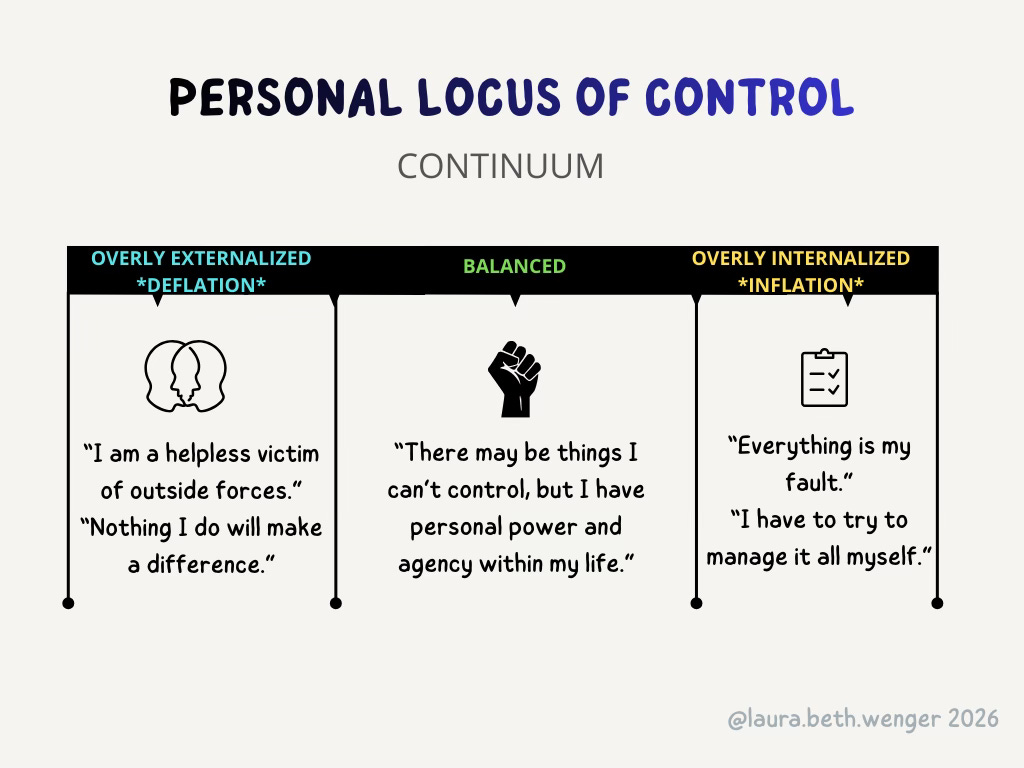
This internalized position is reinforced by our culture’s neoliberal complexes and the emphasis on personal responsibility. For a stark look at how this is being emphasized in 2026, you can check out realfood.gov (I refuse to link to it, so you’ll have to type it in yourself) which tells us that “America is sick” because of our poor food choices. Never mind any of the other biological, social, environmental, or psychological causes of illness— just shop better.
Or, from this internalized, inflated position, we find ourselves caught in the endless cycle of “biohacking” or “self-optimization;” another way to keep us stuck, as Tull says:
“Participating on the treadmill of hierarchy and constant self-improvement to either maintain one place or move higher up the scale, is it self a full-time job that takes us further, and further away from authentic power.”
-Deborah Eden Tull, Luminous Darkness 4
On the other side of the continuum, we have individuals who feel that they can’t control anything in their lives, because they have an overly externalized locus of control. They probably don’t go around saying “I’m a helpless victim,” but you may recognize them from their general apathy and nihilism. Why vote? Why do anything? Nothing matters. We can think of this as a state of deflation, which is what it sounds like. It’s hard to get around in the world if your tires are half-empty. May as well let the car rot in the driveway.
Few of us are totally stuck on one end of this continuum. Most of us bounce back and forth between opposite ends of the continuum, inflation and deflation. In turns, we both feel that it is up to us to try to do something and that nothing we do will make a difference.
Layering this over our “Window of Capacity” model5, you can imagine someone who’s ping-ponging back and forth between bouts of frantic energy (going to the gym! working extra hours! write my Senator! “Be the Change!”) and total collapse (burnout, exhaustion, feeling of failure).
Can you see how convenient this is for a system that wants to keep us from ever having the power to make REAL change? In terms of nervous system work— well, I bet those powers-that-be would be absolutely thrilled to know that we’re learning how to “tolerate” more.
So how do we get to that balanced locus of control, where we can both recognize an inherently unjust system and our own capacity for personal and global change?
This is where Jung’s work comes in.
Our inner and outer dictators
“In childhood we learn, overlearn, our powerlessness; we internalize authority figures and societal norms and later, as adult worker ants, serve them slavishly. To run counter to them causes us inauthentic guilt and anxiety.”
-James Hollis, Swamplands of the Soul
These internalized authority figures drain our life force; they keep us stuck, like “worker ants” in the cycle of inflation and deflation I’ve described above. And while we may not be consciously aware of them, we can see, hear, and experience them directly through our dreams.
I have tracked the effects of our increasingly totalitarian government not only in my nervous system, but in my dreams (and the dreams of my clients). As things escalated in the “real world,” my dreams reflected not only my very-real fears about what was happening in my country (concentration camps, casual s*xual assault, murder), but also my internalized sense of power— or powerlessness.
Working with these dreams and integrating what I was learning from them into my waking life, things started to change for me. In my dreams, Trickster figures emerged, helping my dream-ego (that is, the “me” in my dream) escape from a mob of angry men. I learned, in my dreams, that I could lie, rather than submit to the authoritarian figures that threatened me. In other dreams, my dream-ego grew stronger. In recurring dreams where I’d had previously to submit to thankless, repetitive tasks, I found myself saying, “I don’t have to do that,” and walking away. And figures that had always been dictatorial— a mean old boss, for example— apologized to me. In waking life, I felt myself sliding to the middle of that continuum graph above. Yes, things really were as bad as I’d feared they’d be— but I didn’t feel completely powerless.
Jung’s transcendent function
The two opposite ends of the “locus of control” continuum represent two opposite ways of thinking about ourselves. When we are in an inflated state, we think of ourselves as powerful, omnipotent, totally able to make change.
As an example, I’m thinking of that “75 Hard Mental Toughness” challenge people were doing a few years ago. For 75 days, these die-hards committed to following a particular diet; doing two workouts a day; drinking a gallon of water, and reading 10 pages of non-fiction a day. As long as this was working, these folks were SO INFLATED. They didn’t even let the thought of failure enter in. Some of these people, later, became so completely deflated that they were utterly disenchanted with any kind of exercise or program. “Never again,” they swore. Each aspect of this individual’s personality— “Die-hard” and “Never again” would barely recognize the other— this is how well we silo off our opposite parts.
I think of inflation and deflation— or any opposite personality positions— like two roommates that share the same apartment, but work opposite shifts. They never see each other, and they don’t even want to know about the other one. “This is my place,” they think. But each of them, through their extreme approaches, is creating a huge mess in their shared living space that will have to be dealt with eventually.
Here’s where Jung’s “transcendent function” comes into play:
“The shuttling to and from of arguments and affects represents the transcendent function of opposites. The confrontation of the two positions generates a tension charged with energy and creates a living third thing... a movement out of the suspension between opposites, a living birth that leads to a new level of being, a new situation. The transcendent function manifests itself as a quality of conjoined opposites.”
—C Jung, “The transcendent function”6,
In other words, we need to get these two roommates- Inflation and Deflation— into the same room and have a talk, so that a new position, a new attitude, a more-balanced approach can be achieved.
A case study in power and “service”
“For within living structures defined by profit, by linear power, by institutional dehumanization, our feelings were not meant to survive….We have hidden that fact in the same place where we have hidden our power. They surface in our dreams, and it is our dreams that point the way to freedom.”
—Audre Lorde, Poetry is Not a Luxury
Let’s consider this simple dream7:
I am at a restaurant I like a lot. Waiting for the food, I see the person next to me eating a beautiful, elaborate little dish. A waitress asks me to bring some plates to other diners, and I am happy to help. It feels fun. I take two plates to two tables and a check to another. The person who was next to me asks for another appetizer because this one was so hard to eat. I am surprised at her nerve as it seems like that’s asking for too much, but then realize it’s probably fine and she deserves to get another one. Then I realize it is time to leave and I haven’t gotten to eat anything.
This dreamer recognized, through this dream, how she is “always expected to serve”— and that she never gets to eat herself. This hit her pretty hard; she recognized, felt in her body, how physically tiring, how sad, how achingly familiar that feeling of over-responsibility is.
What about the woman who’s “asking for too much” but “deserves to get another” dish? This, too, hit home. The dreamer said, “Oh…it’s not wrong to ask for what you need.” She took a deep breath, here, as this settled in. The roommates are finally talking.
This dream was nudging the dreamer toward a greater sense of balanced agency. The waitress, representing outside forces (deflated, overly-externalized locus of control)— asks her to “serve;” but it also highlights her overly-internalized locus of control— “I am happy to help.” It’s the other patron whose “nerve” shows the dreamer the way toward a real, balanced agency.
Rebalancing power, starting with ourselves
Nervous system work is an important start, especially in a culture that is wreaking havoc on each of our individual systems. If we stop there, however, we’re stopping short of reclaiming our personal and collective potential— whatever that may be.
Our nervous system is interdependent with our psychic system: they are not separate. As we stabilize and widen our window of capacity, more life force becomes available in the form of peace of mind and ease of body. And when we are not caught in an infinite loop of activation/collapse, or inflation/deflation, we have greater freedom and vitality to engage with our life’s work.
“Inasmuch as collectivities are mere accumulations of individuals, their problems are accumulations of individual problems. One set of people identifies itself with the superior man and cannot descend, and the other set identifies itself with the inferior man and wants to get to the top.
Such problems are never solved by legislation or by tricks. They are solved only by a general change of attitude. And the change does not begin with propaganda and mass meetings, or with violence. It begins with a change in individuals. It will continue as a transformation of their personal likes and dislikes, of their outlook on life and of their values, and only the accumulation of these individual changes will produce a collective solution.”
—CG Jung, Psychology and Religion8, CW 11
Thanks for reading, y’all— wishing you both some ease and power for the week ahead.
XO,
Laura
PS. If you’re into this kind of thing, my colleague (and go-to breathing expert) Jennifer Snowdon and I are offering our Better Breathing for Trauma 4 week course again in April. See what you think and sign up here.
I didn’t include this last week— too big a topic— but “fawning” is another trauma-based survival response in which a person copes with perceived threat by appeasing, pleasing, or submitting to others in order to stay safe, avoid conflict, or prevent abandonment.
in your jeans, of course.
I know that scientifically speaking, the term has no moral weight. However, in common use, I believe it does, if only because the system places the burden on the individual to “regulate” themselves. More on this shortly.
Tull, D. E. (2022). Luminous darkness: An engaged Buddhist approach to embracing the unknown. Shambhala Publications. ISBN 978-1-64547-077-9.
Again, an oversimplification, but maybe helpful as an example.
Jung, C. G. (1960/1969). The transcendent function. In The Collected Works of C. G. Jung, Vol. 8: The Structure and Dynamics of the Psyche (2nd ed., trans. R. F. C. Hull), ¶189. Princeton University Press.
All dreams are shared with explicit permission and identifying details changed to protect the identity of the dreamer.
Jung, C. G. (1958/1969). Psychology and Religion: West and East. In The Collected Works of C. G. Jung, Vol. 11 (2nd ed., trans. R. F. C. Hull), ¶¶134–135. Princeton University Press.
So challenging to regulate your nervous system when there is a daily onslaught of overwhelming external stressors in the world. Some days it's like trying to find our personal balance while walking a tightrope between the tension of the opposites!