


I don’t know anybody who doesn’t feel stressed out.
Whether they’re in high school, retired, or just trying to figure out their social lives, everyone I know seems to be feeling a sense of urgency, frustration, or “I should be doing something differently, but I just don’t know what that is.”
Our culture reinforces this idea with countless articles, podcasts, and services marketed to create greater efficiency or performance in our lives, or to maximize our health, or earning potential. So many of my clients are asking themselves (and me!), “What should I be doing differently? Why can’t I get it right?” Unfortunately, this question, rather than solving the problem, often serves to cause greater anxiety and stress.
So today I want to offer a prompt that I have found really helpful to address this existential idea that something is wrong, we are wrong, we should be doing something differently.
It’s just this: Notice where you are putting pressure on yourself.
Sound too simple? Stay with me and I hope to show you just how transformative this can be.
Language of agency
In the NARM (NeuroAffective Relational Model) framework, one of the simplest ideas is also one of the most powerful. The way we speak to ourselves reveals how much power we believe we have over our own lives.
Somewhere in the space between "I have to" and "I’m choosing to," between "I can't" and "I'm making a choice not to," lives the entire question of our agency.
According to NARM, unresolved developmental trauma doesn't just live in memories or body sensations — it lives in the very way we narrate our experience. The language of survival is the language of no choice: I have to, I need to, I can't, I should, I must.
This is true not just for those who’ve lived through adverse childhood experiences, but for all humans who’ve had to make a choice between authentic self-expression and “fitting in” to a society that doesn’t value differences. We’ve learned that our desires can be dangerous. Somewhere along the way, we made a choice to cut off parts of ourselves that were not acceptable. We can think of this choice as an unconscious strategy that we knew we “had to” use to keep going.
These strategies, and their accompanying internal narrative, become so habituated that we can continue to use them for the rest of our lives— denying ourselves agency without even recognizing it.
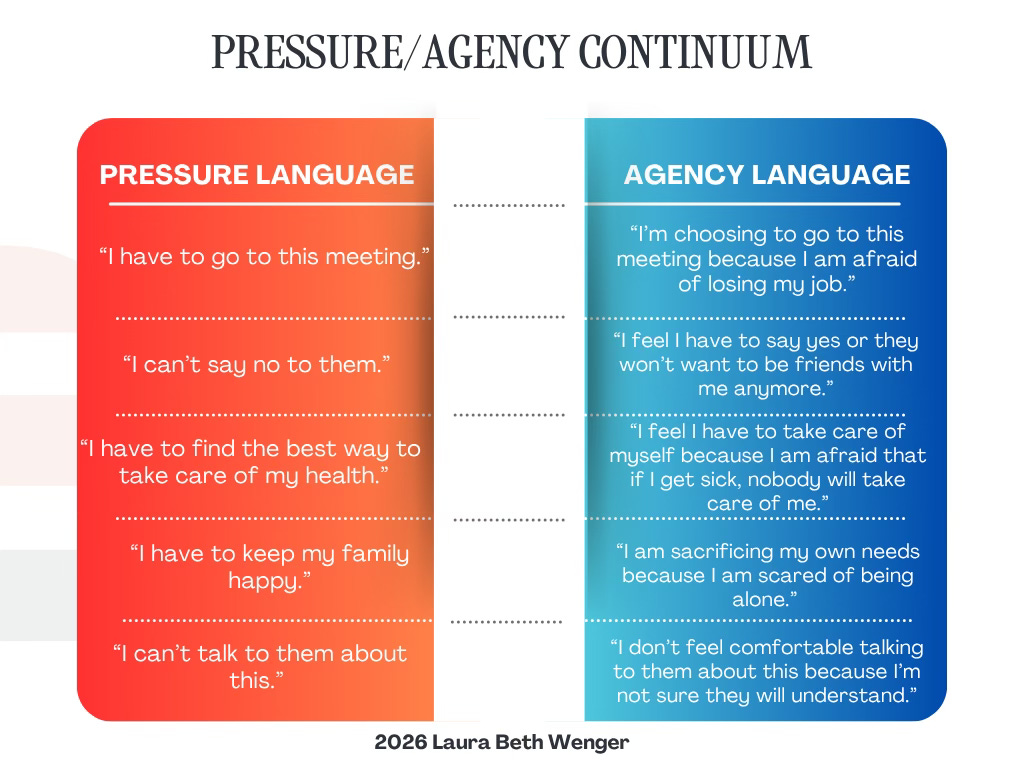
In the image below, we can see exactly how our habitual “pressure” language (our old survival strategy) might sound if we shifted it into “agency” language. Agentive language doesn't deny difficulty. It doesn't pretend that everything is easy or that you can manifest your way out of real constraints. It simply insists on locating the truth accurately: Who is making this choice? And why?
Bringing our agency out of the shadow
From a Jungian viewpoint, the parts of ourselves that we’ve cut off live in the “shadow;” the unconscious part of our psyche that holds all of our unmet potential; everything that’s been repressed or undeveloped because it was unacceptable, shameful, or incompatible with who we felt we need to be.
Our ego— that is, our conscious mind— is heavily invested in maintaining its own sovereignty. It doesn’t like to look at what’s in the shadow, because it doesn’t want to change. This is one of the reasons why we continue to stick to our old patterns— like pressuring ourselves. We've internalized this strategy so deeply we can no longer see it as a choice — it just feels like reality.
It can be surprisingly uncomfortable to own our own agency; to recognize that we have more choice than we previously thought. This is where Jung's concept of the shadow becomes useful — because learned helplessness isn't just a behavioral pattern. It's one of the things we've tucked most carefully out of sight: the belief that we are capable, that our actions matter, that we are allowed to have needs of our own.
Perhaps you’ve heard the term learned helplessness. This refers to the psychological state that develops when a person (or animal) experiences repeated situations where their actions have no effect on the outcome — and then stops trying, even when circumstances change and action would work.
It was first identified by Martin Seligman in the 1960s through experiments with dogs exposed to inescapable shocks. When later given a way out, the dogs didn’t take it. They had learned — at a nervous system level — that trying was pointless.
In humans, this looks like a deep conviction that effort won't change anything; passivity in the face of solvable problems. We may experience difficulty initiating, deciding, or advocating for ourselves. There’s a kind of flattened affect around possibility — not quite depression, but a collapse of the sense that you have any real effect on your life.
This is why agency language is so powerful. "I can't" isn't just a word choice — for someone with a history of learned helplessness, it's the voice of a nervous system that stopped believing in its own efficacy. Compassionately returning to what you are choosing and why is a way of slowly retraining ourselves to recognize where we may be able to make a different choice. We reclaim the power and agency that’s been waiting for us in our shadow.
"I have to" collapses time. It erases the moment you made a decision and replaces it with inevitability. Agency restores that moment — and with it, the possibility of something different.
Compassionate inquiry
“If you’re determined to think of yourself as limited, fearful, vulnerable, or scarred by past experience, know only that you have chosen to do so, and that the opportunity to experience yourself differently is always available.”
-Yongey Mingyur Rinpoche, The Joy of Living
Here’s a simple practice to explore.
Can you think of a time in the past few weeks when you’ve put pressure on yourself? “I have to,” “I should,” or even just a sense of “needing to” do something differently?
Sit with the statement for a moment. Notice any physical sensation — tightening, holding, shrinking.
With kindness, ask yourself why you are putting pressure on yourself. There’s always a reason— why does it feel like you “have to”?
Now try:“I’m choosing to ___ because ___.”Even if the “because” feels like it' doesn’t make sense. Even if it’s just “because I’m afraid of what happens if I don’t.”
Notice if the sensation in your body shifts at all. How does it feel to acknowledge that you’re making a choice? Notice that you may immediately begin to pressure yourself to do something differently— this is another choice, too.
Stay with whatever arises. Grief, relief, resentment, anger, exhaustion — all of it is information.
This isn’t about toxic positivity or pretending you have more freedom than you do. Sometimes the honest answer is: “I’m choosing this because I genuinely have no safer option right now.” That’s still agency. Knowing why you’re doing something — even under duress — is very different from believing you’re helpless.
‘Whoever you are, no matter how lonely’
Moving toward greater agency can be a slow process— we don’t suddenly feel free. This is actually, in my experience, a really good thing. It would be overwhelming to suddenly feel that we have too much choice— like a caged bird who doesn’t yet know how far she can fly. Rather, this is a developmental process that unfolds as increasing internal spaciousness. We glimpse greater freedom as our wings grow stronger to fly.
Within this process, we discover that we are not just surviving, but actually living our lives. We understand that while the choices we’ve made have always been for good reasons, we now have more choices, and better ones, available to us.
You do not have to be good.
You do not have to walk on your knees
For a hundred miles through the desert, repenting.
You only have to let the soft animal of your body
love what it loves.
Tell me about despair, yours, and I will tell you mine.
Meanwhile the world goes on.
Meanwhile the sun and the clear pebbles of the rain
are moving across the landscapes,
over the prairies and the deep trees,
the mountains and the rivers.
Meanwhile the wild geese, high in the clean blue air,
are heading home again.
Whoever you are, no matter how lonely,
the world offers itself to your imagination,
calls to you like the wild geese, harsh and exciting --
over and over announcing your place
in the family of things.-Mary Oliver, ‘Wild Geese’
For those of us who have lived a lifetime of pressuring ourselves, these first four lines of Oliver’s ‘Wild Geese’ are especially resonant. What would it be like, we might wonder, not to have to “be good?” To simply “let the soft animal of our body love what it loves?”
To ask ourselves where we’ve pressured ourselves— and why— does not mean denying our outer circumstances, or attempting to bypass the reality of injustice and oppression. Rather, by recognizing where we are making a choice, and why, “the world offers itself to our imagination.” There are possibilities we’ve never dared dream that we may only know when we “announce our place in the family of things.”
Happy Sunday— or whenever you get to this! Thank you, as always, for reading and sharing my thoughts and feelings. If you like what you are reading, please don’t forget to like, comment, and restack— it really helps. Finally, if you can afford to do so, please consider upgrading your subscription as well. It supports my work, and you get free access to my online streaming site.