


Hi, subscribers! Thank you so much for reading. If you enjoy this piece, please don’t forget to like, comment, and restack— it really helps. Finally, if you can afford to do so, please consider upgrading your subscription as well. It supports my work, and you get free access to my online streaming site.
The murmuration model
Thanks to Descartes (“I think, therefore I am”) and his pals, we tend to think about the mind and the body as two separate entities. At one extreme, we think that the brain directs the body (Cognitive Behavioral Therapy is a good example). At the opposite end, we think that “the body keeps the score,” and that the vagus nerve directs all of our behavior. But I think it’s much more complex than that.
A few years ago, when Jennifer Snowdon and I began to put together our “Better Breathing for Trauma” program, we were struggling with a way to explain the way that we work with clients. The essential problem was this: humans are really complex. And while both of us have been trained in multiple modalities, we found that there is no “one-size-fits-all” explanation we could offer for why some people needed social engagement time (just talking!) before we could change their breathing patterns, or address their knee pain; or why others responded best to yoga nidra, or a drawing exercise first.
When Jennifer stumbled on the quote below from a paper by Thayer and Lane, she knew she’d found something important.
“From a dynamical systems perspective an organism is a complex set of reverberating circuits or sub-systems working together in a coordinated fashion… the emotional response ‘emerges’ from the interaction of the various subsystems with the environmental demands and this response is not orchestrated from a central command center.”
– Julian Thayer and Richard Lane, “A model of neurovisceral integration in emotion regulation and dysregulation”
What these researchers are saying is that within the human system, there is no one part that’s in charge. We can make adjustments to the whole organism at multiple points— through talking; movement; social connection; environmental changes— literally everything can be a way to change our emotional, physical, or mental experience. Each of us is a dynamic, complex system.
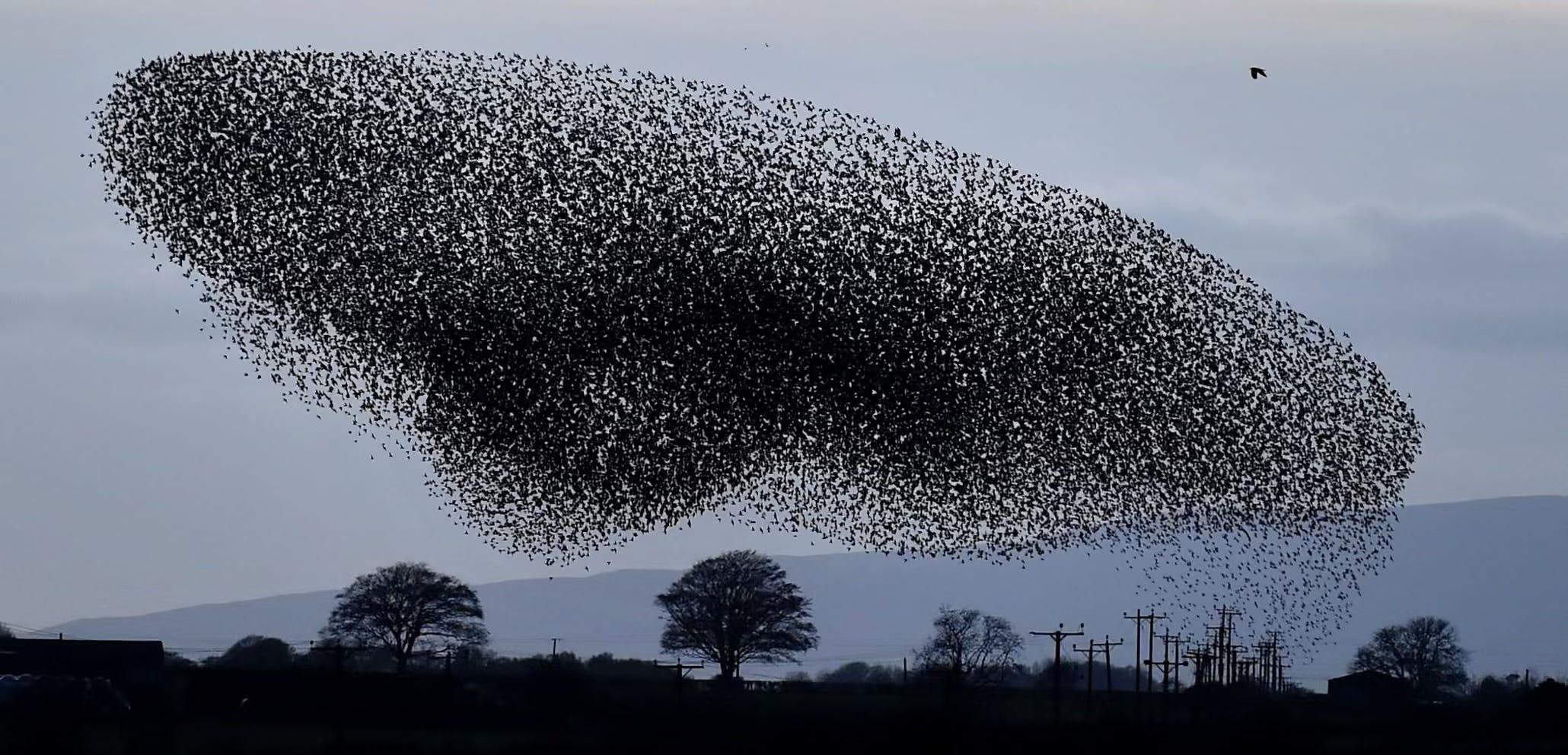
When Jennifer shared this with me, I immediately thought of adrienne maree brown’s Emergent Strategy:
“Guided by simple rules, starling murmurations can react to their environment as a group without a central leader orchestrating their choices; in any instant, any part of the flock can transform the movement of the whole flock.”
Any part of the “flock” can transform its shape and direction.
Changing flight patterns
Ideally, the dynamic system of our body is fluid and adaptable.
When one part of our system perceives danger (our eyes see a threat, or we hear a gunshot), the rest of the “flock” mobilizes. Our bodies and minds shift into a pattern to fight, or flee, conform, or hide. Once the danger has passed, we should be able to return to our more “optimal” patterns— relaxed bodies, easy breathing— as we settle back in our “window of capacity.”
For those of us with a history of complex trauma, or chronic stress, the patterns of our flock can get “stuck.” We’re always circling, looking for danger; or we’re so tired we can’t seem to get off the ground.

Our body/mind systems are a direct reflection of our physical and psychological histories, and show up as patterns like chronic aches and pain, depression, anxiety, illness, exhaustion, and a thousand different diagnoses. And because we are a dynamic system— we are more than just our aching neck, our insomnia, our inability to take a deep breath— we can shift the patterns by addressing a different part of the system. That’s why talk therapy might cure your IBS, drawing a picture can make your headache go away, or working through dream imagery can shift your anxiety. The response “emerges” naturally as the whole system shifts.
Connection, disconnection
We can also think of our “flocks” in terms of connection and disconnection. Our bodies are both how we connect with, and how we disconnect from, the world, from each other, and from ourselves.
We connect with others through mechanisms like mirror neurons, which allow us to literally feel what others are feeling; or oxytocin, which helps us to bond to our loved ones. We can also mobilize patterns of disconnection to keep us safe from dangerous others, preparing us to fight, or flee. And in worst-case scenarios, we have a pattern that allows us to disconnect from our bodies through dissociation— a literally life-saving mechanism.
A quick somatic experiment:
Close your eyes (if you like), and imagine yourself in an unfamiliar country, surrounded by people you do not know or trust. How does your internal experience shift? What happens with your breathing, your heart rate, your posture, your sense of safety, ease or comfort? Is it difficult to stay present? What does your body want to do?
Now, remember a time when you were with people who love and understand you best. Or, recall how you feel when you are alone in your favorite place. What sensations do you feel in your body? What happens with your breathing, your neck, shoulders, chest and belly? How relaxed do you feel? What emotions do you notice?
Notice that even imagining different social and logistical dynamics has a direct and immediate effect on our systems— yet another possibility for shifting patterns!
When our “flock” is mobile, fluid, and adaptive, it is able to connect and disconnect with others as needed. Before we can do this, we may need to get better at connecting to ourselves; by becoming more familiar with our own flock, the multitudes of sensations, emotions, reactions that comprise our experience.
In the practice below, we begin with a brief check-in to explore different parts of our system, and then engage in a "figure 8” practice (read more about this symbol here). After, check in again and notice how your flock may have shifted.
Freedom in the flock
“(T)he truth is that things don't really get solved. They come together and they fall apart. Then they come together again and fall apart again. It's just like that. The healing comes from letting there be room for all of this to happen: room for grief, for relief, for misery, for joy.”
-Pema Chödrön, When Things Fall Apart
One of the reasons I find this model so powerful is that it normalizes a full range of life experiences— as Ani Pema says, things “come together and fall apart” over and over again. An understanding of ourselves as a system that meets life where it is is inherently nonpathologizing in a way that many other models fail to grasp. It also allows for possibilities beyond what we might otherwise imagine.
One of the core teachings of Tibetan Buddhism is that we are not a solid, fixed, permanent “object,” but an ever-changing process. “Mind,” in this tradition, is not a noun, but a verb— something that is unfolding over and over again in new and perhaps unexpected ways.
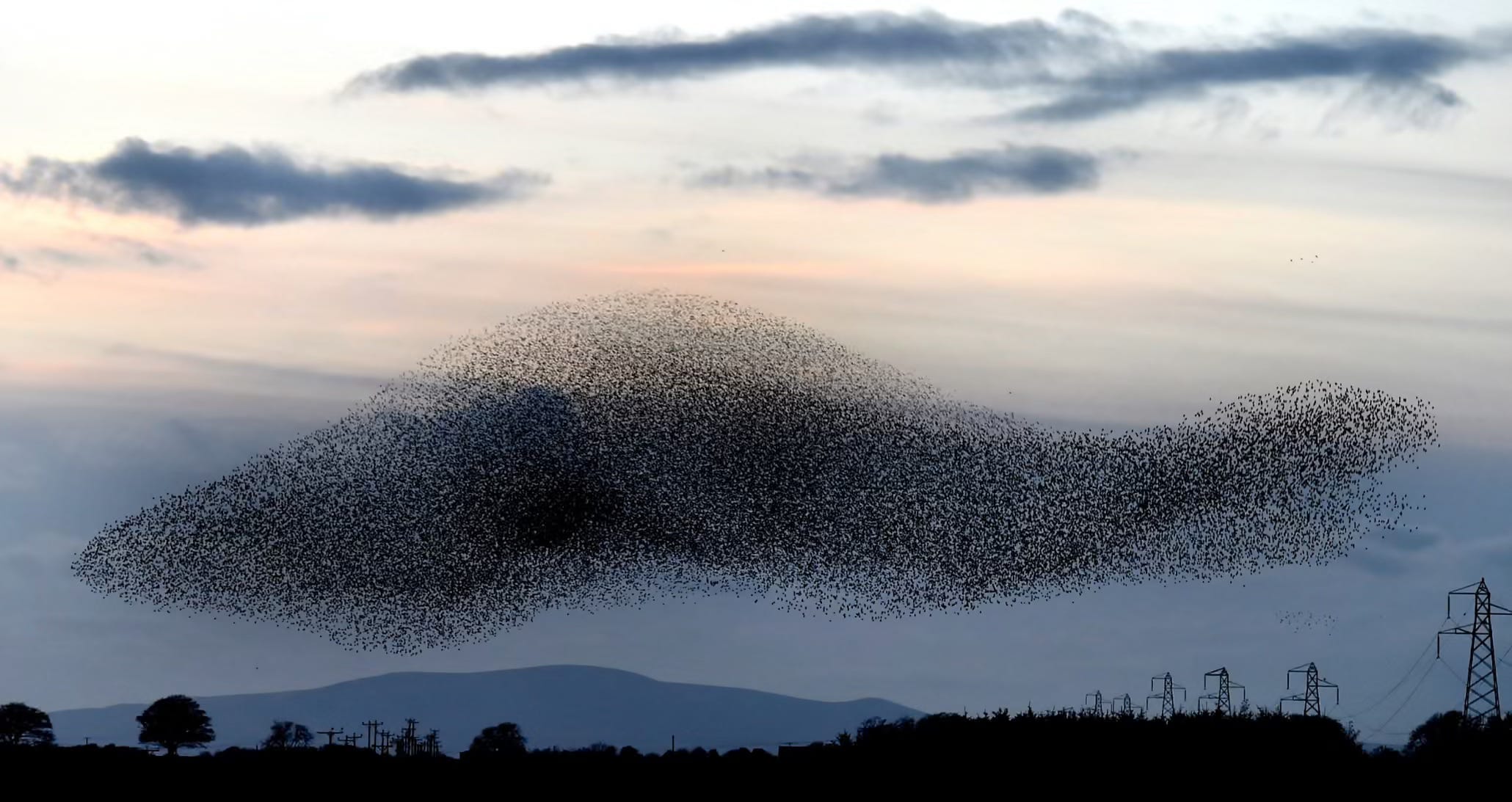
The mere experience of thinking about ourselves as a system rather than a rigid identity loosens ideas about ourselves (“I’ll always be broken,” “This pain will never go away”) and can start to shift our “flock” in new directions. In this view, even our most entrenched patterns are not solid. Here, at the intersection of ancient Tibetan Buddhism and modern neuroscience, the visual image of the murmuration model resonates— each bird moving seamlessly as part of a whole, a living, breathing constellation.
My sense is that we feel these murmuration constellations reverberate with us on such a deep level because they embody truths our souls know, but rarely name:
We are an infinitesimally small part of something greater.
We are not the solid, individual things we take ourselves to be.
We contain multitudes.
Thank you for your beautiful summary and insights. So grateful to have been able to work with you in this.