


We don’t so much solve our problems as we outgrow them. We add capacities and experiences that eventually make us bigger than the problems. -CG Jung
Since the first time I laid down on my yoga mat and felt the full-body satisfaction of savasana, I’ve been fascinated by the interconnection of body and mind— the way that moving the body can shift a mood so completely, without words or conscious mental effort.
In the mental health world, we call this the “bottoms-up” approach (as opposed to the “top-down” protocol of talk therapy), and it’s been the cornerstone of my approach to movement for the past decade. I’m not interested in how ripped my client’s abs are, or whether they can do a handstand or run a 5k (unless they want to!). I want to know how we can use the body to feel better about ourselves in our psyche, too— mind, heart and soul.
The existential question of stability
There are many ways to use movement or embodiment practices to support mental health, but one of the first things I look at is how stable and settled that person feels generally. Is there an existential sense of emptiness, or fragility? Can they feel their feet on the ground, or are they just floating along? Are they able to take a complete breath, or are they on high alert, ready to run? Can they trust their bodies to hold them up, or are they perpetually braced for impact?
While we can’t change the external circumstances of our lives, we can create strategies of more-optimal stability within our bodies to better withstand the challenges of our lives. Many of us were born with a system that needs a little extra support or training to feel safe and stable, or we’ve had experiences that required us to adopt embodied strategies for safety (feeling like we always need to be ready to run, for example— a good short-term strategy, but not one that we want to keep long-term).
Having a sense of stability and a “safe-enough” container in our body is critical to be able to do deeper work, too. In Jungian psychology, we need a strong-enough ego strength to be able to withstand the tension of change. Many of my clients have found that as they were re-establishing a more stable experience in their bodies, their relationship to once-overwhelming life stuff just got a lot easier. As Jung said, “We don’t so much solve our problems as we outgrow them. We add capacities and experiences that eventually make us bigger than the problems.”
What your shoulder blades have to do with it
So, you’re thinking, okay. Core strength, that makes sense. But shoulder blades? Hear me out. Your relationship to your shoulder blades says EVERYTHING about how you stabilize yourself, breathe, and move through the world.
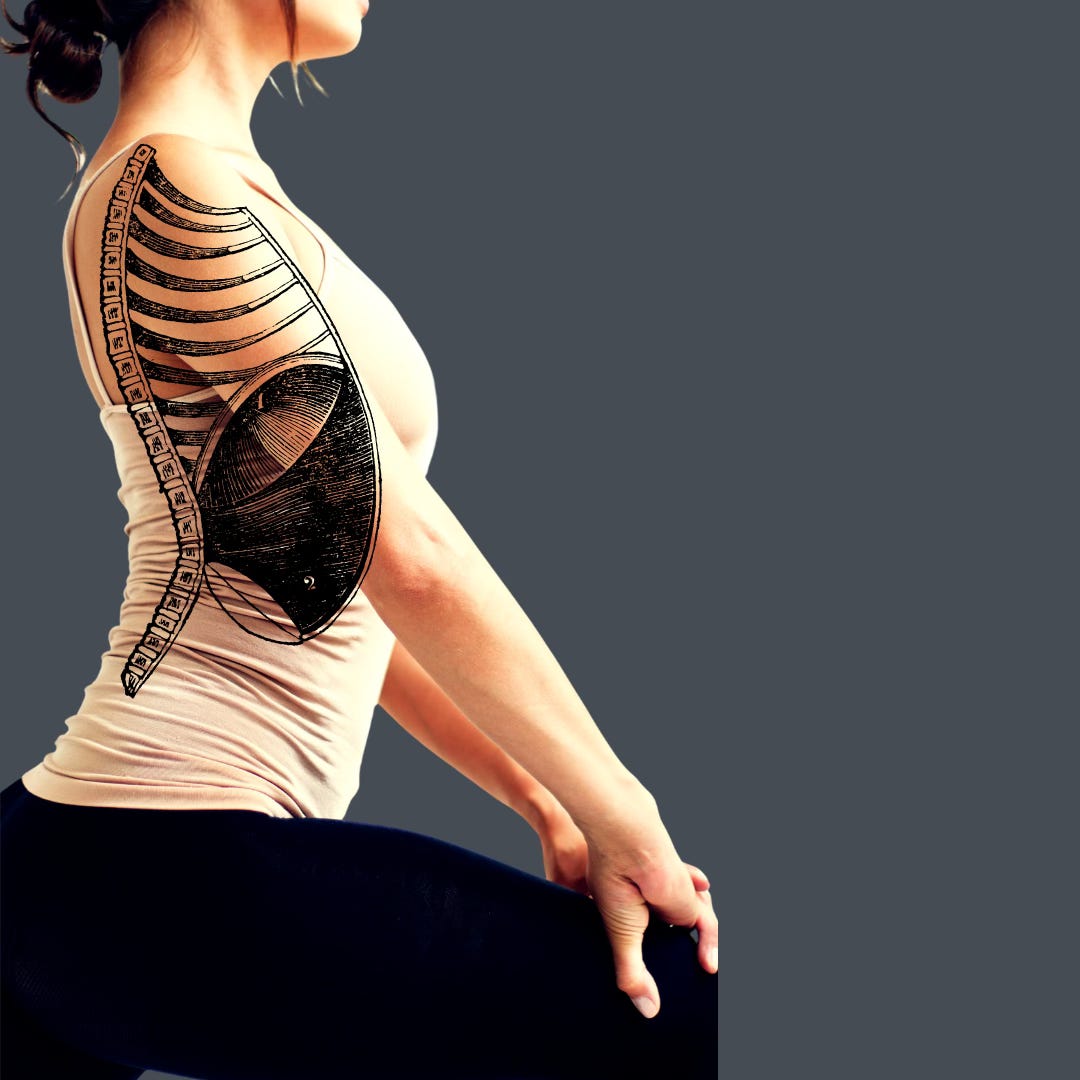
Our shoulder blades sit on the back of our ribcage. If you look at the video below, you’ll see that they’re slightly concave; that curve is meant to fit up against the back of our ribs:
However, many of us are accustomed to having our ribs forward, like this:
We need to be able to move our shoulder blades around, but it’s especially important for them to be able to anchor onto the back of the ribcage. Without this placement:
You cannot utilize core strength (intra-abdominal pressure- more on that here)
You can’t take a complete breath (more on that here)
You are more likely to have neck, jaw, shoulder tension or discomfort
Your brain feels less safe— along with its sense of your feet and your molars, it relies on the sense of your scapula on the ribcage to feel stable
Your range of motion is going to be limited, not just in your shoulders but throughout your entire body
Your shoulder blades are more likely to be moving around in suboptimal ways on the back of your ribcage, increasing likelihood of impingement and injury
All of these things together reinforce a sense of “sometime’s wrong” in our system and can leave us feeling less stable, less confident, less mobile, and more vulnerable, stressed-out, and anxious.
Some really good news about all of this
I know that list above is pretty drastic, but it’s all quite changeable, and the last thing we need to do is feel worse about anything in our bodies. Listen, all of this is SO COMMON. Most people you know are kind of lost with their shoulder blades. But the most important action is really quite easy to work on, and it’s not like learning a new language— it’s recovering a movement possibility that your brain and body will actually really like, once you get it.
Here’s a great place to start:
Grab a light stretchy band (like a Theraband) and place it behind your back and under the armpits. Hold one end in each hand.
Reach your arms forward and keep your elbows straight. Feel how the band wants to pull your shoulder blades together and use the reach of your arms to sense how your two shoulder blades are pulling apart from each other, away from the spine.
Now, KEEPING YOUR ELBOWS STRAIGHT, allow the band to pull your shoulder blades back toward each other. Feel the muscles between the shoulder blades contract and shorten.
Repeat, keeping your neck and jaw relaxed. Especially as you reach your arms forward, your shoulder blades might want to creep up toward your ears— don’t let them! The shoulder blades should move away from the spine (protraction) without elevating.
Finally, pause with your arms reaching forward, and see if you can breathe into the back of your ribs— that place between the shoulder blades. Keep your breath easy and light. Notice the muscles that are working to hold you in place as you do this.
As simple as it is, this is really the essential action of repositioning your ribcage for better scapular stability. Of course, there is more work that needs to be done to integrate it, and to make it a new default pattern— but if you work on this piece consistently, you may find some other things starting to shift.
For those of you who want to really explore these actions, I’m including a 35-minute “practice with me” video below:
This is a free sample from my streaming subscription site. If you give it a try, please leave a message and let me know how it goes— how did your neck, shoulders, and jaw feel afterward? How about your mental state? What was challenging for you? And would this kind of post be useful to you or one you’d like to see more of, maybe as premium content?
That’s it for this week! Until next time, take care of yourselves, and stay in touch! 💚
Laura, Thank you. Never heard of this approach before.
Laura, Thank you. No one ever explained or taught that the rib flare and the the seated yoga pose activates the sympathetic nervous system. It makes so much sense. I have been stuck in this for years. I have a better understanding of my rib flare, scapula connection and diaphragm dropping back into the breath.