


If you’re curious about the intersection between physical and mental health, you might be interested in the upcoming 4-week series on ‘Better Breathing for Trauma I’m cohosting with my colleague and friend Jennifer Snowdon in April. Read more and register here.
The body is merely the visibility of the soul, the psyche; and the soul is the psychological experience of the body. So it is really one and the same thing.
—CG Jung
On June 27, 2022, I had the following dream:
My teeth are breaking and falling out. At first, I could kind of put them back in, and they would stay in place if I was careful (this has worked in past dreams), but this time they just kept coming apart. I had a handful of broken grey teeth. I showed my brother’s ex gf-- I was a little hysterical. I made an appointment with a dentist to put in false teeth because previous repairs obviously had not worked. The feeling is terror, and also shame.
The day before, I had taken a train to Miami, where I met with a Postural Restoration coach. PRI was a modality I’d been incorporating in my practice for the past 18 months. Its emphasis on rebalancing the human body’s inherent asymmetry had helped several of my clients with all kinds of symptoms, from chronic heartburn to low back pain. But I wasn’t getting the results I was looking for in my own body, so I needed some help.
The coach I met tested me thoroughly and gave me several exercises to work on until our next session. The most memorable part, though, was when she told me, casually, to “click your back left molars every once in a while” as I was doing an exercise. I was stymied. “What do you mean?” I asked. “You know,” she said. “Have your top left molars touch your bottom left molars. Don’t clench, just make them touch.” She paused, seeing my face. “Oh,” she said. “Can’t you do that?”
Panic washed over me. Those teeth were nowhere near touching each other. I had read about the importance of molar occlusion in the PRI research— something I’d never heard anywhere else— but I’d somehow managed to ignore this glaring issue in my own body. In fact, none of my top teeth touched ANY of my bottom teeth— they never had.
Who cares about molar occlusion anyway
I’d always thought I was fortunate to avoid having braces as an adolescent. I never loved my smile, but it wasn’t something that I obsessed over. My teeth just didn’t feel like a big deal.
What I didn’t know— consciously, anyway— is that having proper “molar occlusion”— the ability to touch your molars to each other— provides the brain with an essential sense of safety and grounding.
If you take a look at my pre-braces teeth, you can see that my teeth were nowhere close to touching:
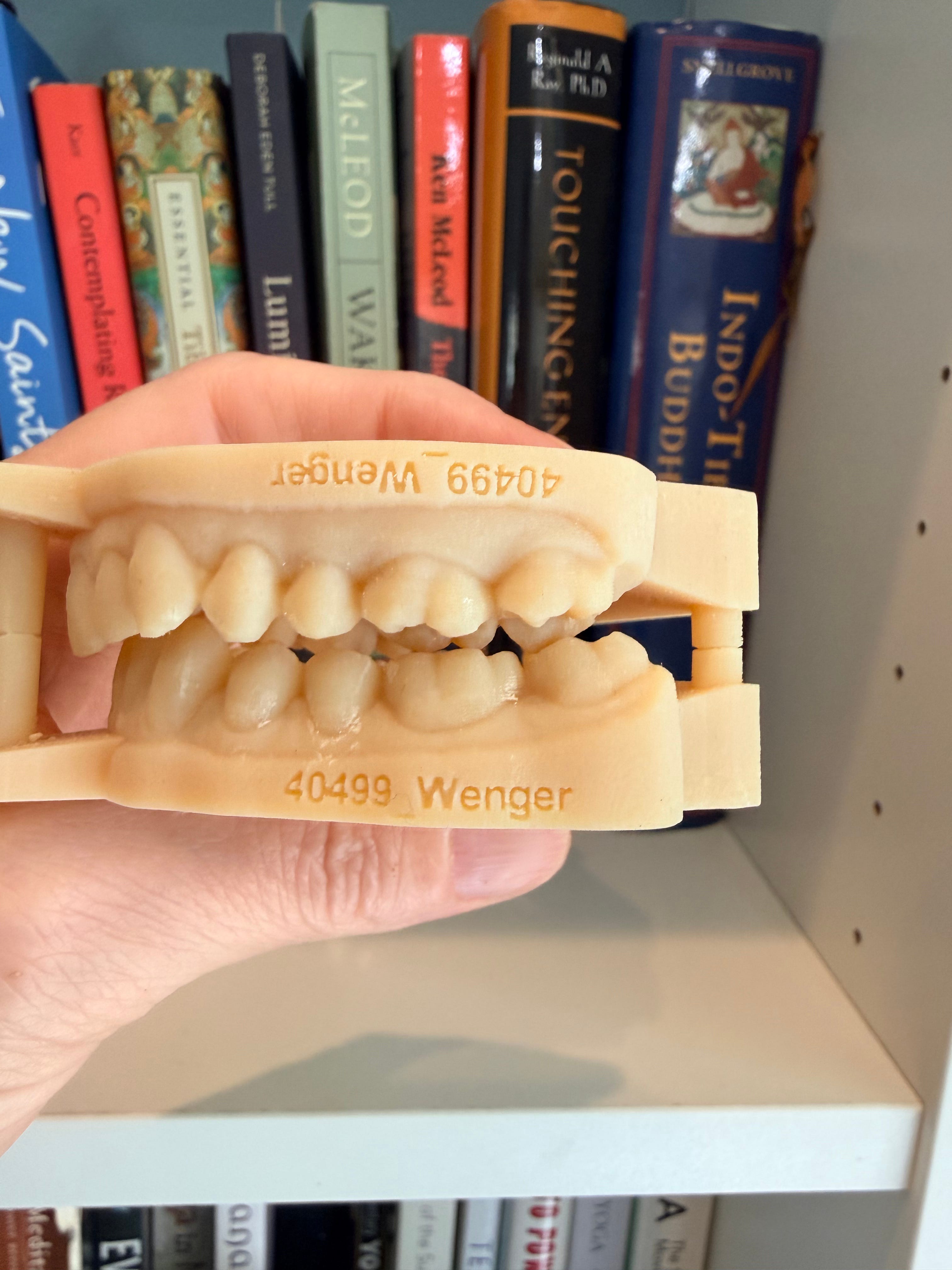
In my case, this meant that I was consistently clenching my jaw, trying to get some kind of contact, resulting in the deep overbite you see here.
It is not at all common knowledge, even among personal trainers, or physical therapists, but molar occlusion is critical for stability. These teeth play a proprioceptive role— helping our brain and body to understand where they are in space. Failure to achieve that contact means that our muscles will have to work in different, less optimal, patterns to stabilize our bodies.
This is why my chronically stiff neck, pinching hips, and limited range of motion weren’t something that I was able to “fix” on my own, because they stemmed from my brain’s existential need to find stability and safety in the absence of the molar contact it was looking for.
Teeth aren’t the only critical stability point (though they may be the most unexpected one). Feet are also key players. Our brain’s ability to sense heel and big toe contact are another commonly-missed issue, along with rib cage placement— when the rib cage is too far forward, our shoulder blades don’t have a good point of contact to rest on, creating more existential angst for our whole system.
Vision, too, is another huge component that is frequently overlooked. I’ve seen many cases where simply changing footwear, getting a new glasses prescription, or even just chewing gum (getting that molar contact!) took a person’s pain away instantly. All this time the brain was just waiting to get the feedback it needed to feel safe enough.
In my own case, the chronic hip, foot pain, and neck pain that I’d lived with for so long had failed to respond to all of the interventions I’d tried because my brain wasn’t able to sense “ground.” And it wasn’t until I found a physical therapist who was trained in both Postural Restoration and Applied Integration techniques that I was able to begin the three-year process of moving my teeth into the proper position to establish the contact I needed.1
The unbearable lightness of being ungrounded
Western medicine has created an artificial dichotomy between mental and physical health. I feel incredibly fortunate to have entered into the mental health field through the physical work I’ve done; it gives me a tremendous advantage in better understanding how and why people are suffering.
For example, individuals who struggle to know where they are in space— who feel “ungrounded”— are often likely to experience anxiety. In the case of hypermobile persons, we can provide tools and training to help them to experience their bodies differently. These individuals benefit from more feedback in their bodies— Therabands, blocks or balls between the knees, weighted blankets. This frees up bandwidth in their brain so that they can literally breathe more easily, engage more economical muscle patterns, and even enjoy the experience of being alive more.
For an individual who has trouble finding ground through their feet or teeth, like me, wearing shoes with enough of a heel cup or arch support for their brain to sense where their feet are in space can be enough to free up their range of motion. I can tell you that in my own body, although I love the natural feel of barefoot shoes, I cannot turn my neck very far while wearing them, and my calves will be exhausted after a short walk. Ironically, in “barefoot” shoes, my brain can’t sense the ground; my body has to work a lot harder to keep me “safe.”
This experience of being ungrounded in our bodies is a physiological nudge toward dissociation; a “lightness” that may feel pleasant and airy, at times (my physical therapist, Amy, said to me once, “you walk like you’re about to float off the ground!”)— but which is, overall, less present, less reality-based, and perhaps less able to cope with the needs of our time. As we’ve seen above, if we do not feel stable, we cannot effectively use our full range of strength and movement. The best we can do is brace ourselves.
Beyond body & mind: symbol 🦷
The last time I saw my grandmother, a few years before her death, she was chewing a piece of candy when a confused and sad look dropped over her face. She spat a broken tooth into her hand, and held it out to show me. The aching feeling of this sudden, almost terrifying loss— that tooth, once strong, now broken and useless— flooded me, an echo of my own recurring dream of broken teeth.
The Book of Symbols says of teeth,
“Symbolically, teeth represent a kind of individual psychic mill where what’s too rough to take in directly can be ground up by conscious consideration, digested and metabolized. Teeth also evoke other aspects of aggression…. Losing teeth is a common image in dreams, often bringing to awareness conflict around assertively grasping and integrating an aspect of life one needs to claim, or a compromised capacity for aggression in general. Or it may depict a state of anxiety, a fear of of affective disintegration, that one ‘can’t hold it all together.’”2
Whitmont and Perera, in their classic Dreams, A Portal to the Source, suggest that dreams of “(l)osing teeth may refer to the loss of a particular reality adaptation, hopefully to be replaced by new ones or prostheses.”3
What did these ongoing,dread-filled dreams of losing my teeth mean for me? Up until this point, I was not consciously aware that my teeth did not touch in the way they were “meant” to. I couldn’t, then, know that this was contributing to an overall sense of untethered-ness, an accidental, existential anxiety that stiffened my joints and constricted my breath. But my psyche knew. It communicated my distress to me quite clearly.
Dream symbols aren’t always so direct, but this is a reminder that in cases where they point directly to a somatic (body-based) experience, we may want to ask: is there something literal to consider here?
My dream journal tells me that I have not had this recurring dream since 2024, when I regained my molar contact. It wasn’t perfect— and I continued to have chronic neck and foot pain while I wore braces, and then while wearing Invisaligns (which prevent the natural contact the brain craves). But I had enough contact that my body and psyche could start to trust their experience more. I have more range of motion in my neck (even as I write this, I’m marveling at how far I can turn my head from side to side!). I don’t limp when I get out of bed in the morning anymore.
And I no longer dream that my teeth are crumbling in my mouth.
Jung’s “psychoid realm”
“Practical medicine is and has always been an art, and the same is true of practical analysis. True art is creation, and creation is beyond all theories. That is why I say to any beginner: Learn your theories as well as you can, but put them aside when you touch the miracle of the living soul. Not theories but your own creative individuality alone must decide.”
—C.G. Jung, Contributions to Analytical Psychology (1928)
What do we do with this kind of knowledge? How should we understand this case study of my teeth, my dreams, and the anxiety that underlay, or coexisted with, both?
One of the more esoteric parts of Jungian psychology is what he termed the psychoid realm— a level of reality in which mind and matter are not differentiated. This is why, if our system is unbalanced, we may experience symptoms as physiological (foot pain); mental (anxiety); or, on the psychoid level itself, symbolic (the dream).
Conceptualizing our bodies and psyches as a holistic system rather than separate realms of experience, we are better positioned to understand three things:
All symptoms can be seen as attempts to restore order to an imbalanced system
We may need more than one practitioner— it might take a team— to address the imbalance, but most importantly,
The client themselves holds the answers, though they will need support in decoding them.
In this light, there is not one right answer, nor even, necessarily, one right methodology, for each client; the process of seeking the answers may be more curative as the final “answer” itself. Exploring my own “grounding,” metaphorically and literally, has been an archetypal experience; one of the “hero’s journeys” of my lifetime; a sacred rite of passage back to “ground.”
This is, as Jung says, “the miracle of the living soul.” It cannot be reduced to simple theories, but must be lived as “true art,” a “creative, individual” act.
The concepts of human asymmetry and grounding that PRI and AIA utilize are not commonly known. For this reason, I don’t refer folks to “regular” physical therapy, but suggest they find one of these providers instead. It’s a whole different approach to looking at the body, and they often find the missing link that folks have struggled with for years.
Archive for Research in Archetypal Symbolism. (2010). The Book of Symbols: Reflections on archetypal images (A. Ronnberg & K. Martin, Eds.). Taschen. ISBN: 978-3836514484.
Whitmont, E. C., & Perera, S. B. (1991). Dreams, A portal to the source. Routledge. ISBN 9780415064538.
Wow this is so interesting!! I have so many of these same things going on and didn’t realize they could be related!
The teeth! Happy to see more awareness of the importance of occlusion.