


Hi everyone— thank you so much for subscribing, and for reading! If you’re enjoying it, please don’t forget to like, comment, and restack.
I also want to thank those of you who have upgraded your subscription. Your support is so incredibly helpful. Writing these pieces from scratch is a labor of love. As a thank you, paid subscribers get unlimited access to my library of streaming recorded classes (like the one at the bottom of this post!)
Finally, here’s a periodic reminder that all of my writing is educational in nature and not a substitute for qualified mental health support. Please seek out support if you need it.
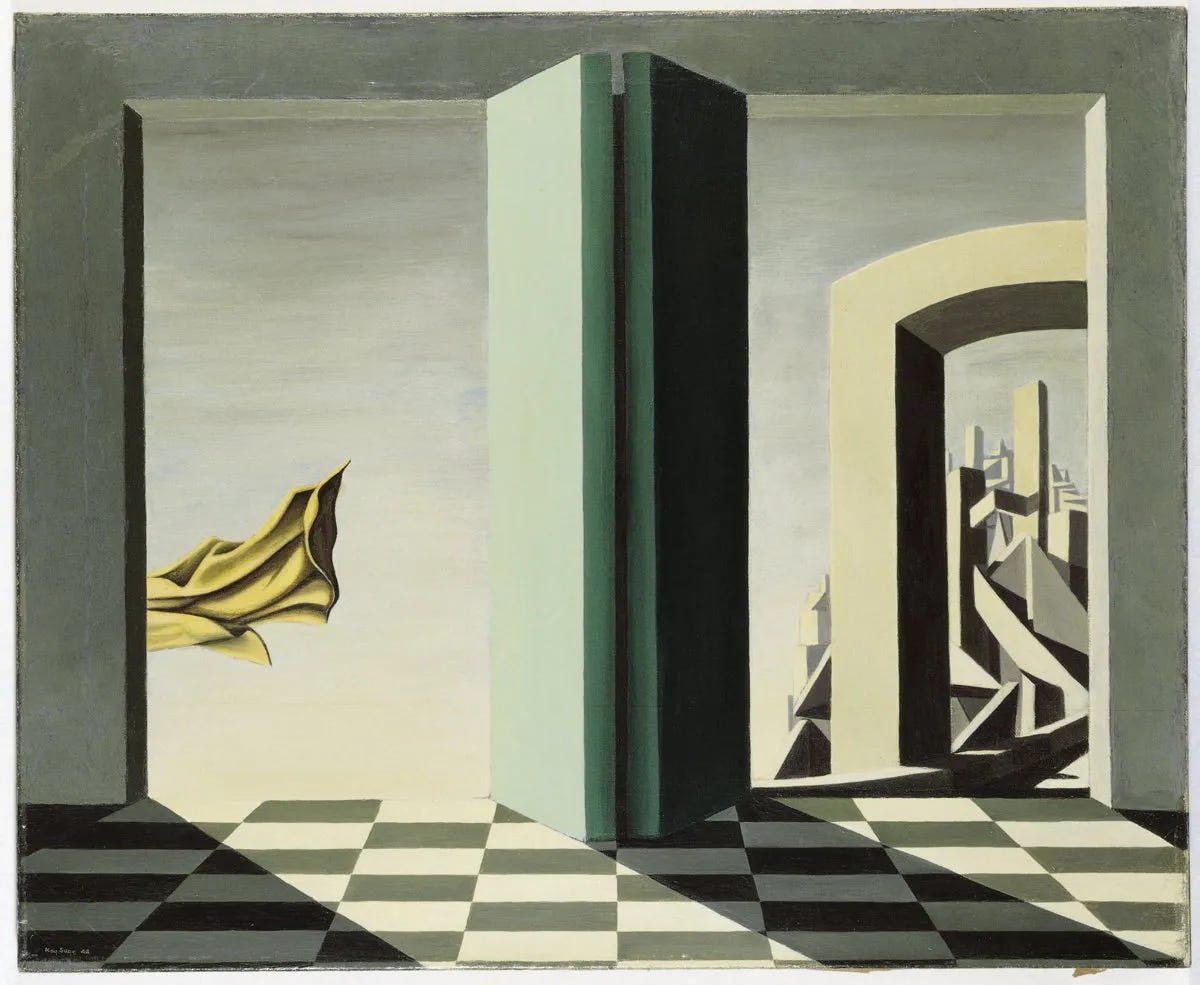
In the mental health world, when we talk about dissociation, it’s often as a negative thing. This is certainly not true of all practitioners (thank goodness), but speaking in generalities, the idea— as with all symptoms— is that dissociation is a problem that needs to be addressed.
What is dissociation? The DSM-5 (Diagnostic and Statistical Manual of Mental Disorders) defines it as “a disruption of and/or discontinuity in the normal integration of consciousness, memory, identity, emotion, perception, body representation, motor control, and behavior.”
In other words, dissociation is a way in which we disconnect from our present moment. As you can see by the broad definition above, this can mean a lot of things. Some of us just kind of “space out,” or “go somewhere else” for a while. We may still be able to pilot our bodies, but we’re not really present.
Some individuals may know that they’re dissociating; others are not aware. Some people are floating above their bodies; others just feel really, really tired, or inexplicably sleepy. And at the far end of the spectrum, in what the DSM-V calls “Dissociative Identity Disorder,” there may be distinctly different personality states that emerge.1
Dissociation could be seen as the shadow side of embodiment— which, in the wellness world, can lead to the misguided notion that dissociation is bad, and embodiment is good. Of course it’s not that simple.
Dissociation is an adaptive response
Like all neurobiological responses, dissociation serves an important purpose. When faced with danger, all animals engage a basic defense system. Allan Schore, citing researchers Gabrielsen and Smith, says that
“In reaction to an environmental threat (a predator), an organism can respond in various ways: It can display offensive behavior, aggression (fight) or locomotor flight (associated with a fear state). In addition to the active defense of fight-flight, these authors also describe two different types of parasympathetic passive defenses: freezing and paralysis.”
Allan Schore, The Science of the Art of Psychotherapy
It is in this paralysis response, which Schore calls “deep freeze,” that we are completely dissociated, no longer alert or present to the danger. This can be life-saving with regard to the predator (i.e., we’ve successfully feigned dead), but it also preserves us from the terror or pain that would otherwise overwhelm us.
This is your nervous system on fascism

The care and tending of my nervous system is a big part of my life.
C-PTSD and dissociation
In the case of developmental trauma, says Schore, emotions themselves are a life-threatening event. Without a caregiver to co-regulate them, an infant’s brain must initiate a dissociative shutdown because the overwhelming emotional response is greater than their biological systems can handle.
Dissociation, then, is a life-saving strategy. Yet there is a high cost to our nervous systems and overall health if we are continually engaging this system when it’s not absolutely necessary.
For those who live with C-PTSD or PTSD, dissociation can be triggered by events that feel threatening even when the individual logically “knows” they’re not. A text message from a friend or family member can literally feel like life or death. And because the response is autonomic and below the level of conscious control, we feel completely helpless.
This is where right-brain, relational work— the kind we do with an attuned teacher, coach, therapist or other helping professional— can be used to rewire our right-hemisphere emotional regulation system. Schore’s work affirms that, over time, we create greater capacity to regulate ourselves and stay present, so that we no longer have to dissociate.
Mindful dissociation
Now that we understand why involuntary dissociation happens, we’re in a better position to think about why we might choose to dissociate.
Right now, as you’re reading this, you are dissociating. I am, too! In every moment of our lives, we have the potential to be inundated by sensory data. This can be external: the hum of the air conditioner, the barking of a dog, far-off thunder in the distance; or internal: an ache in a muscle, the beat of your heart, the throb of a dehydration headache (I’m pausing to drink some water right now). Then, too, there are the emotional and mental events: that thing your friend said, what’s for dinner tonight, should I buy a new pair of shoes?
Can you imagine how overwhelming it would be if we were able to pay attention to all of these at once? We have to dissociate in order to focus on what’s essential for us in each moment.2 This is where what I’m calling “mindful dissociation” comes in.
Mindful dissociation is an aspect of meditative awareness. It’s a tricky thing: if someone says, “don’t think about your breathing,” what do you immediately do? You think about your breathing.
The practice is to be able to hold your awareness on something else instead. Rather than tell you not to think about your breathing, I would ask you to notice something else: the texture object in your hand, or the sound of a ticking clock, or whatever. We get better at paying attention to something else, so that we can “dissociate” from the other thing.
This kind of dissociation is a skillset that all endurance athletes possess. In order to run, or bike, or swim long distances, they have to find something to focus on that is not the signals their body is sending them about how bad they’re feeling.
You’ve probably experienced this, too. When you go for a long walk and your feet start to hurt, the more you think about your feet hurting, the worse it gets, right? We train ourselves instead to listen to our music, or to count our steps, or to focus on how good we’re going to feel when it’s done. 3 We are retraining our brains to dissociate for our own benefit.
Mindful dissociation has a great carryover effect to all areas of our lives. We are learning to focus on what we choose, rather than being caught up in stressful thoughts or sensations. Wouldn’t this be helpful this might be the next time someone at work, or the grocery store, is getting on your very last nerve?
I have found this especially helpful in working with individuals living with the effects of PTSD and C-PTSD. The simple practice of focusing on a neutral (non-threatening) stimulus, coupled with relational support, becomes a template for greater embodied presence over time. It builds agency, capacity and confidence for increased emotional regulation.
Dissociating body parts
There’s one last way that we sometimes talk about “dissociation” in the movement world that might be helpful to consider. Okay, it’s a little bit of a reach, but I think it actually works— because it’s going to give us an opportunity to explore mindful dissociation in our bodies.
Unless we have a lot of experience in movement, or a background in athletics, most modern humans are kind of clueless about “what’s happening” when we move our bodies. We find it difficult to know how to (for example) twist our torso without moving our hips, or our head; we try to move just our big toe, and the whole foot has to come along.
Learning to dissociate one body part from another can be an interesting (though often frustrating) experiment. Even if we “fail,” it inevitably generates more awareness. We are learning to pay attention to something, and practicing letting go of something else at the same time.
In the video below, you can practice with me as we try to dissociate our ribs, shoulder blades, and spine (skip to around 2:55 to get right to the movement stuff— I start out by talking about what you just read!).
For a non-pathologizing lens on this, I recommend Jamie Marich’s book Dissociation Made Simple.
In fact, for some sensitive individuals, a heightened ability to be aware is so great that they have to protect themselves by avoiding stimuli completely.
Obviously, this doesn’t mean I’m encouraging you to override your body’s pain signals in a detrimental way. It’s “mindful dissociation,” not “mindless foolishness.” Please take care of yourselves.
Thanks Laura. This was lovely. Dissociation lives on a spectrum and, like anything, can be super useful, and really harmful. If we learn to harness it, we can use it for good. Mindfulness in action. Thanks for your thoughtful writing.
Ordinary attention was never a complete, unfiltered contact with everything present. It's a continuous, adaptive act of leaving almost everything out so that one thread can be followed clearly, which means the brain's basic operating mode and what gets diagnosed as pathological dissociation aren't different in kind. They're different points on the same spectrum, running from useful and chosen all the way to overwhelming and involuntary.