


I came across an article this week in The Atlantic that caught my eye. Entitled The Dark Side of Mindfulness, this thorough piece discusses some aspects of meditation that many long-term meditators (and meditation teachers) have known about for some time, but rarely discuss. In short, the piece tells us, meditation is not good for everyone, and in some cases, can cause psychosis, severe dissociation, and even suicidality.
I remember finding similar research about ten years ago and feeling extremely anxious about it— largely because at the time, I was heavily invested in both practicing and teaching meditation, and it was distressing to think that something that seemed like such a cure-all could cause serious harm. The subject of the piece, Dr. Olga Khazan, had a similar experience— so much so that it took her decades to accept, and finally publish the results of a study that showed that meditators, in fact, have worse sleep than non-meditators.
As I read through the article this week, I recognized that something in me had changed. I no longer felt defensive about meditation in the same way that I had previously; in fact, I agreed with Khazan’s findings, and believe firmly that intense meditation (like any mind-altering substance) is not ideal for many people, especially those who are prone to dissociation, or who feel, well, less grounded generally.
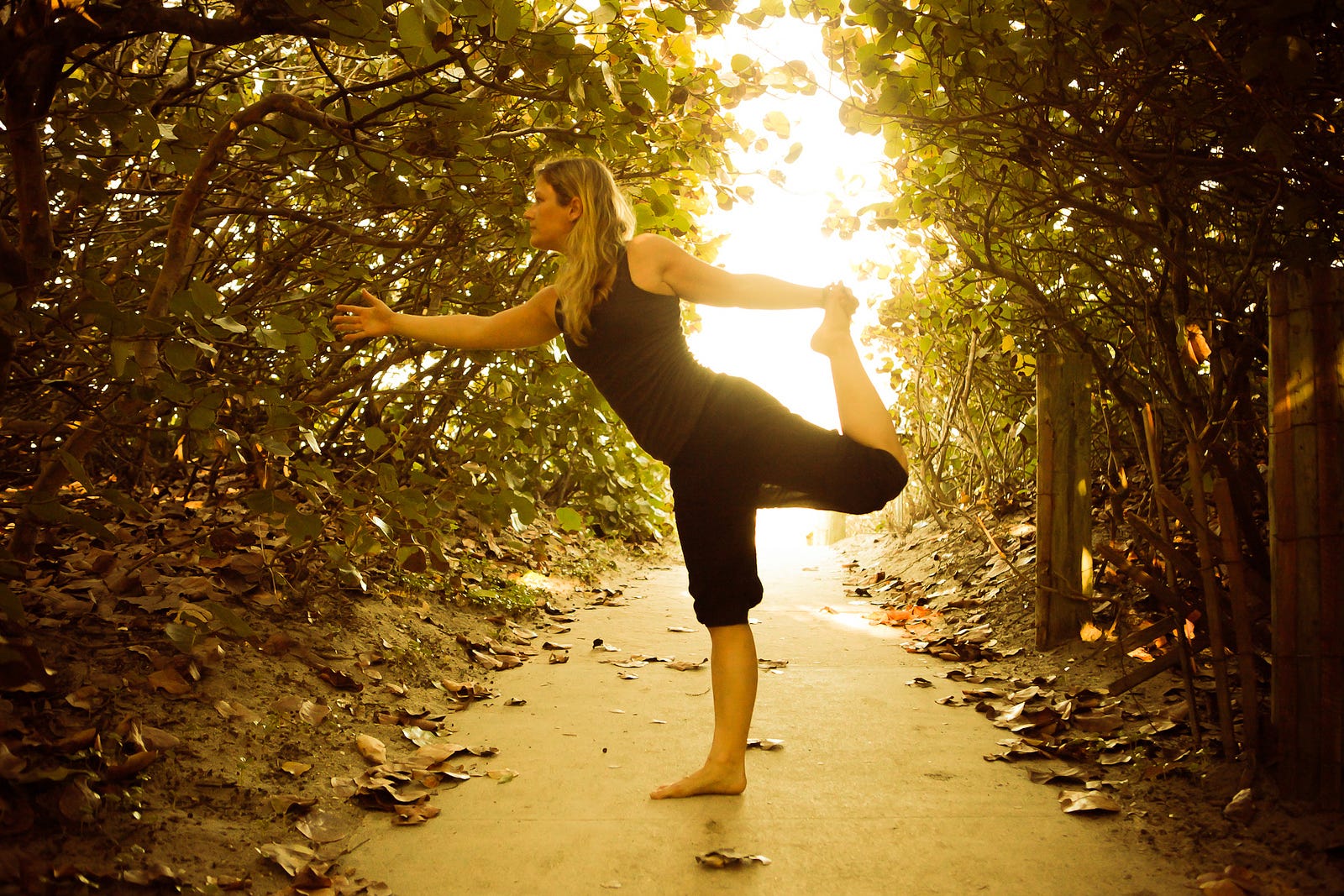
I also recognized this whole dynamic, both in myself and in the wellness community at large. When we find something that works for us— as yoga had, for me, fifteen years ago, so spectacularly— we tell EVERYBODY how great it is, that they need to be doing it. We re-post memes about how life-changing just 10 minutes of yoga a day can be, and that if everyone would do it, world peace would surely follow quickly. And then many of us become yoga teachers, who are also financially invested in this dynamic. We’re underpaid, but earnest, and highly incentivized to think that yoga is the thing that will fix everyone we know— if only they could be convinced to do it.
Who knows what’s “right” for us?
It didn’t take me more than a few years as a yoga teacher before I had to accept that not everyone was going to like yoga. It wasn’t that they hadn’t found the “right kind of yoga,” or “the right teacher for them.” Some people just don’t want to do yoga. In a way, this realization was kind of a relief. I could stop trying to convince people and let them go do something else. After all, there are plenty of people who DID want to do yoga, and I could help them.
But it also got me curious about what we ARE drawn to.
When I closed the yoga studio and began to offer more individual sessions, including different kinds of movement, I had the opportunity to get to know people more intimately, and to understand what it was they were drawn to. Some people, for example, got really excited about strength training. Or they loved the Indian clubs. Or gardening, or horseback riding. And all of those things could qualify as what I was calling “mindful movement;” a way to get in touch with embodied present-moment awareness.
It also became clear to me that even though people would come to me and specifically ask for my advice, or for “a routine they could do at home,” they almost never followed through.
One of my professors captured this brilliantly:
“Maybe you got into this field because your friends said to you, ‘Oh, you give such good advice.’ But if you haven’t figured it out by now, nobody’s gonna take your advice. No, they’re not. They’re going to tell you how they want to cheat on their wife, and all you can do is listen to them and say, ‘So what you gonna do?’ Because you know they’re gonna do whatever they wanna do anyway.”
-Dr. Patrice Leopold, Nova Southeastern University
People are gonna do whatever they wanna do.
“You cannot save people from committing certain nonsense.”
Coming around to this viewpoint can be humbling, as a helping practitioner. How many times have I felt that if this client could just do this one thing, their lives would be improved. And how frustrating it can be to watch the same client continue to struggle, ignoring your well-intentioned advice!
Jungian psychology recognizes that each of us has to follow our own path— what Jung called individuation— in order to achieve wholeness. The mistakes are, in fact, essential:
“You cannot save people from committing certain nonsense because it is in their grain. If I take it away they have no merit. We only gain merit and psychological development by accepting ourselves as we are and by being serious enough to live the lives we are trusted with. Our sins and errors and mistakes are necessary to us, otherwise we are deprived of the most precious incentives to development.”
—CG Jung, The Tavistock Lectures
Oh, those sins, and errors, and mistakes!
I am reminded in particular of a relationship I struggled with for several years. Everyone around me could see that I was making what seemed to be terrible choices; prioritizing someone else’s needs over my own; failing to recognize my own worth; jeopardizing long-term friendships. But nothing, and I mean NOTHING they could say ever made a dent. I just had to work my way through all that frustration on my own and come out the other side with some painfully hard-earned wisdom.
There wasn’t a shortcut to that growth. I didn’t need more external advice. I needed to figure out what I needed— no matter how many “mistakes” I made to get there (feel free to read about these at the link below):
Overthinkers Anonymous

Thanks for reading! If this resonates with you, I’d love to hear your comments, and it would mean a lot if you like, re-stack, or share with a friend. And, as always, paid subscribers have unlimited access to my site of streaming practices. On with the post!
A non-directive approach
The truth is that I have had to accept that, in general, I have no idea what is best for my clients, or for anyone else.
I might think they would benefit from meditation, or yoga, or strength training; or that they should stop talking to that toxic friend; or spend more time with their cat. But those are just my ideas about their life, which have little to do with what they actually will do, and even less to do with what they are meant to do.
Humans are endlessly complex: what we say we want consciously often bears no resemblance to our unconscious desires and needs. So, for example, when a client tells me that they “keep trying to get back to their yoga practice,” I know that there is probably an underlying reason that they are not “getting back to their yoga practice,” and it’s not just a matter of scheduling or willpower.
This is where approaches like CBT (Cognitive Behavioral Therapy)— as helpful as they are in so many ways— can sometimes fall short: they presume that the client wants what they say they want. In fact, most of us are likely to be ambivalent; to have mixed feelings, or even contradictory urges that need to be explored.
When we take a non-directive approach as helping professionals, we are working with the client to determine what it is that they really need, or want. There may be an intra-psychic conflict to be addressed, for example (“I always wanted to be an artist, but my parents insisted I do something practical”). Or we may be supporting the client in making new choices, or trying new things— so they learn to trust their own internal wisdom.
The phrase “non-directive approach” is more Carl Rogers than it is Carl Jung, actually— I have met Jungians who had no problem directing their clients’ lives!— but, at heart, Jung believed that true change, or healing, had to come from within the client themselves, and not from the therapist:
I had given up hypnotic treatment for this very reason, because I did not want to impose my will on others. I wanted the healing processes to grow out of the patient’s own personality, and not out of suggestions of mine that would only have a passing effect. I wanted to protect and preserve my patient’s dignity and freedom so that he could live his life by his own volition.”
—CG Jung, Symbols of Transformation Paragraph 492 (emphasis mine).
What’s right for you?
I want to be clear that being “non-directive” isn’t a cure-all, any more than yoga or meditation is. There is a clear time and place to be directive, especially if a client is in danger, or unable to make decisions themselves, for example.
“Directive” also isn’t a bad thing. There are times when we need someone else’s expertise in a directive way. When I decided that I wanted to learn to nose-breathe, for example, I needed my Integrative Breath Therapist, Jennifer Snowdon, to tell me how to do it. And I am training for a competitive 2k row now— I am grateful to follow the direction of another excellent coach to help me improve.
But when it comes to deciding what we need to do, and how we should live our lives— especially in questions of deeper meaning— external advice can only take us so far. We have to turn inward.
Mary Oliver put the question better than I ever could, in the closing lines of her poem “The Summer Day”:
“Tell me, what is it you plan to do / with your one wild and precious life?”
I love all of this! I remember when I was first getting into meditating and my best friend (who happens to be a Gemini, very fast mind, IYKYK) told me that meditation makes her crazy, normally at that time I would’ve pushed against it—that’s exactly why you needed it! But something in me knew that this wasn’t for her, and I was really surprised that that could be the case. Thanks for sharing the study. It’s very interesting.
So much truth and wisdom in here. As an Integrative Breathing Therapist, yoga teacher & therapist, as a mom, all of this holds. Nobody wants to be told what to do, even if they ask what to do. I laughed quite a few times reading this. Thanks for more excellent writing.