


Thanks for reading! If this resonates with you, I’d love to hear your comments, and it would mean a lot if you like, re-stack, or share with a friend. And, as always, paid subscribers have unlimited access to my site of streaming practices. On with the post!

I felt like a failure for many years.
I failed to do anything constructive with my bachelor’s degree in Spanish.
I failed to become the author or artist I thought I should be.
I failed at two marriages (both ended in divorce).
I failed to be a big success in the banking world, though I did hang on for 13 years.
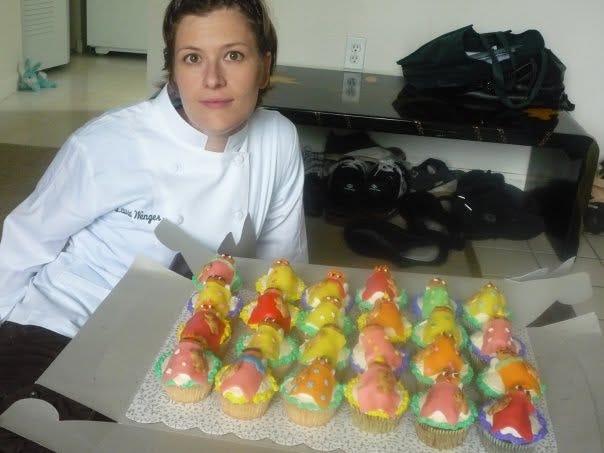
When I went and got a culinary arts degree next, I failed to turn that into a career.
Looking back, I’m kind of amazed that I was able to try new things. I had so much shame around my failures that I sometimes didn’t know how I could keep going.
But somewhere along the way, I realized that all these failures had also been successes. That each of these endeavors, no matter how painful or expensive, was a necessary part of my path.
And so, although I was scared to buy and run a yoga studio, I did, for over a decade.
And when I realized that I couldn’t keep running it, I saw it not as a failure, but as a necessary next step in my coaching career.
Most recently, I wasn’t afraid to embark on a masters degree in psychology, with the goal of becoming a therapist— because I understood that no matter how weird and tangled the path had been, it’s all been leading me here.
For some of us, all decisions are high-stakes
When I started my personal chef business (“The Happy Fork”), my brother Seth said to me, “Most businesses fail. It’s not a big deal if this isn’t a success.” What a tremendous comfort this was! At the time, even the smallest decision for me could feel incredibly high-stakes— let alone investing time and money into a second degree before I could even pay off the loans from the first degree, and into this new business.
Taking risks— even small ones— is harder for some of us than it is for others. In my work now, I meet a lot of people who tell me they are “overthinkers.”
“I just second-guess myself,” one of my clients said to me this week. “It seems like no matter what decision I make, it’s not the right one.”
Another client describes it as “analysis paralysis:” “I just don’t know what the right thing is to do.”
I find that in these cases, “overthinking” is less about actual “thinking.” It’s not that we don’t have enough information, or even that we don’t have enough experience to make a good decision. It’s about an underlying lack of trust in ourselves: we’re afraid to get it wrong.
Overthinking as survival strategy
For many folks, this kind of second-guessing, inability to make a decision, overthinking is rooted in childhood. In our earliest years, when we lack the complex understanding of why our caregivers aren’t able to meet our needs (whether physical, emotional, or social), we have no choice but to assume that we are the problem— and that if we can just get it right, we may be able to stay safe from a caregiver’s anger, or earn love from a distracted or tired parent, or survive in a hostile system (school, for example).
I know many people for whom this worked really well, actually. Being very careful about every decision earned them approval, got them good grades, helped them to succeed in their career, let them survive abusive relationships.
So, “overthinking” can be a brilliant strategy. We try to consider every angle; seek external advice; consider what other people would do. We’re always trying to get it right; meet some invisible, impossible standards; earn approval and acceptance from an unknown audience.
As adults continuing to use this strategy, we can spend hours in a mental back-and-forth, even for the smallest decisions. Which protein bar should I buy? Should I text this person back or not? Should I take a week off? Does my dog need arthritis medicine, or am I going overboard? Put the item in the cart. Take the item out of the cart. Read more reviews. Try again tomorrow.
Even these tiny, almost meaningless, decisions feel very big, because we put a tremendous amount of pressure on ourselves to get it right. We haven’t yet recognized that we’re operating under outdated logic. If I can just get it right, the thinking goes, I’ll be okay, safe, loved, protected.
The cost of overthinking
For chronic overthinkers, there is a high energetic cost to using this strategy. Not only is it literally exhausting to always be second-guessing ourselves, we waste a tremendous amount of time and energy on things that we logically know don’t even matter that much. As one of my clients said to me recently, “My brain just never stops.” This is a huge drain on our minds, bodies, and souls.
At the same time, it’s hard to even imagine a different way of working, because it is so deeply ingrained in us to always do this extra work. And we’ve spent so long considering other people’s thoughts and views— perhaps even tailoring our decisions to someone else’s standards— that we’ve never cultivated our own sense of “what’s right for me.” Case in point: after my first divorce, I stayed in the next relationship well past its expiration date simply because I was afraid of what people would think if this one failed, too. Who was I pleasing? Were the people pleased? I certainly wasn’t.
Whenever we’ve overdeveloped our overthinking muscles, our “self-care” muscles are sure to be atrophied. We may even find it hard to imagine wanting something for ourselves. The idea of wanting something— just for us!— and making a decision to have it, with all the potential consequences that might bring, can feel foreign, frightening, even completely overwhelming.
“But what if I get it wrong?”- reframing failure
For overthinkers, the fear of getting it wrong can be completely paralyzing— because, in childhood, “getting it wrong” had such serious consequences.
Movement artist and improv instructor Elke Schroeder reframes this beautifully: “Failure is just going someplace you’ve never been.”
It can feel terrifying, even annihilating, to risk failure— but an important part of reclaiming our own agency is recognizing that we determine whether something is a success or failure.
Every “failure” I’ve experienced taught me something about who I was:
who I needed to be internally;
who I was in relationship with others;
who I am in my work;
who I am in the world.
Every one of my failures is an important part of my success story.
Exploring another way
So how do we work with this?
One of the simplest ways I suggest that clients start exploring overthinking in their own lives is to simply notice when we’re putting pressure on ourselves about a decision. That’s it! Just notice.
Simply noticing helps us to recognize that we are making a choice to pressure ourselves about this; and that the possibility exists that we could do this a different way. This may not be a choice we feel we can act on right now, but at least we can see what we are choosing to do in this moment.
Second, when we find ourselves stuck in an endless loop of overthinking, we can ask ourselves: what’s the scariest thing about making the wrong decision? What am I afraid of here?
There may be real consequences to consider— if we’re buying something expensive, or considering the end of a relationship, it makes sense to be thoughtful. But asking ourselves what we’re really afraid of can help us to identify why we might be stuck, and to remember what’s most important in making that decision.
Above all, understanding why we are using these strategies, and how they evolved in the first place, can help us to be more compassionate toward ourselves when we’re feeling frustrated and stuck with our thought patterns.
Free to fail
I was terrified to buy that yoga studio. In fact, I really didn’t want to. I had been running it for someone else, and he needed to sell it. “If you don’t want to buy it, I’ll find someone who does,” he told me. It felt like more than I could handle— the paperwork alone felt completely overwhelming, and I cried over QuickBooks more times than I care to remember. But what I learned, and gained, from that decade of business ownership, and client work, was priceless.
Our culture values positivity and certainty so much that we forget how important “failure” is. If failure is, as Elke says, going “somewhere we’ve never been,” how else could we possibly arrive at a new place in our lives?
Each of us has to find our own way, of course, and I have come to trust that as my clients reclaim their sense of agency and power, they naturally begin to find what’s “right for me.” They can take bigger “risks;” they spend less and less time overthinking; they’ve given themselves freedom to fail.
I relate to this a lot. Sometimes my husband says to me that I worry to just have something to worry about. That is definitely far from the truth. I don’t want to worry. But it’s a tough scary world out there and so many bad things can happen. As I started this new school year, my 15th as an elementary school teacher, I made it my motto to stop overthinking. Whenever I catch my self start to worry and overthink about how I interacted with a colleague, taught a lesson, wrote an email to a parent, I am saying to myself these words. “No need to over think this. You are doing your best in this moment. If it’s not landing as you desire you can change your future actions. Or don’t change at all and just believe that who you are and how you show up in the world is good enough. We are all living and breathing and getting wrong and getting it right and that is as the world is.” Or something like that! I have so much internalized shame and not enoughness, and that is my process of being a human. It’s so nice to read your thoughts about all of this, Laura. Like having a nice cup of tea in your warm home together.
Big over-thinker over here 👋🏻 so I appreciated this article. Thank you.
When I’m feeling down my list of failures are endless. When I’m feeling hopeful the same list are stepping stones or pivot points of my story.
Some choices (‘failures’) I made were simply me looking for belonging, love and acceptance. Something I don’t ever remember feeling in childhood. As you say, I never cultivated a sense of what’s truly right for me and went looking in all the wrong places for something that was really just a myth. My idea of belonging, love and acceptance was hugely distorted.
For the first time in my life, at the age of 44, I can see clearly how the belief that I am not good enough has shaped so much of what I have or haven’t done.
Overthinking was always present.
Seeing clearly rather than being in the constant muddle of overthinking has something that has shifted for me recently. I’m not sure why or what happened. But it did.
I’m applying for grad school next year. I also want to become a therapist. It’s something that I have wanted to do since 2019 but I was too scared to until now.