


Thanks, as always, for reading. If you enjoy this piece, please take a minute to let me know by leaving a comment, restacking, or “hearting” it. As a thank you, paid subscribers get unlimited access to my library of streaming recorded classes. If you’re looking for one-on-one support, I’ll be opening up coaching and dreamwork spots again in the next few months as I am (finally) almost finished with grad school. You can read more and book a consult here, if you like!
“It is a dangerous misconception of mental hygiene to assume that what man needs in the first place is equilibrium or, as it is called in biology, ‘homeostasis,’ i.e., a tensionless state. What man actually needs is not a tensionless state but rather the striving and struggling for a worthwhile goal, a freely chosen task. What he needs is not the discharge of tension at any cost but the call of a potential meaning waiting to be fulfilled by him… if architects want to strengthen a decrepit arch, they increase the load which is laid upon it, for thereby the parts are joined more firmly together.”
—Viktor Frankl, Man’s Search for Meaning ‘
When I was first learning to be a yoga teacher, it was common to hear cues like, “relax your jaw,” “soften your face,” and “let your shoulders melt down your back.” Like most other yoga teachers, I began to include these in my classes. After all, the goal was to feel better, right? We want to let go of all of that tension, and really relax.
As I spent the next decade (and more) learning about humans, neurobiology, physiology, and psychology, I began to use these “let go of your tension” cues less and less. Instead, I would say, “notice where there’s tension,” or “see if you can just observe your experience, without needing to change it.”
Why would I shift from “release your tension” to “notice your tension?” Because I found that rather than trying to get rid of the tension, inviting people to accept themselves as they are in the current moment was a better solution to eventually change that tension pattern for good.
Reconsidering tension
When we talk about tension, it’s almost always as something to be eradicated, soothed away, released, dissolved. Guided meditations encourage us to smooth our forehead, or relax our jaw. We ask our massage therapist to help us get the knots out of our shoulders and neck- “I’m just so tense!,” we say. We invest in Botox treatments to soften our tension, and the tell-tale wrinkles it creates.
The truth is much more complicated. Tension is an essential element in our lives. Tension is engagement. Not only do we tense (engage) our muscles in dynamic patterns to move our bodies— each of us is literally held together by tension. Our myofascial tissue is suspended around our bones in a dynamic, tension-dependent system that flexes, stretches, compresses, balances, and propels us through the world. Without tension— without engagement— our skeleton would collapse in a heap on the floor.
At the same time, it’s true that tension often feels very uncomfortable, and it can have negative effects. I can attest that jaw-clenching, tooth-grinding, shoulder gripping, and tension headaches are all really unpleasant.
In Jungian psychology, we understand all symptoms— including muscular and psychic patterns of tension— as meaningful and useful communications from our body/mind system. With this in mind, rather than trying to eliminate tension, we can ask: what is this tension trying to tell me? What problem is it trying to resolve? What does this tension need, or want, and where is it trying to take me?
Fight or flight: the physical tension of unresolved stress
Much of what we think of as negative tension is the result of an ongoing or habitually unresolved stress cycle in the body. When our bodies are under threat, our nervous system reacts by engaging muscular tension— either to run from danger, or to defend ourselves. As a result, we breathe with our accessory breathing muscles (neck and shoulders); another pattern of tension. This is an incredible physiological process designed to keep us safe.
When defense systems become overwhelmed or we are unable to complete the stress cycle, we can get “stuck” in these patterns of tension. However, attempting to soothe away the tension will only have limited or short-term results because we haven’t yet dealt with the underlying issue.
If you’ve ever had the experience of enjoying a really relaxing massage or a relaxing restorative yoga session, only to be swept up afterward in a rebound of anxiety, stress, or panic afterward, then you are familiar with this mechanism. "Relaxation-induced anxiety" occurs when we artificially override the stress response through deep breathing or massage—essentially turning off our alarm system. But when environmental stressors remain, the alarm comes back on more insistent than ever.
Rather than treating our tension as some sort of wrinkle to be ironed out, we can recognize it as a useful and protective adaptation, and find ways to discharge the stress energy (through movement, for example) so that our nervous system feels safer. At the same time, we might work on ways to create more of a sense of felt safety in our own body by integrating mindful strength work. Core strength, posterior chain engagement and hand/grip strength are just a few of the ways that we can increase our sense of internal capacity. When the body feels more capable of dealing with threat, the nervous system has less of a need to armor against it. We can use our internal systems of tension to support us.
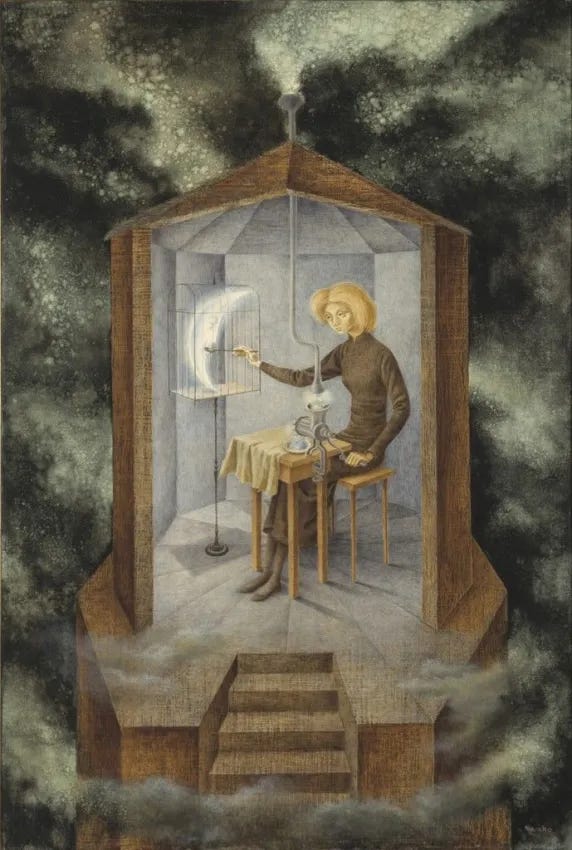
Tension makes a meaningful life
“The greater the tension, the greater is the potential. Great energy springs from a correspondingly great tension of opposites.”
—CG Jung, “Paracelsus as a Spiritual Phenomenon”
I was speaking to a friend this morning about one of our favorite current TV shows, House of the Dragon. We were discussing the possibility that our favorite character— Daemon Targaryen— would be killed off soon. “I don’t think they’re gonna kill him off next episode,” my friend said. “We’ve barely seen him this season.”
What she was reflecting was that this particular character lends a necessary tension to the series. Without him, the plot line (or at least certain parts of it) would be flat, boring, uninteresting. In fact, the series is hinting at his upcoming demise to introduce even more tension. We know it’s coming, and we can’t wait to see what’s going to happen.
Tension may not feel good in our bodies, but it is what creates interest and meaning. Remember that we defined tension as “engagement”— tension tells us that something is happening. Take Joseph Campbell’s quote below (taken from his incredible interview with Bill Moyer on The Power of Myth):
"People say that what we're all seeking is a meaning for life. I don't think that's what we're really seeking. I think that what we're seeking is an experience of being alive, so that our life experiences on the purely physical plane will have resonances with our own innermost being and reality, so that we actually feel the rapture of being alive.”
Yet holding this tension can be deeply uncomfortable, as I wrote about in the post linked below. We have to find ways of being comfortable within this discomfort.
The deep discomfort of doing nothing: somatic practice for tension tolerance

I’m not talking about meditation, although that’s another kind of doing nothing. I’m talking about the kind of doing nothing where you’re incredibly uncomfortable— where you’re experiencing so much tension, a situation has become unbearable, it feels as thou…
Finding Balance
“Your hand opens and closes, opens and closes. If it were always a fist or always stretched open, you would be paralysed. Your deepest presence is in every small contracting and expanding, the two as beautifully balanced and coordinated as birds’ wings.”
―Jelaluddin Rumi
We’ve established that tension is a necessary part of our lives— but at the same time, I’m not recommending that we must simply white-knuckle our way through life. When we are in pain, or suffering, or tension is wracking our whole system, there may be moments where we need to ease that tension in order to keep going. Here, I always think of Rumi’s quote (above), which reminds us that life is a series of expansion and contraction, tension and relaxation.
If all things are going well in our lives, we should be able to engage with challenge, experiencing more tension. Then, the tension resolves temporarily, and we get to rest and live life with a little more ease for a while.
However, there are times— especially when systemic forces feel they’ll overwhelm us, and there is no reprieve in sight— where we will need to seek refuge from tension. In these moments, we should absolutely engage in self-care: massage, restorative yoga, whatever it is that helps us to sustain ourselves so that we can engage in the longer-term work of our lives. My argument here isn’t that we should necessarily encourage more tension, or avoid practices to feel better.
Rather, it’s that our culture’s tendency to treat tension as some sort of moral wrong, or as an existential threat is, ironically, a threat to our own species’ survival. In fact, Jung saw this ability as existentially critical:
“I think it depends on how many people can stand the tension of the opposites in themselves. If enough can do so, I think the situation will just hold, and we shall be able to creep around innumerable threats and thus avoid the worst catastrophe of all: the final clash of opposites in an atomic war.”
-CG Jung, quoted in Barbara Hannah’s Jung: His Life & Work
Our ability to tolerate tension is precisely what will save us.