


Well, happy holidays, I guess? Here we are at the end of the year, somehow. I’ve barely begun to process the election, and yet we’ve now in the midst of the holiday frenzy. Actually-- we’re so late in the holiday frenzy already that a client told me yesterday her local Target has relegated Christmas to a few sad aisles and is now pushing spring decor! And I have yet to bake a holiday cookie.
I experience this as a highly charged time of year. We’re inundated with emails pushing gift ideas on us, each one more threatening and tense than the last (“WE NEVER DO THIS!” they swear, thrusting their low prices into your inbox, though you know they do this every year. “THERE’S STILL TIME TO SHIP!”, they insist.) You delete and delete, and yet the onslaught continues. Your Netflix home screen is full of sappy, silly holiday romances. And, heaven help you if you need to go into any kind of retail environment-- the music, the decorations, the junk, the urgent desperation in the air-- it’s like a holiday assault.
And, in a bitter twist, even folks who don’t celebrate Christmas have to deal with Christmas stress:
Roughly one in five adults who celebrate traditionally Jewish holidays (23%) and those who celebrate other non-Christian holidays (20%) said they experience stress because the holiday season doesn’t reflect their culture, religion or traditions, compared with 7% of adults who celebrate traditionally Christian holidays. They also said they do not feel a part of what is considered “the holiday season” in the U.S. (45% of those celebrating Jewish holidays and 57% other non-Christian holidays vs. 29% Christian holidays) and that they worry they may be discriminated against for their religion, traditions or culture at this time of year (42% and 55% vs. 13%, respectively). (APA, 2023)
Maybe you love the holidays. Maybe this really is the hap, happiest season of all. But for many folks, this is a pretty rough time. This same 2023 APA survey cited above showed that for 7% of the population, stress is lower this time of year. If that is you, I am so happy for you! But maybe you should keep reading, because it’s likely that you know someone who’s struggling. The same survey showed that 41% of the population is feeling more stressed at this time. And many of us experience a combo platter of emotions: 43% of the individuals polled use both positive and negative adjectives to describe their feelings around this season. For sure— like the time a few years ago where I found myself baking cookies and singing, under my breath, “It’s beginning to look a lot like ‘F*** this.”

It’s not you, it’s the complex
Let’s review what a “complex” is. In Jungian terms, a complex is a collection of symbols, images, and ideas that are clustered around a core theme. We all have complexes— a father/mother complex, an inferiority complex, a money complex, etc. And while everyone I know has some kind of parent complex (for example), these are individually tailored based on our history and personal experience. These complexes live in our unconscious mind, for the most part, though we can see traces of them in our daily lives, and definitely in our dreams.
Occasionally, something will happen that signals to the complex, “It’s time to shine!” When a complex is triggered in us, it takes over our ego consciousness temporarily. Each complex has its own script; it acts like a program that directs our thoughts and behaviors, many of which may not align with our conscious values. We are in an altered state.
Now, there are some complexes that are so big, we share them as a culture. The Western Christmas Complex (I’ll just call it the Christmas Complex for short) is one that each of us is subject to, simply because we live in a culture is dominated largely by both Christian and capitalist traditions. While we may not like or want to participate in these, we are subject to them: the Brenda Lee song playing at the grocery store. The Christmas pageant at your school growing up (or “holiday pageant,” but, wink wink, it has gifts and a tree). The emails, the commercials, the decorations in your neighborhood. Cultural complexes pack a one-two punch, because not only do you have your personal triggers, you’ve got a whole culture breathing down your neck about it, pushing your buttons. The Christmas complex is bigger than all of us.
How do you experience the Christmas Complex?
To answer that, let’s take another look at this fascinating poll. This image shows causes of stress during the holiday season, which may help you to identify how your own Christmas complex shows up:
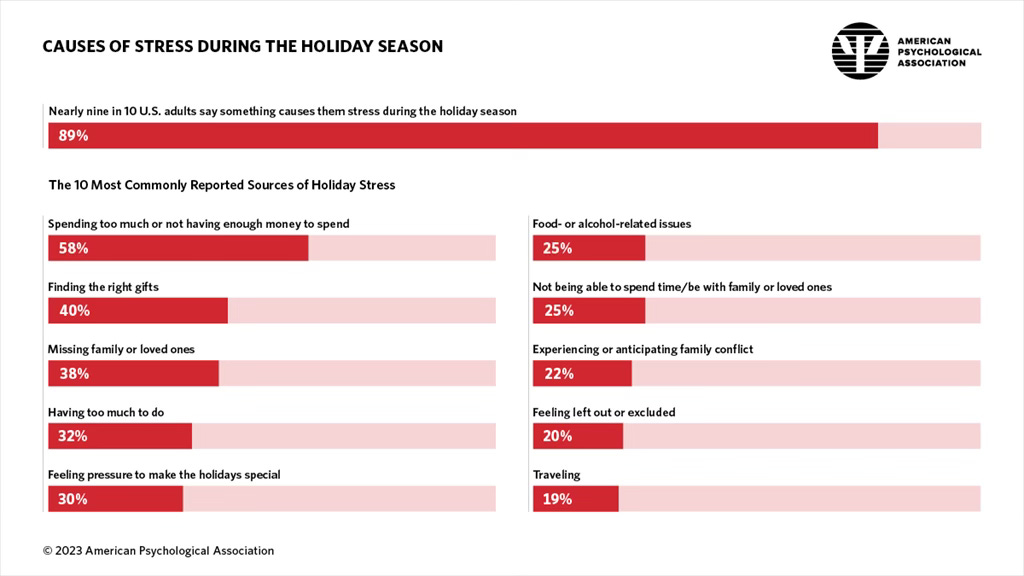
That first percentile— spending too much or not having enough money to spend— damn, that’s relatable. I know when my Christmas complex has me, because I find myself staying up late, visiting websites I wouldn’t normally visit, thinking about buying gifts for people that I really, really, don’t need to buy gifts for. Then there’s the stress of not finding “just the right gift.” And those are just the commercial aspects of the holiday.
The Christmas Complex promotes a shiny, perfect, unachievable vision of togetherness, affluence (think about those car commercials— who’s buying their spouse a car with a big bow on it??), abundance (overflowing gifts; a table laden with gleaming food); nostalgia (hindsight being 20/20, after all, we can easily remember things being perfect that never actually were); and a sense of total ease— somehow, this will all come together, perhaps with a few snowflakes and a holiday miracle, perhaps reunited with family (the real miracle being the fact that in this glowing, sparkling ideal, everybody gets along so well).
NOBODY IS HAVING THIS CHRISTMAS. IT IS NOT A THING YOU CAN ACTUALLY DO. And yet it is perpetuated by our culture so much that we can’t help but be affected by it. Whether we long for it, or feel excluded by it, or hate it, the Christmas Complex is powerful.
Jung noted that we know we’re in the grip of a complex when we feel its strong affective (emotional, somatic) qualities. What do you notice as you look at that poll? Do you feel tense, irritable? Sad, nostalgic? Are you dying for some eggnog? Do you feel heavy in your body, or urgent— like you need to go buy someone a gift, stat? When we are in the grip of a complex, we don’t feel like “ourselves.” And we may not notice until it passes.
Do you have a complex, or does the complex have you?
For many years, I didn’t recognize how my own Christmas Complex was operating, although people around me could definitely identify it (this is true of most complexes— we’re unaware, but our friends could tell us all about it, if we’d let them!). Every year, I would find myself in a cycle of over-spending; feeling depressed that I’d spent so much and still didn’t have gifts for all the people I wanted to give to; feeling like no matter what, I couldn’t do enough. No amount of tradition-following, baking, giving, or decorating could feed the yawning chasm of my Christmas Complex, which demanded that I always do more, more, more— and that it could never live up to the nostalgic ideal it upheld.
Recognizing the script, pattern, or program of your own Christmas Complex is the first step. What triggers you? Movies, songs, commercials, a date on the calendar, a text from a certain family member (you’re likely to find that your complex is tied in to other complexes— family, religion, money— making it even stickier!)? What is the experience of that in your body? Do you feel fast and anxious, or sluggish and depressed? Do you “overindulge” (whatever that means) or restrict yourself from pleasure to control the experience?
Once you’ve identified your triggers and patterns, we can start to interrupt the cycle. You may need to do something physical or deliberate to break the complex’s hold. Going for a walk, heading to the gym, or simply deciding you’ll wait until tomorrow before clicking “buy now” can be helpful.
When we are able to observe the complex, rather than lie helpless under its spell, we can make more conscious choices and see how they feel. James Hollis suggests that we ask ourselves, “Where am I complying with pressures from outside that compromise my values?” These pressures may be internalized— like the idea that you have to give the perfect gift— but they’re not intrinsic to who you are. Keeping in mind that for most, the Christmas Complex is short-lived and seasonal, you might ask yourself, how will you feel about your actions in a month? A year?
The other pole of the Christmas Complex (and I don’t mean the South Pole—)
So far, I’ve been speaking about the Christmas Complex as a pretty negative experience. But we need to remember that all complexes have a positive and a negative aspect. For example, if you’re someone who does celebrate Christmas, the positive aspect might be the parts that really do feel good and connect you with your sense of spirituality, generosity, and connection. If you don’t celebrate Christmas, the positive aspect might be the drive to practice the traditions that are meaningful for you. Or if you experience anger as part of the complex, that may be a powerful catalyst to create personal (or community) change.
Complexes— especially, I think, cultural ones— contain an enormous amount of energy and vitality. When they remain unconscious, they act like an app on our phone that drains the battery; our energy is siphoned into their powerful pull. While we can’t get rid of our complexes, we can bring them into our conscious awareness. When they no longer “have us,” then we may find that we have more life force available to us again to use in ways that are more truly aligned with our own interests and values.
What’s your experience of the Christmas Complex? How do you work with it? Leave a comment below, if you like— and until next time, I wish you a December/January full of things that feel right for you.
In my opinion, this Christmas season feels especially tense. For the past few years we have lived in a politically divided, post-pandemic environment that has put a wedge into our relationships with friends and family. Social media has become the group mind for fueling aggression and celebrating violence. How we have become so heartless? Has technology and media taken away our compassion and hope for humanity? Kindness and connection takes courage these days! I know change starts with ourselves, making a small effort every day to have eye contact and meaningful conversations with people around us can make a world of difference. Thank you for asking this question and giving me a chance to think about how I really feel. ❤️