


Local readers! I’d love to see you at the Holistic Wellness Fair, Sunday, October 4 from 12-4 at Unity of Stuart. I’ll be under the Mangata tent offering 15 minute sessions teaching Indian clubs— a great tool for somatic awareness and nervous system regulation. I’d love to see you there! I’m also accepting new clients for both coaching and therapy (as a Registered Mental Health Counselor Intern), online and in-person at Mangata Wellness in Stuart. As always, I appreciate your reading my “thoughts & feelings”— if you’re enjoying these posts, you can support this work with your like, restack, or comment. And, as a thank you for any paid subscribers, I offer free unlimited access to my online subscription site of streaming practices- you can subscribe or upgrade here. On to the post!
“I just can’t tell what my shoulders are doing,” my client said. “I have no idea what’s happening back there.” She gestured at her left shoulder, and then raised it comically toward her ear. “Up here, it feels like I know what it’s doing.” She let it drop. “Down here, no clue.”
This wasn’t a surprising comment. My client, despite her high somatic (body-based) intelligence, was describing a challenge that many of my clients face: Sometimes, we just can’t feel what our body parts are doing. .

Existential anxiety
To a certain degree, this sense of “I don’t know what my body is doing” is true for all humans, especially with certain regions of our body. Our back, for example, has fewer sense receptors than our fingers, which we use to explore the world— which makes it difficult for us to tell exactly what is going on back there. And our scapulae (shoulder blades) can be very tricky, particularly on the left-hand side, where our ribcage sits more forward, making it harder for the shoulder blade to feel a solid connection. This means that, as my client was noticing, we tend to feel a little lost in general with that left shoulder (you can read more and play with these concepts at the link below).
Anchor Your Shoulders, Calm Your Mind: Scapular Stability for Mental Health

We don’t so much solve our problems as we outgrow them. We add capacities and experiences that eventually make us bigger than the problems. -CG Jung
Other individuals, especially those with hypermobility spectrum disorder, can find themselves even more challenged. Their ability to sense where they are in space— which we call proprioception— often doesn’t work as well as it does in others. And while this can be trained and assisted, there will always be a greater challenge, or, as this article puts it, “more noise” in the way when they’re trying to sense those signals.
(It’s also true that if you’ve had an injury to a joint— such as a broken left elbow and wrist, in my case— proprioception will be impaired in that joint. It will always be just a little bit more work to know what exactly is happening there.)
So why does this matter? We’re not all trying to be Olympic athletes, right?
Frustratingly, this actually matters a lot, for one singular reason that underlies all aspects of our lives: When our brain doesn’t know what our body is doing, it feels less safe, and it will automatically try to create safer circumstances for you.
This can mean that if your body doesn’t sense the ground under your feet so that you can walk efficiently, it will stiffen up your muscles to try to stabilize you. You won’t have full range of motion; your body is trying to keep you from being hurt. This can result in chronic aches and pains that never truly resolve, no matter how much you stretch or massage them.
Your brain may produce pain signals to prevent what it thinks might be an injury-producing movement. That twinge in your knee doesn’t necessarily mean there’s any tissue damage at all— it’s just as likely that your brain is concerned that you are going to hurt yourself if you squat too deeply. Yet the pain is real either way.
As a result, our movement options become more limited. We grow more fearful, and our lives get smaller. We are less likely to take risks— even small ones, like walking up and down the stairs without holding on to the rail— and so our bodies become less conditioned and less mobile.
And, on a meta-level, if we have a difficult time knowing where we are in space, we may feel existentially displaced, or lost, or, perhaps, just more anxious in general.
“End range”
All of the above are happening at an autonomic level— that is, we don’t consciously make choices around stiffening muscles, or creating pain (after all, who would do that?).
But these symptoms often lead folks to try to find relief— in a yoga class, or physical therapy, or with a trainer. And because proprioception is a challenge, these individuals can feel even more lost, especially if the practitioner isn’t well-versed in addressing these types of challenges.
This brings us to a second existential truth about individuals who feel a little bit lost in their bodies: for many, the only place they can really feel what’s happening is at what we call “end range.” For example, in the image below, it’s possible that this individual has a difficult time feeling what is happening in her elbow unless she straightens it all the way.
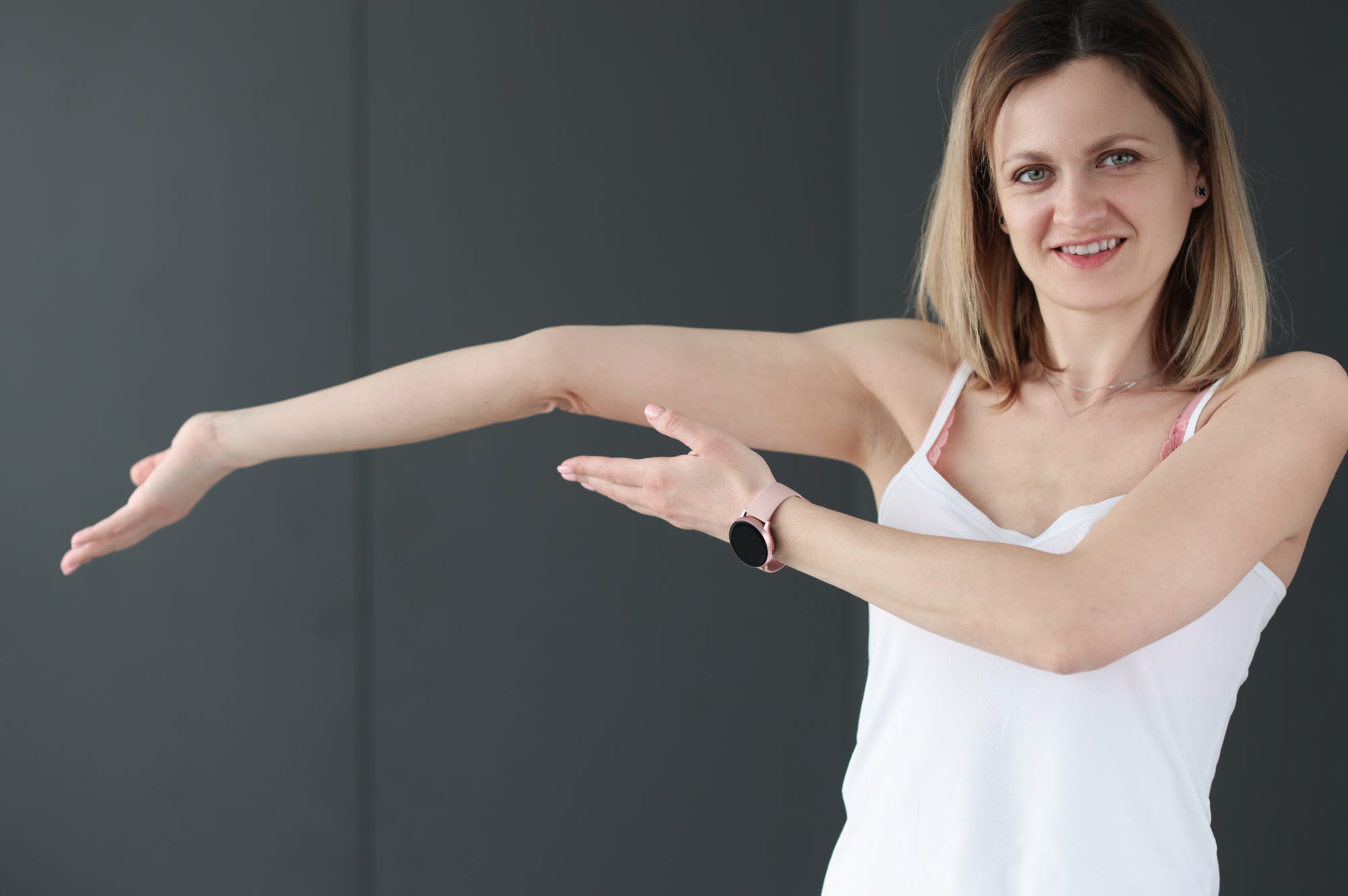
Proprioception can both be trained, and supported, through exercises and feedback. Using bands, for example (as in the video below), can provide additional feedback; using a nubbly ball to stimulate the sense receptors is another favorite way for some of my clients.
And it’s not inherently wrong, or scary, or bad, to have hypermobility, or joints that extend past 180 degrees. It’s just a human variation. At the same time, if this person is proprioceptively challenged, she may experience some other symptoms that she’ll want to address.
“Life at end range”- the dopamine connection
We’ve already discussed the correlation between the physical symptoms of “feeling lost” and the mental/emotional symptoms, which can feel like an existential displacement, or anxiety, etc. We’ve established that, without specific proprioceptive training or support, they need to “feel” “end range” in order to know where they are.
This same pattern- needing to reach an extreme before we feel anything at all— is true on another level, as well. For some folks, especially in the case of both shock and complex trauma, it can be difficult to “feel” life itself when it’s not “at end range.” This can be true of individuals with or without proprioceptive challenges (but it’s a bit of “double whammy” when it’s both).
For example, individuals who were raised in chaotic environments may feel really uncomfortable when life is stable and things are going well. Instead of feeling peaceful, they feel uneasy, bored, or even anxious. One reason for this may be our dopamine system.
We tend to think about dopamine as that feel-good chemical hit we get when we’re getting something we really want. But dopamine release actually not about acquiring the thing itself so much as it is about the search. Once we’ve got whatever it is we’ve been seeking, the pleasure fades quickly, and we find ourselves feeling a “dopamine lull”: low energy, flat mood, kind of blah.
This dopamine “lull” is normal; it’s what lets our system “reset.” For individuals who live with the effects of chronic stress or complex trauma, it’s more complicated. Because consistent stress and trauma lower our dopamine baseline, our brains produce less of the chemical over time. We feel more and more “flat” after the dopamine wears off. And for individuals who live with addiction, there’s an added problem: our dopamine receptors don’t work as well, so the negative effect can be intensified.
This means that we’ll gradually need increased doses of that pleasure-seeking activity (gambling, shopping, substance use, scrolling social media)—just to feel kind of normal, or eventually, not to feel completely depressed. We’re living life at end range, seeking the extreme sensations that let us know we’re alive.
When you add in a culture (like this one!) that absolutely cannot tolerate quiet, rest, stillness, or boredom of any kind, we have a recipe for a very destructive cycle.
Risky behavior—that chaotic feeling-- stimulates the release of adrenaline, as well as dopamine. The two systems fire together, coupling the experience of chaos and pleasure—which, although stressful, feels both exciting and familiar.
The “boring” middle
The good news is that our brains are incredibly pliable and can change at any age. Just as we can train our bodies to “feel” when they’re not at end range, we can train ourselves to “feel” life in that boring middle place where nothing is really wrong.
Our dopamine system itself can be trained quite effectively. Exercise has been demonstrated to increase our dopamine D2 receptors, and in addiction cases, may reverse the damage to dopamine receptors.
In my own work with clients and complex trauma, I’ve found this to be very effective. Working somatically with movement provides a great template to “feel” into the more subtle sensations that we may be less conditioned to notice. But it’s tricky, too: because these folks are often quick to push past their own limits into the familiar and chaotic “adrenaline zone,” a slower pace is required to avoid further exacerbating the cycle. So, for some individuals, group classes or traditional fitness spaces will be a great fit; but for others-- especially those who live in the high-activation end of the spectrum-- working in a titrated way with a trauma-informed practitioner really is essential.
Learning to tolerate life in mid-range can be a long-term project for individuals with C-PTSD. At first, especially, as we’re adjusting, it can feel like nothing is happening; that life has little flavor, or color. But, like my client moving around that niggly left shoulder, we start to notice: oh, there is some feeling there, if I really pay attention. And (over time!), the more I pay attention, the more there is to notice.
In the same way, we may become aware that we enjoy the bitter taste of unsweetened iced tea, or the sound of our cat purring on a weekday afternoon— sensations that previously flew under our radar, because we were so attuned to more intense feelings. Backing away from the stimulation of “end-range,” we find, in reality, these “boring,” everyday, “mid-range” moments make up the bulk of our lives. When we are able to sense, and even savor them, our lives become much richer.
You give me hope
YES! So much good stuff here. Had a conversation about just this stuff with a client yesterday, who used to not notice anything until it was extreme. Learning to notice small movements in the body has translated to noticing smaller shifts in emotions and mental states. It's a journey for sure.
Thanks for your work here!