


For those who prefer to read than to watch, I feel you! Here’s a text version. You can skip ahead to approximately 12:20 in the video above if you want to practice the “sorting the seeds” somatic drawing exercise with me.
Fairytales, according to Jungian thought, offer a kind of map to archetypes and psychic processes. Through them, we can recognize timeless patterns of individuation and the challenges we face along our road to psychic growth.
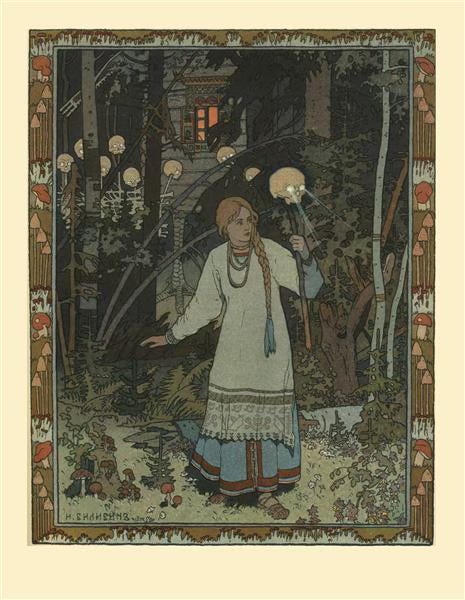
This week I wanted to talk about a fairytale motif that appears in many different fairytales (such as Amor and Psyche, Vasalisa the Wise, and versions of Cinderella). — sorting the seeds. Here, the heroine is asked to perform an impossible task overnight: to sort an enormous pile of seeds, the mildewed ones from the clean, or the chickpeas from the corn.
This can be understood as a metaphor for our ability to discriminate what is right for us; what is nurturing versus what would make us ill; a task that comprises a thousand tiny decisions, altogether overwhelming. As we discussed last week, managing our own health, caring for our own psyche, can truly feel like an impossible task. Who can manage this?
Well, as a matter of fact, the heroine doesn’t have to do it all by herself. In these tales, she accomplishes the task with the help of an animal (a cow, a bird, an ant) or a doll— her instinct, which operates at night, while she sleeps (that is, unconsciously!). She has to learn to listen to, and trust, this tiny voice, in order to complete the task.
But it’s not just about the instincts; we can also understand this theme as encouraging us to develop our feeling function. Feeling (according to Jung), is not about emotions, but about how we value something. It is the opposite of thinking. For example, if I am going to make a decision about where to go on vacation, I can use my thinking function (weighing the pros and cons), or I can rely on feeling, which says, “I like Sedona better than Vermont.”
The feeling function is itself under-developed in our rationalistic/ materialistic culture. We would rather know why someone wants to do something— “I like Sedona” isn’t enough of a reason. So, developing our feeling function is a task that many of us struggle with.
This is further complicated by the way, as modern humans, we’ve become disconnected from our instinctual selves. We rely so heavily on external advice about what to eat, how to move, and how we should live, that we have lost that connection to the small animal voice inside that knows what’s nurturing for us— or, at a more basic level, even that we’re hungry at all.
And while many of us are natural-born “feelers” 🙋🏼♀️ (rather than “thinkers”), we may have had to adapt strategies of setting aside our own needs and instincts in service of others’ needs. “What do you want for dinner?” “I don’t know, whatever you want.”
(The fact that the protagonists in these tales are gendered female— one of many social identities that is often acculturated to subvert its own needs— may give us a clue here, too!)
Learning to “sort our seeds”
In the video above, I show an exercise— called “sorting the seeds”!— from Cornelia Albrecht’s “Guided Drawing” techniques that we can explore as a means to experience that sense of fine discernment in our bodies (if this looks familiar, it’s because we used it to explore anger in this post):
Good girls getting angry

In the past few weeks, I’ve been thinking (and writing) a lot about how our cultural complexes affect us internally— and the importance of feeling a sense of our own power.
Beyond this, how can we practice “sorting the seeds” in our own lives? We can start small, with our next meal. What do I like to eat? What do I not like? Or, we can notice how we feel in our movement practice: this feels good. This does not feel good. We can notice (without shaming ourselves) when we simply do not know. That’s a good beginning.
Finally, we can be inspired by the animals in our lives, who are so much closer to their instincts (and who often symbolize our “instinctive selves” in our dreams!) They eat when they’re hungry and sleep when they’re tired. They bark at the FedEx man and wag at their friends. They hiss when you touch them “wrong,” or meow for affection. These instincts are alive in us, too.
Fairytales and myths (alive and well in movies and tv shows!) hold truths that transcend culture, time and place. The developmental task of “sorting the seeds” is one that we can all practice. Knowing what is right for us isn’t easy when we’re bombarded with advice and images of idealized others— but it’s key to finding real satisfaction in our lives.


