


“In some ways suffering ceases to be suffering at the moment it finds a meaning, such as the meaning of a sacrifice.”
— Viktor E. Frankl, Man’s Search for Meaning
In recent posts, I’ve discussed how Jung’s transcendent function brings mind and body together to make meaning— and how difficult this can be in a materialistic world. Add on to this the challenges of our day-to-day lives, and the very real financial and logistical challenges most of us face, and we might ask: who has time, or money, to try to find meaning in our lives? I’m just trying to survive.
But it’s meaning itself that gives shape to our suffering; that contextualizes the ongoing pain of growth; that allows us to understand why our suffering matters in the first place.
The privilege of higher needs
This was highlighted recently during a group class for adults with disabilities that I was co-facilitating at my internship site. The topic was “Money Management.” The group had been tasked with differentiating “wants” from “needs.” We were sitting outside at a park, with a whiteboard we’d brought with us.
This group of people, all of whom were living on a limited income— and who are facing drastic cuts due to our government’s changes to Social Security and Medicaid— were having to decide what in their life constituted a “want,” and what was a “need.” Some things were easy: food, transportation, housing costs. These all went down on the board under “Needs.” Then one young woman (let’s call her Jenny) called out, “Dance classes,” and my co-facilitator paused. “Is that a need?” he prompted. “Or is that a want?”
“I need those classes to keep me mentally healthy,” she said. I wrote “dance class” under “Needs,” and the class moved on, but I kept thinking about Jenny’s comment. I happen to know that this client’s dance classes do indeed represent a need for her. They offer a physical and mental benefit, but more importantly, they offer her an important source of meaning in her life. She loves practicing, dancing, performing, being part of a team.
Our cultural ideas about “wants vs. needs” are based on Maslow’s Hierarchy of Needs, which positions our “basic needs” at the bottom of the pyramid, and the “higher needs” at the top:
Maslow’s “self-actualization” correlates to Jung’s idea of individuation— where we get to become who we were always meant to be. According to this pyramid shape, we only get to care about “meaning” when alllllll of the other needs are met.
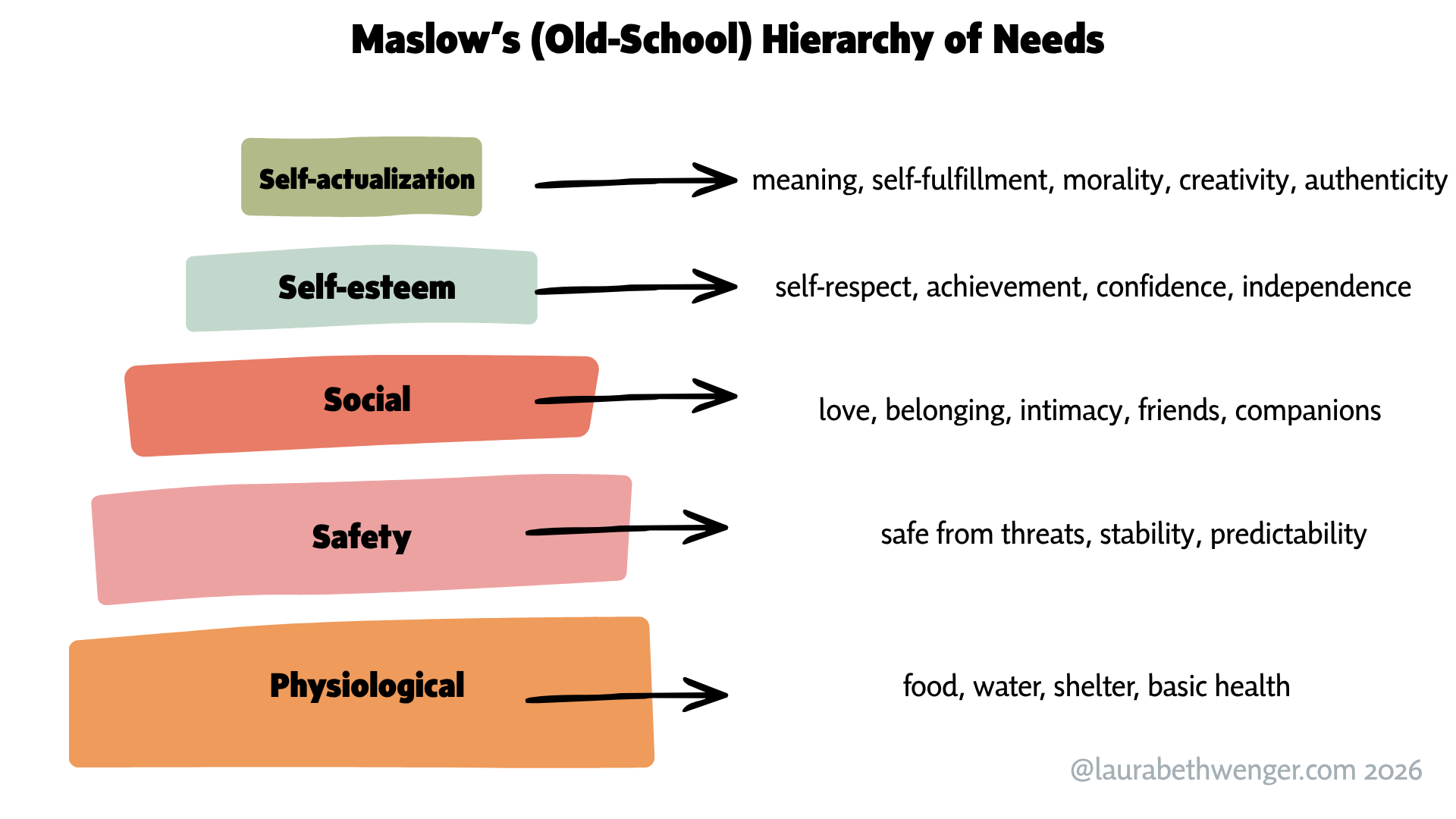
This kind of hierarchical thinking pervades our social support systems, down to the details of what kind of food we will let people buy with food stamps. It’s built directly into our managed care systems as well. In order for a client to receive mental health services through Medicaid, providers must prove that the services are “medically necessary.” Due to scarce funding, sessions are parceled out meagerly, and as soon as possible, clients are encouraged to “graduate” from therapy so that others with more urgent needs can take their spot. Within this system, mental health support is a first-aid situation. The idea of finding meaning, self-fulfillment, or self-actualization feels frivolous; a privilege most of us cannot afford.
Of course, it is most urgent to feed hungry people and get them out of danger. But the idea that “higher” needs such as social needs, self-esteem, and self-actualization must be completely set aside until their “survival” needs are met is a dangerous oversimplification. The need for human connection, for life’s meaning, is inherent to all beings— not just those who can afford to make it to the top of a pyramid. A life without these higher needs is bleak; it becomes mere survival. Take, for example, the Romanian orphans who were deprived of human contact as children. Despite being fed and sheltered, the lack of early attachment led to profoundly detrimental effects on their mental and physical health. Connection and meaning are necessities. We’ve got our “basic needs” wrong.
Making stress meaningful
When Jenny said, “I need these dance classes,” she challenged everything that Maslow, and the United States government, would suggest she should have on a limited budget.
I was facing a parallel dilemma. I was deep in the final stretch of grad school. The previous semester, I’d had Covid and just could not seem to recover— at a time when work, family, and school stress were extremely high, and the relentless news cycle was only making things worse.
I’d cut back on my group exercise classes, in an effort to conserve both financial resources, and my own energy. But rather than make me feel better, this cutting back felt worse, and my health continued to decline. Finally, in frustration and desperation, I decided I’d pick up a few classes again: rowing, strength training— just to see what happened. And it was just then that our trainer suggested that we start preparing to row a 10k. I thought, “This might be a terrible idea, but what the hell?”
In some cases, adding physical stress may be just what we need to “make sense” of the experience our bodies are already having.
It felt completely counterintuitive, at a time when my stress was incredibly high, to add more stress to my life with increased physical activity (not to mention the mental and emotional stress of pushing myself— I find cardio very stressful). I added two more days of intense rowing per week. I was rowing further, and harder, and faster, than I ever had. I thought I might end up getting sick or having to stop training.
But within a few weeks, with the added stress, my metrics began to improve. My heart rate variability, which had been steadily decreasing since August, finally began to move back upward. My resting heart rate settled down to a level I hadn’t seen in years. And my mood improved drastically— though my life was actually more stressful than previously.
“Beautiful suffering”
The experience of deliberately choosing to undergo a difficult challenge is what some ultra-endurance athletes called “beautiful suffering.” One participant in a 2023 study described it this way:
“This was when I discovered something about myself that I knew was there but I was not consciously aware that all my reasons (for racing Ironman) were deeply internal and I had hundreds of them. All life experience that I had, all the suffering that I had seen, all the joy—it all lives there.”
While an ultra-endurance race is an extreme example, each of us may choose our own opportunity to “suffer beautifully.” Returning to school to complete our B.A. after raising four kids; signing up for an art class that we’ve always been afraid to try— the choice itself is ours. Part of what makes it meaningful is that it’s a challenge specifically for us. If external circumstances— such as an already-high stress load make it even more challenging, then perhaps the potential rewards are that much greater.
Why did this work so well for me? I believe that in my case, the physiological stress of the training I added to my life became a way to use the stress hormones that were already being generated as a response to the mental and emotional situation I was in. By channeling that stress into something physical, my whole system was able to release and finally complete a stress cycle where I’d been stuck for months.
This is your nervous system on fascism

The care and tending of my nervous system is a big part of my life.
From a physical standpoint, doing any kind of movement is often the very last thing we feel capable of when we’re exhausted, burnt-out, etc. And it’s not the right solution for everybody— individuals with chronic fatigue, for example, will need a different approach. But in some cases, adding physical stress may be just what we need to “make sense” of the experience our bodies are already having.
During the four months of training that led up to the 10k race itself, I can’t say that I enjoyed my experience, particularly. But the suffering— the intense training, the muscle soreness, the sweat, the tendonitis— all meant something. I was working hard, doing something that mattered to me; something I had committed to; something that I hadn’t thought was possible before. And when I completed that race, I wept with joy, even as my heart rate was pounding out of my chest, and my body hurt, and the breath was so fast it felt like I was dying. That’s beautiful suffering.
Regaining control of our lives
The psychological benefits of “beautiful suffering” are profound. As one participant from the study linked above said of the race, “(A)fter that I knew I could do anything.” By challenging ourselves and overcoming obstacles to complete a meaningful task, we can change the way we experience ourselves and the world completely.
Researchers in a 2025 meta-study reviewing elite ultra-endurance athletes found that these individuals are more likely to possess an internal locus of control, which is associated with higher pain thresholds, greater psychological flexibility, and less likelihood of avoidance behavior and hypervigilance.
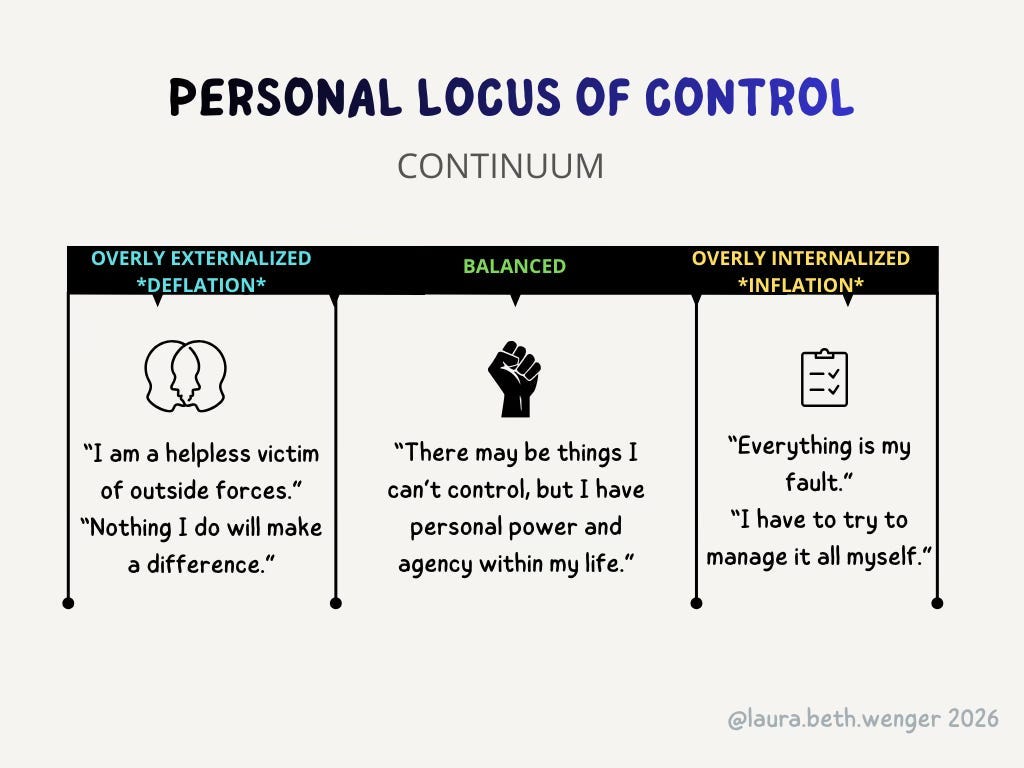
This may be especially potent when we are living through circumstances that feel outside of our control, or when the suffering we see in our own lives, or in the world around us, feels senseless and chaotic. A balanced internal locus of control is the antidote to depression, helplessness, and nihilism.
Reconnecting with the inner compass
"The sailor cannot see the North –
But knows the Needle can”
-Emily Dickinson
Each of us is already having a somatic response to what we are experiencing in our lives. Perhaps you’re stuck in fight/flight, “tired but wired,” always “on.” Or you find yourself exhausted, dragging so hard you can barely manage to feed yourself, let alone make meaning of it all. Others still may be in a fawn/appease pattern, “going along to get along” to survive in a hostile system.
The question for each of us is, what is it that I need to make this experience meaningful?
If everything in your life feels kind of “blah,” what is it that you are interested in— no matter how off-the-wall that sounds? Was there something that you loved to do as a kid, but got disconnected from later in life? Or you might consider a recent dream. Was there something that was helpful in the dream, or was there something that was missing in the dream that would have been helpful for you to have?
You don’t need to try to find the meaning of life right now— we’re just looking for a starting point; something that feels alive in you. The inquiry is often enough to swing the needle in the right direction, so that we can start to reconnect with what does feel meaningful for us.