


Many of you know that I recently completed a year of clinical internship as part of my master’s degree in mental health counseling.
Unlike my peers, I was entering the field in sort of a backwards way: I had a career’s worth of information about working with clients and their bodies, and the ways in which their psychological experience manifested as physiological symptoms (the larger challenges, for me, were about setting aside my own preconceptions so that I could practice educational humility and learn the clinical side of the mental health world!).
There was some overlap. One of the core competencies that any therapist should be able to offer their clients is “Grounding Skills.” Now, these are often pretty basic (“feel your feet on the ground;” “count five things you can see,” etc.)— but it encouraged me to see that there was some understanding of the importance of the body, and grounding, in the mainstream mental health world.

What is “grounded,” anyway?
Grounded is one of those fantastic words that is a complete, direct metaphor in and of itself. To be grounded is to have a direct connection to the earth; to feel solid, supported, rooted (there’s another wonderful metaphor!), connected to something wholesome and natural. To be grounded implies a sense of presence and awareness.
Alexander Lowen, who created the early somatic psychotherapy modality known as “Bioenergetics,” was the first person to use the term in a psychological sense. He notes that some individuals are “connected to the ground, not ‘up in the air’ or ‘hung-up.’”
To be ungrounded, then, is the opposite— untethered, flighty, scatterbrained, unfocused, unstable, head in the clouds. This person might be anxious, fidgety, hypervigilant, unable to rest, or they could be dreamily dissociated, floaty, emotionally absent.1
As we can already see from the descriptions above, whether we are ungrounded or grounded, the experience occurs on both physiological and psychological levels. We can feel heavy and solid in our bodies, or light, or absent. We can feel anxious, or fidgety; present and responsive, or depressed and hopeless. We might use substances deliberately to try to induce a feeling of groundedness, or escape (bringing us into our “faux window of capacity,” as described in the post below).
The Unicorn, the Maiden, & the Faux Window of Capacity

Hi readers! Just a quick note to let you know that Jennifer Snowdon and I will be offering our four-week Better Breathing For Trauma course this April. Join us for a different look— beyond “hacks” and “fixes”— at how the physiology of stress affects breathing, and how we can work with it.
Who gets to be grounded?
I don’t know exactly why some folks are more grounded than others. Sometimes I think it’s physiological— individuals who live with hypermobility, for example, are almost always less grounded. Other times, it seems to me that it has just as much to do with our typology; as though we were born with our feet an inch away from the ground, metaphorically. Then again, trauma— or just life experiences— taught others of us that the ground wasn’t a very safe place for us to be, metaphorically. We learned to space out, dissociate, never quite touching down.
While I might look like a pretty solid person, I am someone who is naturally a little bit ungrounded. Like many of my clients, I find it literally very difficult to feel my feet on the ground.
Jung spoke about this phenomenon specifically. During the Visions Seminars, in 1933, he recalled a patient of his:
“I remember a girl who was by no means insane, who informed me that she was rather upset by the fact that when she was walking on the pavement she did not feel her steps. She was twenty-eight years old, and in the course of her examination she said she had never seen her body.”
“But you take baths, you must see it then,” Jung protested. “No, I cover the bath tub in order not to see it,” she replied.
Jung goes on:
“So I told that girl to go home and undress and study her body. Then she dreamed she was on top of a balloon and I was aiming at her and brought her down.
That was an exceedingly intuitive type.”
Ungrounded people not only have a hard time feeling their feet, but, as Jung says here, they are less grounded in what we might call reality itself- or, at least conscious, grounded reality. Like Ursula LeGuin, these individuals are “realists of a larger reality.” Highly intuitive, these individuals live rich internal lives. They are far more interested in the unconscious world of dreams, thoughts, and possibility, rather than the day-to-day world of facts, objects, and things. I love this world. I really do. But without some balance, it can’t pay the bills, respond to an email, or remember to show up to work. I can get into trouble because I’m not paying enough attention— “my head is in the clouds,” as they say.
And so interestingly, when one is really too ungrounded, and we are out of balance, the psyche knows it. Like Jung’s patient, we dream of flying, living in airy towers, being on top of a mountain, or on top of a balloon— until a helpful therapist brings us back to earth.
The relational aspect
There is one more piece to consider when we think about chronically ungrounded individuals, and that is the relational element of grounding.
If we think about electricity, to be grounded means to have a connection to the physical earth, so that excess or stray electricity can escape safely. An ungrounded outlet can cause an internal short circuit, or pass along an electrical shock when someone else touches it, as they become the grounding element.
In the case of complex trauma or PTSD, some individuals may be holding an immense charge of live energy— like electricity— that has nowhere safe to go. It can loop endlessly, short-circuiting, in repetitive behaviors and patterns, in nightmares, all attempts to release this unprocessed, raw, electric energy.
In my experience, these individuals struggle to connect to ground to the earth (metaphorically, or perhaps even directly). It doesn’t feel safe enough, or, in the case of developmental trauma, they never learned how to do it. They sizzle with ungrounded energy, exhausted, until they collapse.
This is where right-hemisphere, empathetic attunement is necessary. Another human— a trauma-informed practitioner, loved one, or trusted friend— can act as a grounding wire to help them diffuse the energy until they can contain it, and ground themselves. While this might sound pretty “woo,” it’s based in the research of infant attachment; babies learn to regulate their systems through their caregivers, who regulate for them until they can regulate themselves. This is how we learn to ground, developmentally.
For these individuals, no matter how many “grounding techniques” they are taught, they will consistently struggle to achieve the results a well-intentioned practitioner is offering. This can be incredibly frustrating for both the client and the helper, as the helper runs through their bag of tricks and the client feels like a failure.
While there are many robust techniques that can be helpful for these individuals (I’ll share a few below), in my experience, it takes tremendous patience and time as the clinician must act as the “grounding wire” for the client until the client is able to start to ground themselves. This is not easy work for either party, but it is incredibly rewarding.
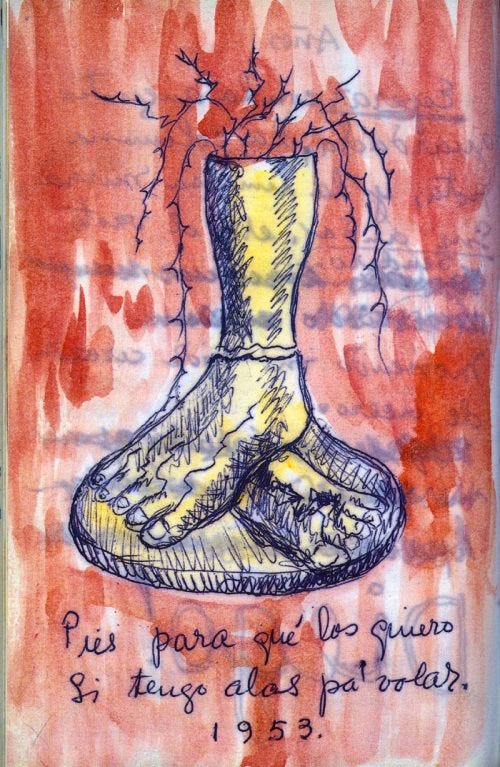
Finding our feet
So, returning to our “grounding exercises,” what does it take to bring an ungrounded person “back to earth?” Well, for folks who are chronically ungrounded, a simple exercise like “feel your feet” isn’t gonna do it. Remember? They can’t feel their feet in the first place.
These individuals need a better connection to their body. Perhaps, like Jung’s patient, they need to spend some time reconnecting to it— actually looking at it, for a start, or getting a massage. Self-massage can be a good technique, especially for hypermobile folks, to wake up the sensory map of our body in our brain. These individuals have a less acute sense of proprioception, which tells us where we are in space; rolling a ball under their foot, using stretchy bands, or giving them direct sensory feedback can help to improve that, at least temporarily.
These clients may also need more permanent assistance. In my case, I have to wear shoes that have an arch and a heel cup that my feet can feel, rather than a pure barefoot shoe. And a surprising thing that helps some folks is chewing gum, especially if they don’t have good molar contact. Our brains have a better sense of grounding when we can feel those teeth. Perhaps you, like many of my clients, are someone who’s already been chewing gum while they exercised— not knowing why it helped, but that it felt better.
De-pathologizing ungroundedness
“The psyche is a self-regulating system that maintains its equilibrium just as the body does. Every process that goes too far immediately and inevitably calls forth compensations, and without these there would be neither a normal metabolism nor a normal psyche.”
-CG Jung, CW 16, par 330
I remember one particular session with my physical therapist. She had tested me for grounding— a simple, side-lying test where one’s feet are on the wall, and the examiner attempts to move the feet from the wall. Despite all my muscle— and I have a lot— I couldn’t resist the light push of her hand. Watching me walk across the room afterward, she said, “You walk like you’re floating… like you are trying not to touch the ground.”
The physical consequences of being ungrounded are quite real. In my own body, my ungroundedness makes it difficult for me to stabilize my body, literally. I tend to compensate with less-optimal movement patterns, or brace with my pelvic floor, neck, and jaw. These, according to Jung, are the very compensations he speaks of in a process that has gone too far; symptoms that are indicating my system is out of balance.
The truth is that I do consider myself, like Jung’s patient, “an exceedingly intuitive type.” If I had to choose between living on solid earth and walking on air, I’d pick the latter every time. This one-sidedness of my psyche (and body) must be balanced if I am to maintain equilibrium.
This lens— that we are simply self-regulating systems— is one of the reasons that I love Jung’s work so much. There’s no judgment, pathologization, or shame around the symptoms; simply the understanding that a process has “gone too far,” and must be adjusted. Jung goes on to say, “We do not stop feeling thirsty by repressing our thirst.” Just so, a lack of groundedness calls for more grounding; a process that some of us will repeat countless times throughout our lives.
It’s also worth considering that someone might be too grounded— they can become rigid, fixed in their thinking, immovable, or perhaps they are so earthy that they begin to decompose; a collapsed, depressed, inert, unresponsive mass.
A lot of standard interventions assume a baseline capacity that not everyone actually has, then treat the failure to respond as evidence of not trying hard enough, when it's really evidence the tool was calibrated for a nervous system different from the one using it. That's in line with a lot of misapplied advice generally, correct for the population it was designed around, and quietly harmful to the population it gets handed to anyway.
Love the depathologizing here (as an EDS person, I’m just wired differently!) and especially the idea of a process “going too far”- lets balance it out. Theres no better or worse, and in fact some ultra grounded people lack imagination if I may say so!