


Hi everyone! A quick announcement before the post. Beginning November 18, I’ll be leading a new weekly online Somatic Movement Exploration class (Wednesdays at 11 eastern)— and I’d love to have you join me to move, stretch, connect to your body and regulate your nervous system from the comfort of your home. You can read more and register here, and feel free to reply to this email with any questions. As always, thanks for reading, and remember that as a thank you, all paid subscribers get free access to my online library of streaming practices.
If I had a nickel for every client who has said to me, “I know what I should do, but I just can’t seem to do it,” I would have a lot of nickels.
Often, these people wanted ME to help them make those changes. Because coaching, you might think, is all about getting people to do things they wouldn’t do on their own. People hire coaches to motivate them, hold them accountable to goals, push them to past their uncomfortable edges into new levels of greatness.

I have never been that kind of coach.
One of the reasons is that I myself do not respond well to this kind of “motivation.” While I am happy to pay someone to give me guidance when I need it, I am not motivated externally by their praise or punishment. Instead, I know that I have to be internally motivated in order to follow the program or advice. I have to believe it’s right for me.
This is why I take a non-directive approach, which I wrote about in a recent post, “Only you know what’s right for you.”
Only you know what’s right for you

I came across an article this week in The Atlantic that caught my eye. Entitled The Dark Side of Mindfulness, this thorough piece discusses some aspects of meditation that many long-term meditators (and meditation teachers) have known about for some time, but rarely discuss. In short, the piece tells us, meditation is
But sometimes— and actually, I think, most times— it’s not as simple as “knowing what’s right for you.” We might think we know… but we can’t seem to make it happen. We want to go to the gym, or take that yoga class, but week after week, we don’t go. Or, we might feel kind of confused, as one of my clients said to me this week: “I feel like I should know what I want. But I just don’t.”
What’s going on here?
I’m glad you asked, because this is the kind of help I CAN offer.
The “You You Are”
We tend to think of ourselves as one, unitary, solid entity. But who is that person? Are you the same person with your parents that you are with your partner, or your kids? Do you act the same at work as you do at the local dive bar, or church on Sunday?
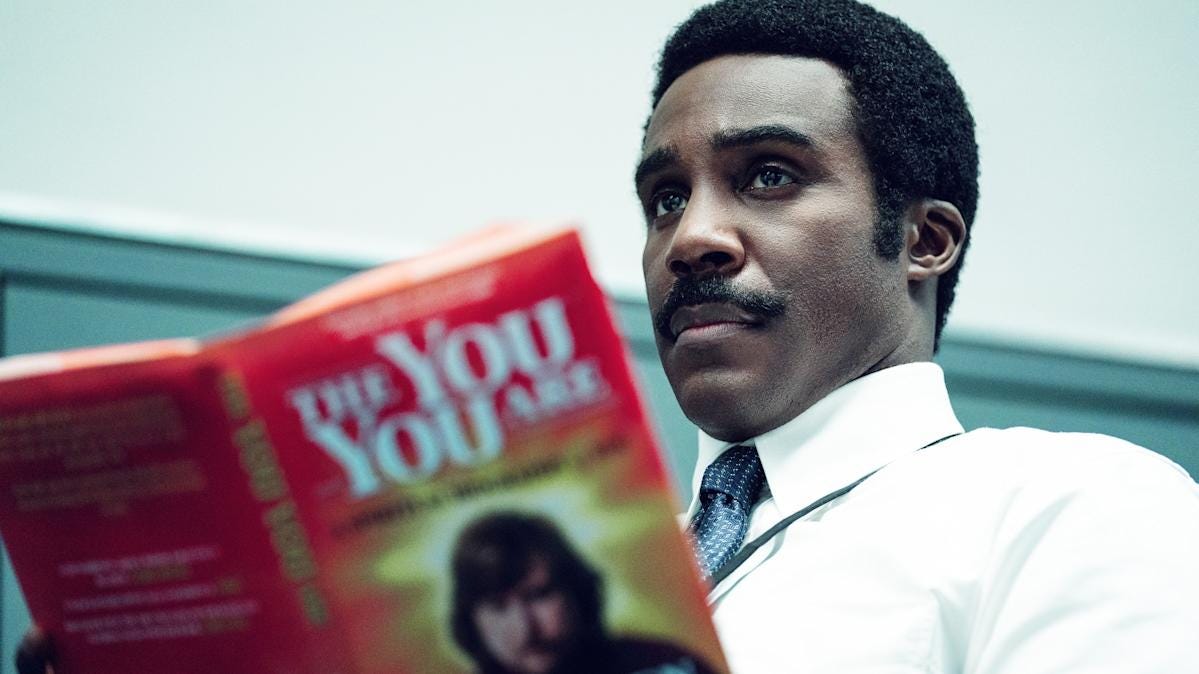
While it might be easy enough to recognize that we act differently in certain scenarios, it gets a little more complicated when we ask ourselves which one of these is the most real, or which is in charge, or who gets to decide what we do. I mean—who are we, really?
A quick look at Jung’s map of the psyche
For the most part, we walk around thinking of ourselves as an ‘I’ that has wants and needs and a solid identity. Jung called this the “ego,” portrayed on the diagram below as the green circle:
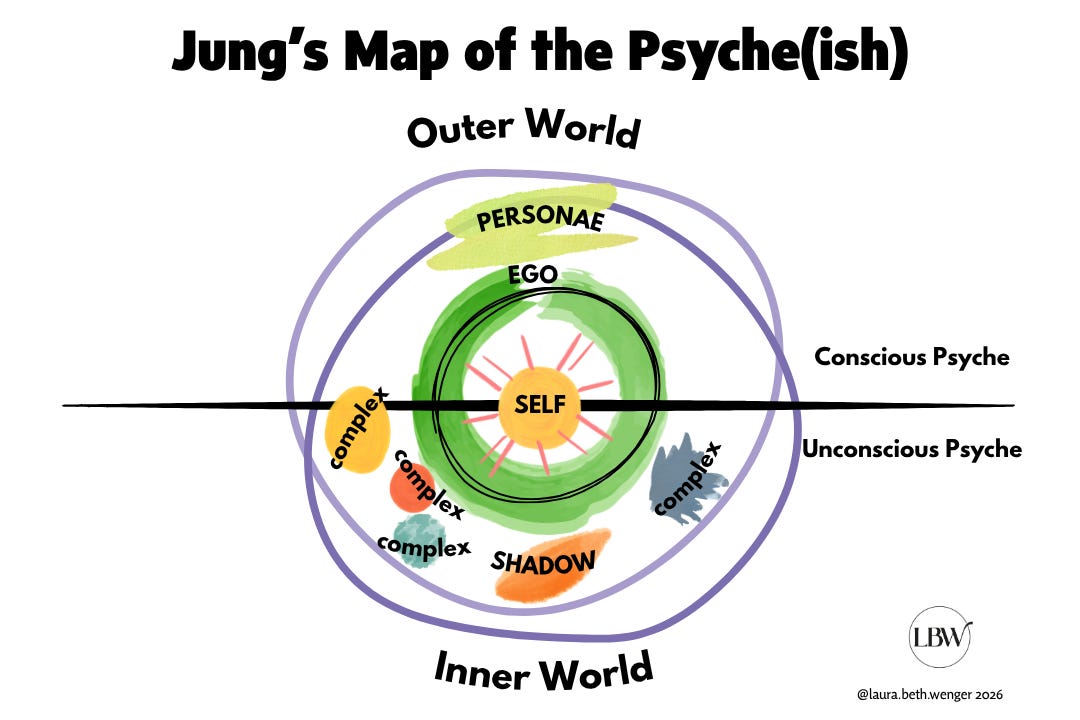
Ego, in Jungian terms, isn’t a negative thing. While many spiritual traditions emphasize loosening our attachment to ego, for our day-to-day living purposes, we really do need a healthy ego. It’s a necessary part of our psyche: without it, we don’t have any sense of who we might be at all; we’re not able to stand up for ourselves, or move through our lives with power or purpose.1
Mistaking the mask for the face
As important as the ego is, however, it’s not the totality of who we are. Additionally, Jung suggested that we each have a persona— or, more likely, multiple personae— that we use to interact with the world (you can see this portrayed in light green at the top of the circle in the diagram above). These personae are like masks we wear. They are the versions of ourselves that we share with others. My Substack persona, for example, while still authentic, is not synonymous with my Ego. Nor is that persona the same thing as the “me I am” at home with my dogs (why would it be? They don’t care at all about these topics).
So, when we think “I’ve really got to get back to the gym,” theoretically, this is our ego talking. But one of the ways that we can get “confused”— and encounter conflicting desires, or ambivalence— is by mistaking our persona for “who we are.” In our increasingly online world, this is an especially tricky pitfall.
For example, if I get hooked into thinking that my social media persona is who I am, then I can find myself trying to fill that role inappropriately in other areas of my life. I might think “I need to go to the gym every day so that people who follow me online know that I go to the gym.” Because this impulse is at odds with other parts of my life— and my own ego’s needs— I would experience ambivalence about it. And maybe confusion, or shame, or who knows what. We need to be clear about what we really want to do, and who it’s for. Our persona is designed to interface with the outside world. Its purpose is to serve us, to protect us. If we find ourselves working for it, instead, then something is out of balance.
It gets more complex
So far, I hope that it’s clear that your ego has its own desires, and those are not the same as what other people might expect from your persona. But wait, there’s more.
Let’s take another look at our diagram. See those little blobs of color that are floating around in the bottom half of the circle? These are complexes. Jungian analyst John Betts defined the complex elegantly as “a cluster of feeling-toned associations around a common theme.”
For the most part, they live in our unconscious (the bottom half of the diagram). We are only vaguely aware of them, if we’re aware of them at all.
We all have complexes. Mother complexes, father complexes, a Christmas complex, a body complex.
Betts goes on:
“When we are triggered by a thought or signal in environment, that complex in the personal unconscious comes up, and makes us behave in ways that aren’t usual to our everyday personality. Our ego takes a beating, and it can’t operate appropriately. Our normal personality drops off and another takes over briefly (The Jung Podcast).”
Each of our complexes has its own program, its own agenda, that comes online when it’s activated.
Take for example someone who has a body complex (which, as far as I know, is just about everybody). We see an “unflattering” photo of ourselves, and ta-da! the body complex gets activated. You can visualize that complex moving into the center of our diagram and eclipsing the ego. While it’s active, the complex runs the show for us: it thinks negative thoughts about our body, it monitors our food, it sends us to the gym for a two hour session on the elliptical2. Eventually, that complex’s charge runs out. The spell is broken, and our ego comes back online. We can find ourselves saying, “What the hell just happened?”
Let’s look at another example. Perhaps we have a history of disordered eating that we long ago overcame— but now we have an opposite complex that is organized around never going through that again. So, when our ego says, “hey, I think we should go to the gym,” that complex gets activated. “You can’t tell me what to do,” it says. It goes into the kitchen, finds a huge bag of potato chips, and settles you down on the couch to watch reruns of The Golden Girls.
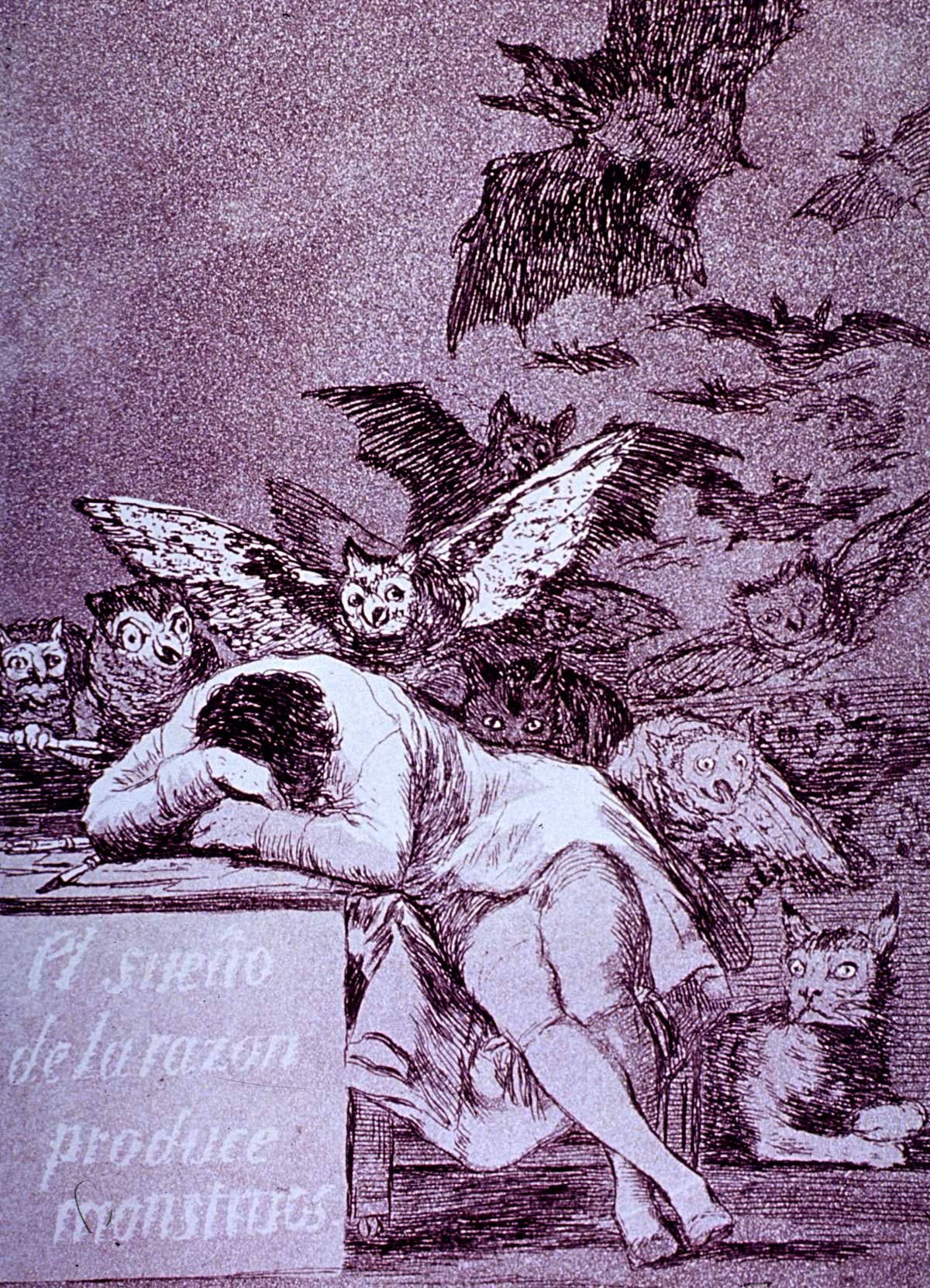
These are dramatic examples, but perhaps you can relate. Even when the complex isn’t completely triggered, it’s lurking below the surface, ready to counteract the ego’s actions if it feels threatened.
Jung tells us that the complex:
“has a powerful inner coherence, it has its own wholeness and, in addition, a relatively high degree of autonomy, so that it is subject to the control of the conscious mind to only a limited extent, and... behaves like an animated foreign body in the sphere of consciousness. The complex can usually be suppressed with an effort of will, but not argued out of existence, and at the first suitable opportunity it reappears in all its original strength (CW 8, par. 201).”
So what do we do with these competing desires? Are we doomed to inaction forever?
Reconciling our opposites: achieving “bothness”
It can be easy to feel frustrated, or discouraged, when we encounter this ambivalence in ourselves. It may feel like self-defeating, or even self-sabotaging behavior. But that’s not the whole story.
In many cases, when we understand our complexes, we can recognize that there is a kernel of wisdom in them. Complexes (and their agendas) are never random. They are parts of ourselves that have been splintered off, sequestered in our unconscious psyche— but they can be quite helpful.
For example, that last complex we looked at— the “anti-eating disorder complex”— it wants to make sure that we are not engaging in behavior that has been harmful for us in the past. Or, to take a more common complex, think about someone who is a perfectionist. A little bit of a perfectionist complex is a wonderful thing; it keeps us on track. It’s when we’re completely unaware of our complexes— and they grow overly powerful— that we’re in trouble.
The reality is that each of us holds a combination of many different points of view. The sooner we come to terms with this, the easier it will be to deal with it; so that when we encounter ambivalence in ourselves, rather than being frustrated or beating ourselves up, we can ask: What else might be happening here? Is there a reason I might not want to do this thing I think I want to do?
This work— identifying and working with our own inner opposites— is an essential part of Jung’s theory. One of my brilliant clients refers to this as “bothness.” When we’re able to hold all of our different points of view, we become less stuck. Instead of our usual frozen state, where the unstoppable force of the ego meets the immovable object of the complex, we can become a committee, of sorts. We have a deeper understanding of our own needs, and a broader field of options from which to choose.
So how do we know what’s right for us?
We could end the discussion there, and I’m quite tempted to, because this next part gets pretty deep. But it wouldn't be fair to Jung to omit this next part. And some of you may have already noticed that there’s one part of the diagram above that we haven’t discussed yet— that yellow circle in the middle, the Self.
The Self, according to a Jungian map of the psyche, is both the center and the totality of the psyche. Sometimes referred to as “the ordering principle of the psyche,” it is our understanding of God, the Divine, etc.— however we define that. You can read more at the post below:
A personal relationship to the divine

Hi all! I want to start today by thanking all of you for subscribing. It means more than you know. I also want to ask that if you like what you are reading, please don’t forget to like, comment, and restack— it really helps. Finally, if you can afford to do so,
While our ego likes to think it’s who we really are, the Self is who we really are. James Hillman3 suggests that we think of it like an acorn; that each of us has within us the seed of who we are meant to become. The oak tree of our lives has its own growth pattern and trajectory (guided by the Self’s wisdom) that lies beyond our ego’s understanding. And while our ego, personae, and complexes may each have their own agendas for us, it is ultimately the Self that guides our path.
While this may be a bridge too far for some of us, I personally take great comfort in the idea that there is a greater wisdom pattern unfolding in my life. In this paradigm, what we may think of as mistakes become learning opportunities. The intrapsychic4 conflicts we’ve been describing here (that is, reconciling our ambivalence around the many issues of our lives) act as necessary struggles to help us to recognize what it is we truly need.
How do we know what’s right for us? How do we know what the Self wants? The explorations we’ve delineated so far are a terrific start to answering that question. When we find ourselves getting stuck, we can ask: who is this goal for? What is being protected? What else is there to understand here? These questions are how we begin to listen.
As we shine more light on our unconscious complexes, and get better at allowing “bothness” in ourselves, we become more whole; the Self’s designs reveal themselves to us. And dialogue with the Self is always happening, when we can hear it— through dreams, synchronicities, and the deep inner knowing that emerges when we let go of external ideas about “what we should do,” and begin to trust ourselves more.
For more on this, listen to this episode with Satya Doyle Byock on Pulling the Thread.
Please bear in mind this is a simplified illustration, not intended to be a characterization of how eating disorders actually work!
For more on this, check out The Soul’s Code by James Hillman.
This is just a fancy word that means, “within our own psyche.” So, an intrapsychic conflict would be an internal conflict.
Thanks for this. Now excuse me while I go have chips for breakfast, bake a cake, then row for an hour. ¯\_(ツ)_/¯ (kidding/not kidding)
Seriously, holding the tension of opposites and figuring out what’s right for me is so hard sometimes. And sometimes it’s just good to remember I’m not alone in that.